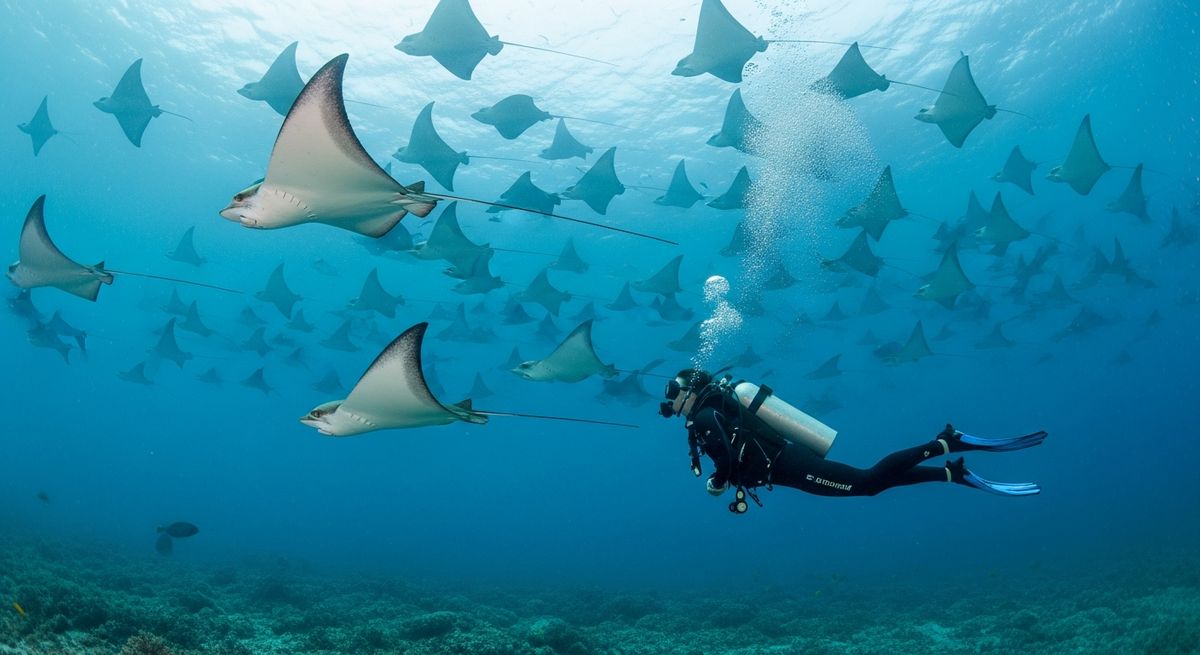
Manta point
Protected Area
Povilla Forest Reserve
Why dive here
With 116+ marine species recorded in the area - including dugongs, eagle rays, great white sharks, manta rays and mobula rays (devil rays) - Manta point offers some of Loyalty Islands's richest drift diving. Water ranges 24-29°C, warmest January, February, March.
Manta Point is one of those dives that sticks with you, a cleaning station where the big oceanic mantas come in, along with their reef cousins. We’ve seen both *Mobula birostris* and *Mobula alfredi* here, each with their own patterns and markings, which is pretty special. You drop into the blue at the mouth of the pass, right where the currents meet, so it’s not a dive for the easily flustered. Visibility often hovers around 12 meters, sometimes better, sometimes a bit murky, but honestly, when a manta bigger than your car glides over, you don't really notice anything else. We love settling onto the coral at about 15 meters, just watching the show. The mantas cruise in, circle, and hover for their clean, sometimes so close you can count the remoras clinging to their undersides. It’s not just mantas either; we’ve seen dorado flashing past in the blue and the occasional sperm whale on deeper excursions further out, though that's a rare treat. This is a dive for experienced divers who are comfortable with current and want to witness the sheer grace of these giants up close.
Safety Notes
Drift dive - carry a surface marker buoy (SMB) and stay with your group. Brief the current direction before entry.
Nearest Dive Centres to Manta point
Dive shops near Manta point
View all dive centres in Loyalty IslandsReviews for Manta point
Conditions
Ocean conditions, forecast and tides for Manta point
Manta point Ocean Conditions
Monthly averages for Manta point, sourced from Open-Meteo marine data + Copernicus Marine (EU) - nearest station: Open-Meteo marine grid (-20.94, 165.47) (8km away)
October Averages
Sea Temperature
25°C
77°F · Range: 23.4–27.1°C
Current Speed
8.06 cm/s
Direction: S (187.1°)
Chlorophyll-a
0.052 mg/m³
Very clear (oligotrophic)
Salinity
35.08 PSU
Based on 4 years of monitoring data · Data sources: Open-Meteo marine data + Copernicus Marine (EU)
Plan & book
Ways to dive Loyalty Islands, from day trips to liveaboards.
Day trips & courses
via GetYourGuideGuided dives, courses and snorkel trips with instant booking.
Find dive trips in Loyalty IslandsPlaces to stay
via Booking.comHotels and dive resorts near Loyalty Islands.
Search stays in Loyalty IslandsDive insurance
Most travel insurance excludes or limits scuba. Check what you need before you go.
Dive insurance explainedPartner links: we may earn a commission if you book, at no extra cost to you. How we make money
Where to Stay near Manta point
Prices from Booking.com. We may earn a commission at no extra cost to you.