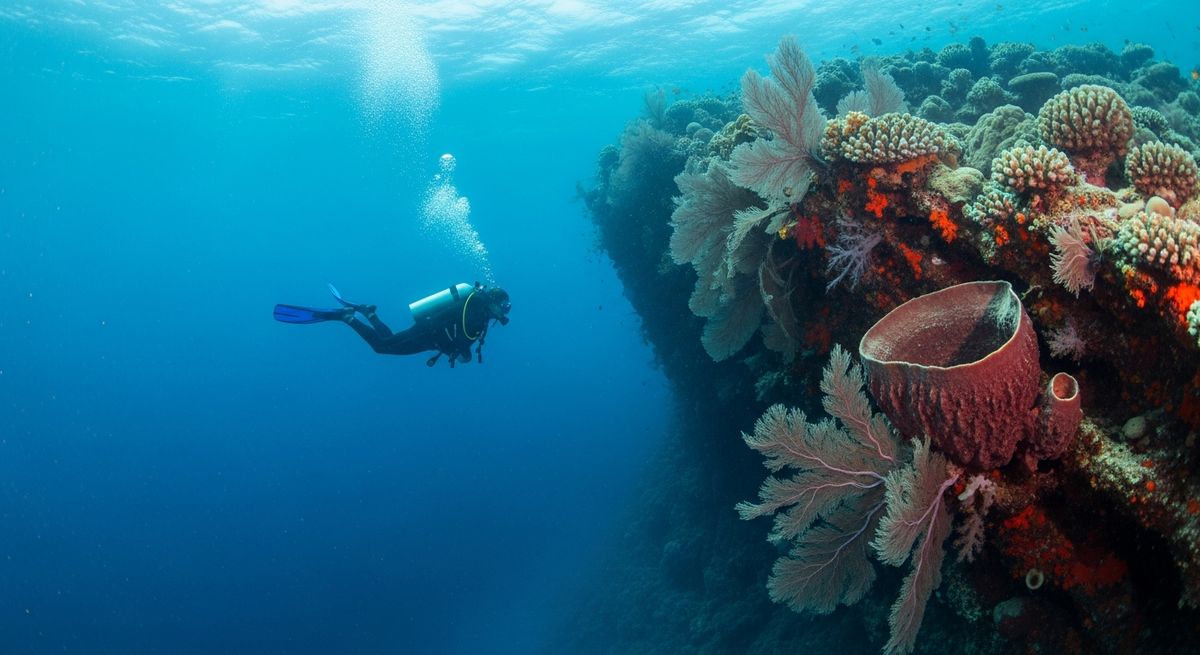
Spyglass Wall - Salt Island & Cooper Island

Spyglass Wall, despite its name, is more of a gentle slope than a sheer drop, making it a comfortable dive for all experience levels. We often find ourselves drifting along, admiring the colourful sponges – particularly the golden and purple tube varieties – that carpet the face. It’s a great spot for watching the smaller stuff: fairy basslets flitting in and out, damselfish guarding their territories, and schools of blue tangs grazing. Keep an eye out for tarpon cruising the deeper sections and rays gliding by.

Location
Salt Island & Cooper Island, British Virgin Islands, Caribbean
Coordinates
18.340000, -64.580000
Type
wall

Marine Protected Area: Dead Chest Island

Best Time to Dive in Salt Island & Cooper Island

The warmest water temperatures in Salt Island & Cooper Island occur in January, averaging 27.1°C. The coolest conditions are in December at 27.1°C.

Monthly Water Temperatures

  • January: 27.1°C (air: 25.5°C)
  • February: 27.1°C (air: 25.1°C)
  • March: 27.1°C (air: 25.2°C)
  • April: 27.1°C (air: 25.7°C)
  • May: 27.1°C (air: 26.8°C)
  • June: 27.1°C (air: 27.6°C)
  • July: 27.1°C (air: 27.8°C)
  • August: 27.1°C (air: 28.1°C)
  • September: 27.1°C (air: 28.3°C)
  • October: 27.1°C (air: 28.0°C)
  • November: 27.1°C (air: 27.1°C)
  • December: 27.1°C (air: 26.3°C)

Nearby Dive Sites in Salt Island & Cooper Island

Nearest Dive Centres to Spyglass Wall

Marine Life in Salt Island & Cooper Island

Home to 504 recorded species including 410 reef fish, 39 hard corals, 13 sharks & rays, 9 other, 7 whales & dolphins, 6 seagrass & algae.

Notable Species

Recommended Packing List for Spyglass Wall

Based on average water temperature of 27.1°C.

  • Shorty or Rashguard - warm 27°C water needs minimal exposure protection
  • Mask - essential for every dive
  • Fins
  • BCD - buoyancy compensator
  • Regulator - your most safety-critical piece of gear
  • Dive Computer - tracks depth, time, and NDL
  • Surface Marker Buoy (SMB) - essential for boat pickups
  • Dive Torch - useful for crevices and colour at depth
  • Underwater Camera - capture your diving memories

Frequently Asked Questions

What is the typical depth range for scuba diving at Spyglass Wall?
The Spyglass Wall offers a captivating dive experience, with the wall beginning at 20 ft (6 m) and descending to 60 ft (18 m). This makes it an accessible yet engaging mini-wall dive within the British Virgin Islands, suitable for exploring its vibrant ecosystem.
What marine life and coral formations can divers expect to see at Spyglass Wall?
Divers at Spyglass Wall can expect to be amazed by vibrant coral formations including sea fans, golden tube, and purple tube sponges. The site is teeming with diverse marine life such as fairy basslets, damselfish, blue tangs, tobaccofish, anthias, tarpons, Atlantic spadefish, rays, turtles, and squid, offering fantastic opportunities for wildlife spotting.
Is Spyglass Wall considered a difficult dive site, or is it suitable for novice divers?
Spyglass Wall is rated with an intermediate difficulty. While it offers an amazing scene, novice divers should ensure they are comfortable with wall diving and have some experience before exploring this site. It provides a rewarding challenge for those with a bit more experience.
What is the best time of year to dive Spyglass Wall for the calmest conditions and best visibility?
The provided data does not specify the best time of year for the calmest conditions or best visibility at Spyglass Wall. For general information on optimal diving seasons in the region, you might consult our When to Dive guide to plan your trip to the British Virgin Islands.
What level of scuba certification is recommended or required to dive Spyglass Wall?
Given its intermediate difficulty rating, Spyglass Wall is best suited for certified divers who have some experience beyond entry-level. While not explicitly requiring an advanced certification, divers should be comfortable with wall diving techniques and general open water skills to fully enjoy the site.
Are there strong currents or challenging water conditions typically found at Spyglass Wall?
The provided data indicates that Spyglass Wall has an intermediate difficulty rating. While specific details on strong currents or challenging water conditions are not explicitly mentioned, an intermediate rating suggests that divers should be prepared for potentially varied conditions or require a certain level of skill. Always check local conditions before your dive.