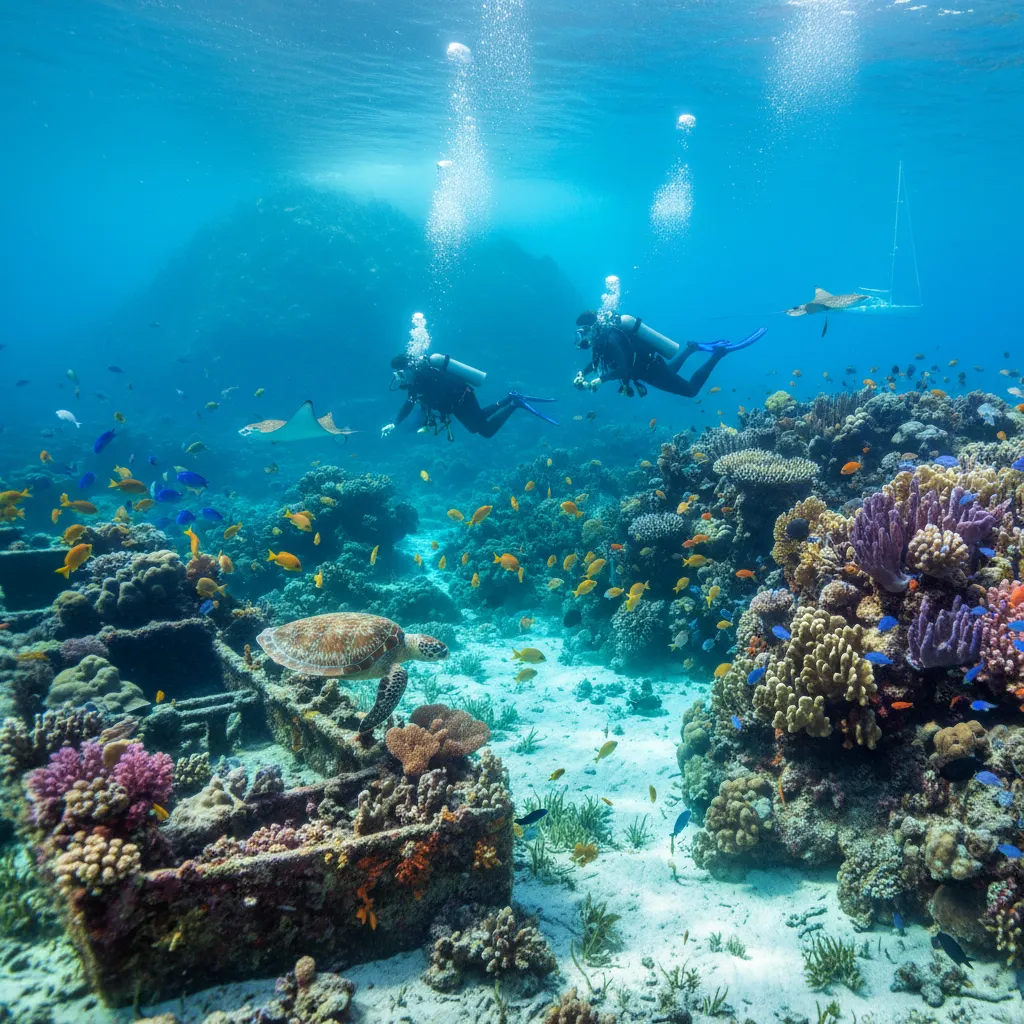
Diving in Salt Island & Cooper Island
Why dive here
Salt Island & Cooper Island offers some of British Virgin Islands's richest diving, with 491+ marine species recorded in the area - including barracuda, blacktip reef sharks, dolphins, dwarf minke whales and eagle rays. Water ranges 27-30°C, warmest August, September, October.
This corner of the BVI, around Salt and Cooper Islands, is where we often recommend divers start their exploration. It's home to the legendary RMS Rhone wreck, and honestly, we think the Rhone alone is worth the trip. We love diving the bow section early, before the day boats arrive, watching the morning light filter through the old iron, revealing the schools of spot snapper tucked into every crevice. You’ll feel the history down there, a tangible silence in the wreck's shadow. Beyond the Rhone, the reefs nearby offer a more relaxed pace. We’ve spent hours drifting along the walls, spotting green turtles gliding past and occasionally a blackedge triplefin darting between the bushy coral. The currents around here can pick up, especially if you’re venturing further from the main channels, so it’s always wise to check the conditions. Our favourite little tip: if you’re looking for something a bit different, keep an eye out for granular frog shells on the sandy patches near the coral heads - they’re a real treat to find. The visibility is usually excellent, making it easy to spot even the well-camouflaged hamlets or the intricate patterns of scroll coral. We find late morning is a great time to be in the water around Cooper, the light is bright and the fish are active.
Salt Island & Cooper Island Dive Site Map
Dive sites and dive centres in Salt Island & Cooper Island
Salt Island & Cooper Island Dive Sites
36 dive sites in Salt Island & Cooper Island
Alice in Wonderland, BVI
Alice in Wonderland gives you a real feel for how the reefs grow here, pushing up from the seafloor. It's not one of those sites where you drop down and immediately get swarmed by fish, but rather a place to explore the architecture of the reef itself. We love the massive mushroom-shaped boulder corals that give the site its name, creating these deep canyons and overhangs you can weave through. It feels like navigating a maze, and that’s the real appeal. Keep an eye out for Pearl Blennies peeking from small holes, or Mimic Blennies darting across the coral heads. We often find Dusky Jawfish hovering over the sand patches, their heads bobbing, and in the shallower sections, families of Yellowhead Jawfish are almost always there, tending their burrows. The maximum depth is around 21 metres, making it comfortable for most divers. While the current description mentions sharks and rays, we’ve found them to be pretty rare here, so manage your expectations on that front. It’s a site for those who appreciate the subtle beauty of reef structures and the smaller, more cryptic critters.
Alice in Wonderland, BVI
Alice in Wonderland gives you a real feel for how the reefs grow here, pushing up from the seafloor. It's not one of those sites where you drop down and immediately get swarmed by fish, but rather a place to explore the architecture of the reef itself. We love the massive mushroom-shaped boulder corals that give the site its name, creating these deep canyons and overhangs you can weave through. It feels like navigating a maze, and that’s the real appeal. Keep an eye out for Pearl Blennies peeking from small holes, or Mimic Blennies darting across the coral heads. We often find Dusky Jawfish hovering over the sand patches, their heads bobbing, and in the shallower sections, families of Yellowhead Jawfish are almost always there, tending their burrows. The maximum depth is around 21 metres, making it comfortable for most divers. While the current description mentions sharks and rays, we’ve found them to be pretty rare here, so manage your expectations on that front. It’s a site for those who appreciate the subtle beauty of reef structures and the smaller, more cryptic critters.
Angelfish Reef
Angelfish Reef is one of those sites we always try to hit when we're in the BVI. Forget the name, it's not just about angelfish here, though you'll spot plenty of queens and greys weaving through the coral heads. We love it for the sheer density of the smaller stuff. Think emerald sleepers flicking across the sand, tiny bearded gobies peeking out from their holes, and if you’re lucky, an Atlantic shrimp goby doing its meticulous garden work. The reef itself is a series of low coral mounds and sandy patches, dropping to a comfortable 17 metres. It's a relaxed drift, generally, and that lack of strong current lets you really take your time examining the cracks and crevices. We often find comb groupers hunkered down, and the sunray lettuce coral formations are surprisingly intricate, catching the light in a beautiful way. Keep an eye out for long-snout seahorses here; they blend in incredibly well, so a slow, patient approach is key. This is a brilliant spot for macro photographers and anyone who enjoys a leisurely poke around rather than a high-speed tour.
Angelfish Reef
Angelfish Reef is one of those sites we always try to hit when we're in the BVI. Forget the name, it's not just about angelfish here, though you'll spot plenty of queens and greys weaving through the coral heads. We love it for the sheer density of the smaller stuff. Think emerald sleepers flicking across the sand, tiny bearded gobies peeking out from their holes, and if you’re lucky, an Atlantic shrimp goby doing its meticulous garden work. The reef itself is a series of low coral mounds and sandy patches, dropping to a comfortable 17 metres. It's a relaxed drift, generally, and that lack of strong current lets you really take your time examining the cracks and crevices. We often find comb groupers hunkered down, and the sunray lettuce coral formations are surprisingly intricate, catching the light in a beautiful way. Keep an eye out for long-snout seahorses here; they blend in incredibly well, so a slow, patient approach is key. This is a brilliant spot for macro photographers and anyone who enjoys a leisurely poke around rather than a high-speed tour.
Beata
Beata is a tugboat wreck resting upright at 25 metres, quite close to Salt Island. It’s an older wreck, broken up a bit, but still holds its shape enough to explore the wheelhouse and engine room. Expect to see plenty of schooling fish swirling around the superstructure and a good chance of nurse sharks tucked underneath. It’s a solid dive for those who enjoy poking around a smaller, more accessible wreck.
Blue Chromis Reef
Blue Chromis Reef often gets a quiet nod as a beginner’s spot, and it is, but we think that understates its charm. At just 15m deep, it’s a brilliant place to stretch out a dive and really absorb the details. We love dropping in around those rock formations closer to shore; the overhangs are almost always packed with lobsters tucked into every crevice, and the way the light filters in around them is something special. You’ll see plenty of parrotfish here – the stoplights and redbands are everywhere, munching away. But for us, the real magic is in the smaller stuff, the stuff you only spot when you slow down. We’ve had great luck finding Rosy Blennies peeking out of holes, and the Mimic Blennies are always a treat. On one dive, we even found a Padded Clingfish, which is always a delightful surprise. The schools of blue and brown chromis drift and swirl, a constant, soothing movement that really defines the place. It’s a site for relaxing, for observing, and for appreciating the small wonders of the reef without feeling rushed. It suits divers who want to take their time and really explore a shallow, bustling coral garden.
Blue Chromis Reef
Blue Chromis Reef often gets a quiet nod as a beginner’s spot, and it is, but we think that understates its charm. At just 15m deep, it’s a brilliant place to stretch out a dive and really absorb the details. We love dropping in around those rock formations closer to shore; the overhangs are almost always packed with lobsters tucked into every crevice, and the way the light filters in around them is something special. You’ll see plenty of parrotfish here – the stoplights and redbands are everywhere, munching away. But for us, the real magic is in the smaller stuff, the stuff you only spot when you slow down. We’ve had great luck finding Rosy Blennies peeking out of holes, and the Mimic Blennies are always a treat. On one dive, we even found a Padded Clingfish, which is always a delightful surprise. The schools of blue and brown chromis drift and swirl, a constant, soothing movement that really defines the place. It’s a site for relaxing, for observing, and for appreciating the small wonders of the reef without feeling rushed. It suits divers who want to take their time and really explore a shallow, bustling coral garden.
Cane Garden Bay
Cane Garden Bay, just off Tortola, gives you a mellow dive without too much fuss. We often duck in here when we’re looking for a relaxed afternoon in the water, maybe a second or third dive of the day. It’s a shallow spot, topping out around 12 meters, so you’ve got plenty of bottom time to drift over the coral. You’ll typically see schools of little fish flitting around, some starfish clinging to the reef, and if you’re lucky, a nurse shark might be napping under a ledge. It’s a good choice for newer divers getting comfortable or for anyone wanting an easy, pleasant underwater stroll.
Carval Rock
Carval Rock sticks right out into the open ocean, catching whatever current decides to roll through that day. That’s why we love it. You’ll drop down onto a slope of boulders and coral that feels wilder than most BVI sites. We’ve often found ourselves eye-to-eye with a Caribbean reef shark cruising the perimeter, and the schooling sennet here can be thick, a shimmering wall of silver. The real show, though, is tucked into the rock crevices. We’re always on the hunt for the little guys – the Orange-spotted and Blackfin Blennies peeking out, or a Shortchin Stargazer buried in the sand, just its eyes visible. It’s a site that rewards patience and a keen eye, not just big animal sightings. We’d suggest hitting it on a calm day, if possible, but honestly, even with a bit of chop, the action below is usually worth the ride. It’s a great pick for divers who appreciate both the pelagic and the macro, happy to drift along with the current and then slow down to scrutinise a tiny blenny.
Chromis Reef (middle)
Chromis Reef’s middle section is a quiet spot, often overshadowed by the larger sites nearby, but we always make time for it. We’ve found the best approach is to drop in close to the rock formations. You'll find overhangs and crevices there, perfect for spotting lobsters and big schools of glassy sweepers tucked away from the sun. The reef itself is a gentle slope, topping out at around 14 metres, which is why it’s fantastic for newer divers or for a relaxed second dive. The blue chromis here are everywhere, darting in and out of the corals – sometimes so many of them that they create a living current. We’ve also had great luck finding sharpnose puffers picking their way through the sponges, and on one memorable dive, a huge green moray poked its head out from under a plate coral, completely unfazed by us. Keep an eye out for mottled jawfish bobbing in their sand burrows; they’re pretty shy, but if you approach slowly, you might get a good look. It's not a site for big pelagics, but for a calm, colourful exploration, it’s a solid pick.
Cistern Point
Cistern Point feels like a proper BVI dive: bright, shallow, and full of those small, interesting moments you find when you take your time. We love it as a second dive, especially after something deeper, because you can just relax and watch the reef unfold. The namesake "cisterns" are these big, bowl-like depressions in the coral, almost like natural amphitheaters. They collect light beautifully, making it a dream for photographers, especially later in the morning when the sun is high. We’ve spent entire safety stops here just watching Spaghetti Eels poke their heads out of the sand, or spotting Mimic Blennies darting between coral branches. Keep your eyes peeled for Nurse Sharks tucked under ledges; they’re pretty reliably found here. And while the reef itself is the main show, we always suggest a quick peek into the blue for bigger pelagics. We’ve seen Tarpon cruising by, and on one memorable dive, a Southern Stingray drifted past us, ghost-like. Maximum depth is just 13m, so it’s perfect for extended bottom times and suits anyone who enjoys a leisurely poke around a vibrant, sun-drenched reef.
Cistern Point
Cistern Point is exactly what we look for in a BVI wall dive: easy to navigate, great visibility, and loaded with those little details that make you want to slow right down. Dropping in, you'll feel the gentle sway of the open water, then the wall just… appears. It’s not a sheer, dramatic drop-off, more of a sloped, sponge-covered canvas that descends gracefully to around 30 metres. We love tracking the barrel sponges, some of them absolutely enormous, and peering into every crevice. That’s where you’ll find the lobsters tucked away, sometimes waving an antenna out. Keep an eye out for the smaller stuff too; we’ve spotted Sharpnose Puffers darting about and even the elusive Nine-lined Goby here. It’s a great spot for intermediate divers who appreciate a relaxed drift along a healthy reef, with plenty of time to really observe the smaller inhabitants.
Show all 36 dive sites in Salt Island & Cooper Island
- Devil’s Kitchen
- Diamond Reef
- Dip n Scrub
- Dry Rocks East
- Gingers Backside
- Ginger Steps
- HMS SANTA MONICA?
- ISLAND SEA
- Jeff Rocks
- LIVEABOARD SEARCH
- Monkey Point
- PORT BOUGENVILLE
- RMS Rhone
- RMS Rhone Bow
- RMS Rhone Stern
- Spyglass Wall
- STANDFAST II
- The Indians
- Virgin Islands Coral Reef National Monument
- Willy T
- Willy T (Wreck)
- WORKING GIRL
- Wreck Alley
- Wreck of the RMS Rhone
Salt Island & Cooper Island Dive Centres
3 dive shops and operators in Salt Island & Cooper Island
Ocean Wildlife in Salt Island & Cooper Island
491 species recorded in Salt Island & Cooper Island
Salt Island & Cooper Island Daylight & Sunrise/Sunset
Sunrise and sunset times for Salt Island & Cooper Island, calculated from coordinates
Today - Sunday 11 October
Sunrise
06:11
Sunset
18:01
Daylight
11h 49m
Golden Hour
17:32
First light (dawn) at 05:49 · Last light (dusk) at 18:22
Monthly Averages
| Month | Sunrise | Sunset | Daylight |
|---|---|---|---|
| Jan | 06:54 | 18:02 | 11h 8m |
| Feb | 06:47 | 18:19 | 11h 32m |
| Mar | 06:28 | 18:29 | 12h 0m |
| Apr | 06:03 | 18:35 | 12h 32m |
| May | 05:46 | 18:45 | 12h 59m |
| JunLongest | 05:43 | 18:56 | 13h 13m |
| Jul | 05:51 | 18:59 | 13h 8m |
| Aug | 06:01 | 18:47 | 12h 46m |
| Sep | 06:07 | 18:23 | 12h 16m |
| OctNow | 06:12 | 17:58 | 11h 45m |
| Nov | 06:25 | 17:42 | 11h 17m |
| DecShortest | 06:43 | 17:45 | 11h 2m |
Times are approximate local times based on longitude. Actual times may vary slightly depending on the exact timezone observed in Salt Island & Cooper Island.
Where to Stay near Salt Island & Cooper Island
Prices from Booking.com. We may earn a commission at no extra cost to you.
Marine Protected Areas near Salt Island & Cooper Island
52 protected areas near Salt Island & Cooper Island - please respect local regulations when diving
Horseshoe Reef
Virgin Gorda
Virgin Gorda north
The Dogs
Virgin Gorda South
Dead Chest Island
Anegada Island
Tobagos
Anegada west
Peter Island
Green Cay, Sandy Cay, Sandy Spit
Tortola
Showing 12 largest of 52
Getting to Salt Island & Cooper Island
Beef Island
Charlotte Amalie
San Juan
Plan & book
Ways to dive Salt Island & Cooper Island, from day trips to liveaboards.
Day trips & courses
via GetYourGuideGuided dives, courses and snorkel trips with instant booking.
Find dive trips in Salt Island & Cooper IslandPlaces to stay
via Booking.comHotels and dive resorts near Salt Island & Cooper Island.
Search stays in Salt Island & Cooper IslandDive insurance
Most travel insurance excludes or limits scuba. Check what you need before you go.
Dive insurance explainedPartner links: we may earn a commission if you book, at no extra cost to you. How we make money