AFRICA SHELL
Why dive here
With 95+ marine species recorded in the area - including blue sharks, bull sharks, humpback whales, manta rays and mobula rays (devil rays) - AFRICA SHELL offers some of Bazaruto Archipelago's richest wreck diving. Water ranges 24-29°C, warmest January, February, March.
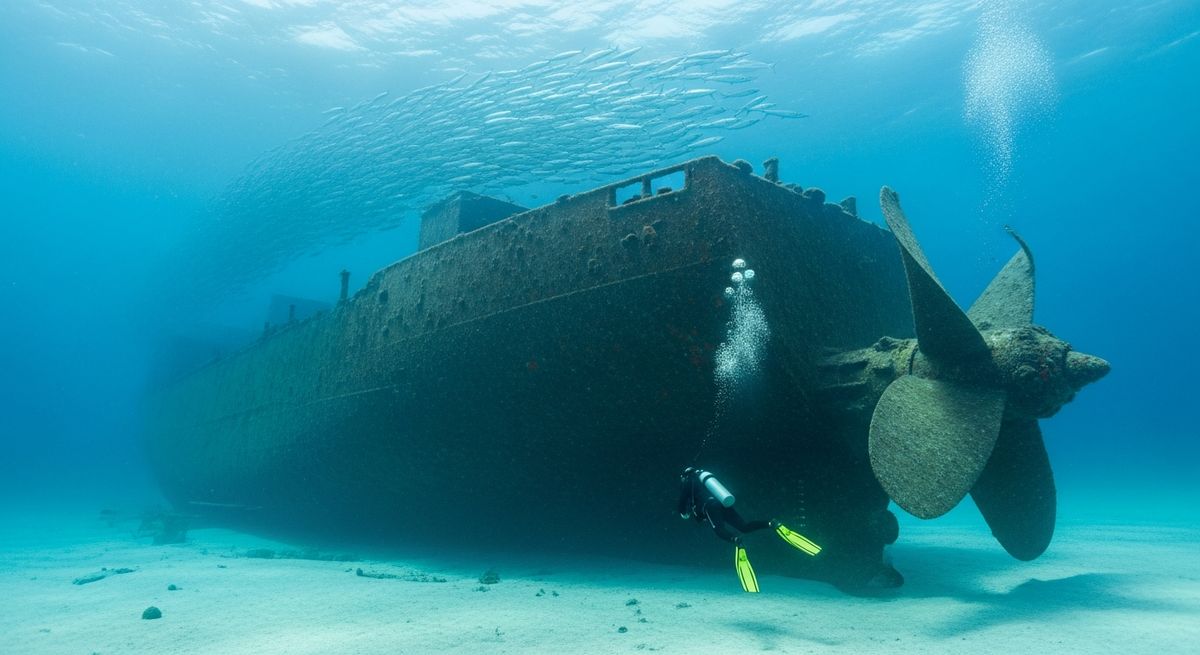
Africa Shell is a proper historical dive, sitting at 29 metres, sunk by the Graf Spee back in 1939. We love that it’s still largely intact, a real testament to its build and the relatively calm currents down there. Dropping onto the deck, you’ll find the bow and stern sections are still clearly defined, though the midship superstructure is well collapsed now. Look closely at the metalwork, we’ve found some impressive nudibranchs tucked into the crevices, particularly along the railings. Our favourite part is exploring the cargo holds, where you can still fin through sections. Sunlight filters down, illuminating schools of snapper that dart through the shadows. It’s a photographer’s dream, that light play. On a good day, visibility can hit 20 metres, really letting you appreciate the scale of the old tanker. Keep an eye out for potato groupers, they seem to consider the wreck their personal hunting ground. It’s a dive that rewards slow exploration, perfect for those who appreciate a bit of history with their marine life.
Typical AFRICA SHELL Dive Profile
Illustrative profile based on site depth and type. Actual dive profiles vary - always follow your dive computer and training.
Safety Notes
Depth of 29m - Advanced Open Water certification recommended.
Wreck site - avoid penetration without wreck diving certification. Watch for sharp metal and entanglement hazards.
Always perform a 3-minute safety stop at 5m before surfacing.
AFRICA SHELL Wreck History
Year Sunk
1939
Vessel Type
tanker
Cause
scuttled
The 'Africa Shell' has a history far more dramatic than its small size would suggest. This 700-ton coastal tanker was operating in the Mozambique Channel in the early months of World War II. On November 15, 1939, she had the misfortune of crossing paths with one of Germany's most feared surface raiders, the pocket battleship 'Admiral Graf Spee'. The battleship, vastly more powerful, easily intercepted the tanker. Following the rules of cruiser warfare, the crew of the 'Africa Shell' were taken aboard the 'Graf Spee' as prisoners before the Germans scuttled the small tanker with explosive charges.
The sinking of the 'Africa Shell' was the first British merchant navy loss in the Indian Ocean during the war. Today, she rests at 29 meters in the stunning Bazaruto Archipelago, a world-class diving destination. The wreck is broken but recognizable, with her engine and boilers providing a focal point for the dive. The warm, clear waters have turned her into a spectacular artificial reef, swarming with tropical fish, moray eels, and crustaceans. Diving the 'Africa Shell' is a unique opportunity to explore a historic WWII wreck connected to a famous naval predator, all while surrounded by the incredible biodiversity of Mozambique.
Nearest Dive Centres to AFRICA SHELL
Dive shops near AFRICA SHELL
View all dive centres in Bazaruto ArchipelagoReviews for AFRICA SHELL
Conditions
Ocean conditions, forecast and tides for AFRICA SHELL
AFRICA SHELL Ocean Conditions
Monthly averages for AFRICA SHELL, sourced from Open-Meteo marine data + Copernicus Marine (EU) - nearest station: Open-Meteo marine grid (-21.65, 35.55) (0km away)
October Averages
Sea Temperature
26°C
78°F · Range: 24.7–27.4°C
Current Speed
14.76 cm/s
Direction: SW (208.3°)
Chlorophyll-a
0.09 mg/m³
Very clear (oligotrophic)
Salinity
35.09 PSU
Based on 4 years of monitoring data · Data sources: Open-Meteo marine data + Copernicus Marine (EU)
Plan & book
Ways to dive Bazaruto Archipelago, from day trips to liveaboards.
Day trips & courses
via GetYourGuideGuided dives, courses and snorkel trips with instant booking.
Find dive trips in Bazaruto ArchipelagoPlaces to stay
via Booking.comHotels and dive resorts near Bazaruto Archipelago.
Search stays in Bazaruto ArchipelagoDive insurance
Most travel insurance excludes or limits scuba. Check what you need before you go.
Dive insurance explainedPartner links: we may earn a commission if you book, at no extra cost to you. How we make money
Where to Stay near AFRICA SHELL
Prices from Booking.com. We may earn a commission at no extra cost to you.