Manta - Bazaruto Archipelago

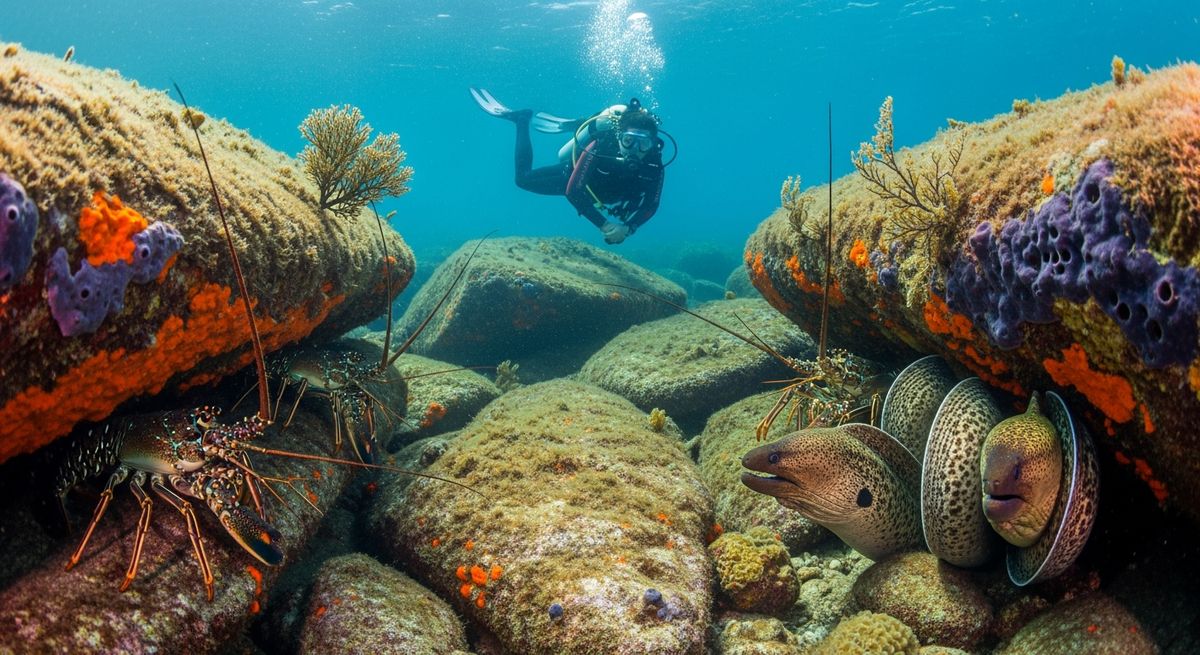
Pasito Blanco is one of those sites we often recommend for a chill afternoon dive, especially if you’ve spent the morning battling currents elsewhere. It’s just five minutes from the sports beach, and the generally calm conditions mean you can really take your time poking around. The seafloor here is a shallow, rectangular stretch, dropping to a maximum of 19 metres, perfect for extended bottom times. We particularly love the way the light filters down, illuminating the sandy patches where you’ll spot Wide-eyed Flounders doing their best impression of the seabed. Keep an eye out for African Striped Grunts, their silvery scales flashing as they cruise past, often accompanied by schools of Canary Damsels. It’s a reliable spot for seeing common octopuses tucked into crevices, their eyes watching you with surprising intelligence. And while it’s not guaranteed, we’ve often been greeted by the slightly grumpy faces of moray eels peering from their hideouts, especially if you get there a bit later in the day. Visibility averages a solid 17 metres, making it easy to spot the more subtle residents, like the little Rock Gobies. This is a site for unhurried exploration, for divers who appreciate the smaller, intricate details of the reef rather than dramatic drop-offs.

Location
Bazaruto Archipelago, Mozambique, Indian Ocean & East Africa
Coordinates
-24.204700, 35.644700

Best Time to Dive in Bazaruto Archipelago

The warmest water temperatures in Bazaruto Archipelago occur in January, averaging 28.3°C. The coolest conditions are in August at 23.3°C.

Monthly Water Temperatures

  • January: 28.3°C
  • February: 28.3°C
  • March: 27.6°C
  • April: 27.0°C
  • May: 25.9°C
  • June: 24.8°C
  • July: 23.8°C
  • August: 23.3°C
  • September: 23.6°C
  • October: 24.5°C
  • November: 25.8°C
  • December: 27.4°C

Nearby Dive Sites in Bazaruto Archipelago

Nearest Dive Centres to Manta

Marine Life in Bazaruto Archipelago

Home to 99 recorded species including 70 reef fish, 14 sharks & rays, 4 other, 3 sea cucumbers, 3 hard corals, 2 whales & dolphins.

Notable Species

Recommended Packing List for Manta

Based on average water temperature of 25.9°C, currents 35 cm/s.

  • Shorty or Rashguard - warm 26°C water needs minimal exposure protection
  • Mask - essential for every dive
  • Fins (stiff blade recommended for strong currents)
  • BCD - buoyancy compensator
  • Regulator - your most safety-critical piece of gear
  • Dive Computer - tracks depth, time, and NDL
  • Surface Marker Buoy (SMB) - essential for boat pickups
  • Dive Torch - useful for crevices and colour at depth
  • Underwater Camera - capture your diving memories

Frequently Asked Questions

What is the typical depth range for diving at Manta Point and what marine life can I expect to see there?
The typical dive depth range at Manta Reef is between 19m and 29m. Divers can expect to encounter a rich variety of marine life, including macro favorites like painted frogfish, shrimp, and nudibranchs. Keep an eye out for larger inhabitants such as giant barracudas, loggerhead turtles, giant morays, ribbon eels, and smaller rays.
How difficult is diving at Manta Point, and is it suitable for beginner divers?
Diving at Manta Reef is classified as intermediate difficulty. As such, it is not typically suitable for beginner divers who may require more experience and advanced skills for these conditions. Divers should possess the necessary certifications and experience for intermediate-level dives.
What are the usual currents and water conditions like at Manta Point, including water temperature and visibility?
At Manta Reef, the average visibility is 13m. While the data does not specify typical currents or water temperature for this site, divers should always consult local dive operators for the most current conditions before planning their trip.
When is the best time of year to dive at Manta Point for optimal manta ray sightings and calm conditions?
The current data does not provide specific information on the best time of year for optimal manta ray sightings or calm conditions at Manta Reef. For general advice on seasonal diving and marine life encounters, we recommend checking our When to Dive resource.
What scuba diving certifications are required to dive at Manta Point?
The provided data does not explicitly state the specific scuba diving certifications required to dive at Manta Reef. Given its intermediate difficulty, divers should consult with local dive operators in the Bazaruto Archipelago to confirm any prerequisites.
Beyond manta rays, what other unique marine species might I encounter at Manta Point?
Beyond the potential for encountering rays, Manta Reef is home to a variety of other unique marine species. Macro lovers will delight in spotting painted frogfish, shrimp, and nudibranchs. Divers can also expect to see impressive creatures such as giant barracudas, loggerhead turtles, giant morays, and ribbon eels. For more details on marine life, explore our wildlife database.