Diving in Silfra & Thingvellir
Why dive here
Silfra & Thingvellir is a diving destination where divers can encounter dwarf minke whales, humpback whales, orcas and seals & sea lions. Water ranges 2-13°C, warmest July, August, September.
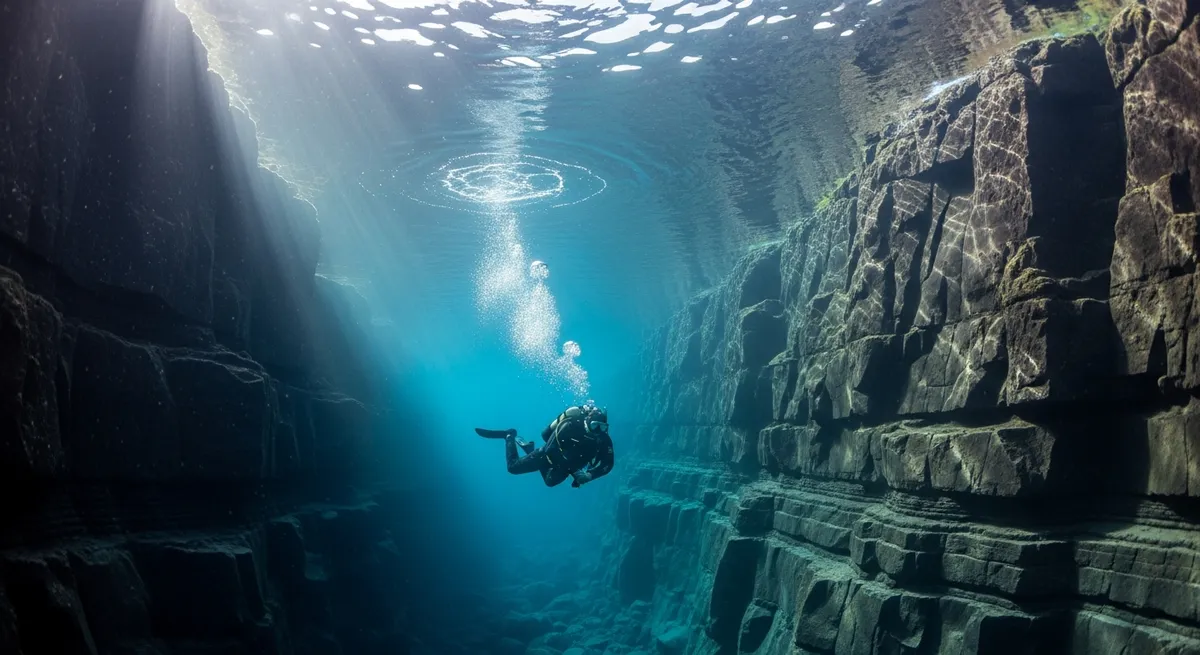
Diving Silfra isn’t like any other dive; it’s an Iceland-specific experience that will reset your expectations for water clarity. We’re talking over 100 metres of visibility in glacial meltwater so pure you can drink it, all while drifting between the North American and Eurasian tectonic plates. The sheer scale of the fissure, dropping to around 30 metres in places, makes you feel incredibly small. It’s chilly, often sitting around 2-4°C, so a drysuit is non-negotiable, and we’d suggest investing in good quality undergarments for warmth. We love the feeling of weightlessness in the ‘Cathedral’, where the fissure widens, letting more light filter down. Marine life here isn't the point; you might spot a few Arctic char or some of that vibrant green ‘troll hair’ algae clinging to the rocks, but the draw is the geological drama. Our favourite practical tip: get there early to avoid the crowds, especially in summer, as it can get busy. The light plays differently at various times of day too; late morning usually gives the best illumination into the deeper sections.
Silfra & Thingvellir Dive Site Map
Dive sites and dive centres in Silfra & Thingvellir
Silfra & Thingvellir Dive Sites
26 dive sites in Silfra & Thingvellir
Æðaklettar
Æðaklettar offers a different perspective in Silfra, a compact dive around a submerged volcanic island. You'll navigate a small reef, observing the unique geological formations up close. This site is a good option for those looking for something a bit less open than the main Silfra crack, better suited to divers who appreciate unique topography over abundant marine life.
ANDRI
Forget the glacial rift of Silfra for a moment, and head out to the Reykjanes Peninsula for something completely different. The Andri, a fishing vessel that went down in 1971, sits upright at a manageable 10 meters. It’s a proper wreck dive without the extreme depths. You can swim around the superstructure, peering into what’s left of the wheelhouse, and imagine the working life of the ship. While not overflowing with colorful reef fish, the wreck has become home to a fascinating array of local marine life, often including wolf fish, various flatfish, and nudibranchs clinging to the metal. It’s a solid wreck dive for those looking for a piece of history in Iceland’s cold waters.
CHARLES H. SALTER
Forget the crystal-clear splits of Silfra for a moment. If you’re in Thingvellir, our pick for a totally different kind of Icelandic dive has to be the Charles H. Salter. This isn't your pretty reef wreck; this is a proper old steamer, resting broken on the seabed since 1946. We love how the story unfolds as you descend – a cargo ship on its way from Hull to Reykjavik, now a scattered monument off Landeyjarsandur. At 12 metres, it’s a relatively shallow dive, but don’t mistake that for easy. The water can be cold, genuinely cold, and often a little murky, but that just adds to the atmosphere. You’ll find stern plates and twisted metal, the remains of the ship’s structure slowly surrendering to the North Atlantic. Keep an eye out for the local cod and flatfish; they’ve made this wreckage their home, darting between the skeletal ribs of the hull. It’s a dive for those who appreciate history and the raw power of the ocean more than vibrant colours. This one really suits divers who appreciate a wreck with a tangible narrative, and who don't mind trading coral for colder, deeper blues and the stark beauty of a ship long lost.
CLAM
Forget everything you think you know about diving in Iceland. CLAM isn't Silfra’s crystal clarity; this is a proper wreck dive, and it’s a big one. The tanker, sunk back in 1950, stretches out at 134 metres, offering plenty of structure to explore. We’ve found the stern section particularly interesting, with some of the plating collapsing inwards, creating cool swim-throughs if you're comfortable with overhead environments. The currents here can be a bit frisky, so check the conditions before you go, but the rewards are worth it, with decent visibility on good days revealing the scale of this maritime relic.
ESKE
So, "Eske." Not your typical Icelandic dive, that's for sure. We're talking about a trawler that went down back in 1930, hitting some skerries and pretty quickly becoming an artificial reef. You'll find her sitting upright, which is always a bonus, allowing for a good sense of her original form. Eighty-odd years underwater means she's well-colonised, with plenty of anemones and some decent fish life sheltering in the nooks and crannies. It's a proper wreck dive, best for those who appreciate history and the way the sea reclaims things, rather than a busy coral garden.
Faxasker
Diving Faxasker is a different kind of Iceland experience, not the usual Silfra fissure. Think less tectonic plates, more open water. It’s a shoal, really, and what makes it interesting are the bigger visitors. We’ve seen harbour porpoises glide by, and there's always a chance of an Orca or basking shark passing through, especially if you hit it right. Keep an eye out for common seals, too, often curious, making a closer pass than you might expect. It's an exposed spot, best for divers comfortable with a bit of swell and focused on pelagics rather than micro-critters.
GJAFAR
Forget what you think you know about Icelandic diving. Gjafar isn't some pristine reef, it’s a time capsule. We love how the story unfolds beneath the surface here. This trawler, beached in 1973 after a close call with Grindavik Harbour, lies broken but surprisingly intact in parts. Dropping down, the cold water bites, but the visibility – often 20 metres or more – lets the wreck reveal itself slowly. We usually find the bow section first, rising out of the sand like a skeletal finger. Our favourite moment is swimming through the wheelhouse; the controls are still there, corroded but recognisable, a poignant reminder of the crew's last moments. It’s a shallow dive, maxing out at 8 metres, which means plenty of bottom time to really soak it all in. Look closely, and you'll spot small sculpins darting between the rusted plates, and sometimes a curious crab peeking from a dark corner. This site is perfect for those who appreciate history and don’t mind a bit of a chill; it’s a dive that really makes you think.
GODAFOSS
We'll be straight with you: diving Iceland is not about the corals or the critters. It’s about the raw, visceral experience of being somewhere truly unique, and Godafoss delivers on that promise. This isn't a tropical reef, it's a piece of history, frozen in time and cold water. Dropping down onto the Godafoss, the first thing that hits you is the sheer scale. At 70 metres long, this old steamship is substantial, a proper wreck sitting upright on the seabed. She went down fast after a U-boat torpedo hit in 1944, and you can still sense that sudden, tragic end. We love exploring the bow, which is still largely intact, and peering into the holds. The stern is a bit more broken up, but there's a certain beauty in the twisted metal. Visibility here can be incredible, sometimes 30 metres plus, especially on a calm day, which makes the whole wreck visible as you descend. It feels like flying over a sunken ghost ship. The water is cold, around 4°C, so a drysuit is non-negotiable, and thick gloves are a blessing. While there aren't specific "species" to tick off, the way the ambient light filters through the water and plays on the steel is its own kind of magic. This dive is for the wreck enthusiasts, the history buffs, and anyone who appreciates the stark beauty of a truly wild dive location. It’s not a dive you forget easily.
HENRIETTE
Henriette isn't your typical tropical wreck. This site in Silfra, Iceland, feels like a submerged time capsule, a stark contrast to the usual volcanic rock and glacial meltwater. We love it because it’s unexpectedly eerie, a fishing boat deliberately sunk in 2005. At a maximum depth of 14 metres, it’s an easy dive, perfect for those wanting to try wreck diving without the pressure of deep, dark penetrations. The experience here is less about coral and more about the interplay of light and decay. Visibility is usually superb, letting you make out the boat’s silhouette from a distance. You can explore the deck, the wheelhouse, and what’s left of the cabins. Keep an eye out for the resident sculpin, often tucked into crevices, and the occasional lumpfish clinging to the metal. We’d suggest going in the morning; the lower sun angle creates dramatic shadows through the superstructure. It’s a quiet, reflective dive, a unique twist on wreck exploration.
HMS Graph
Forget what you think you know about diving Iceland, because the HMS Graph is a total curveball. Most folks come here for the gin-clear crack in Silfra, but we love the weird, almost sci-fi vibe of this German U-boat. She’s a Type VIIC, sunk in 1941, and just thinking about her history sends shivers down your spine before you even hit the water. Dropping down, the sheer scale of her hits you. This isn’t some broken-up debris field; it’s a proper submarine, albeit one listing heavily on the seabed. We often find ourselves just hovering, taking in the torpedo tubes and the conning tower, imagining the cramped quarters. There’s a quietness here that’s different from a reef, a real sense of intrusion into a steel tomb. While you won't find a riot of colour, the way the light filters through the water and plays on the rusted metal is genuinely beautiful, creating these deep, moody blues and greys. We’d suggest bringing a strong torch, not just for penetration (which we’d advise only for experienced wreck divers with proper training) but to really pick out the details on the exterior. It’s a dive for those who appreciate history, the cold beauty of a wreck, and a truly unique experience far from the tropical crowds.
HMS Newcastle
Okay, so this one's a bit of a trick, isn't it? The HMS Newcastle, a British light cruiser, was absolutely a real ship, launched in 1936. But you won't find her anywhere near Silfra or Thingvellir in Iceland. Those sites are famous for their glacial meltwater, the continental rift, and incredible visibility, not shipwrecks. The Newcastle spent her war years in various theatres, saw plenty of action, and was eventually scrapped in the 1950s. If you’re looking for wrecks, we'd point you towards places like Scapa Flow in Scotland, or even some of the deeper Norwegian fjords for cold-water historical sites. Silfra, on the other hand, offers something entirely different: the incredible experience of diving between tectonic plates, with visibility that often exceeds 100 metres, where the only "wreck" you'll find is perhaps an accidental dropped camera from a less-than-careful diver. It’s a truly unique dive, just not for wreck enthusiasts.
HRAFN SVEINBJARNARSON III
Forget the dramatic landscapes above the surface for a moment. HRAFN SVEINBJARNARSON III gives you a proper taste of Iceland's diving history, a sharp contrast to Silfra’s glacial cold. This isn't a deep dive, sitting at a comfortable 10 meters, making it accessible for most open water divers who are comfortable with the chill. The wreck itself is a fishing vessel, the HRAFN SVEINBJARNARSON III, which ran aground back in '88. We love how much of the vessel is still there to explore; you can really get a sense of its original form, the deckhouse, the holds. It’s a proper wreck, not just a few scattered plates. We usually find it’s the smaller stuff that truly brings it to life. Anemones coat the metal, nudibranchs graze on the growth, and we've spotted sculpins tucked into crevices. The visibility can vary, but even on a slightly murkier day, the outline of the wreck emerging from the gloom is genuinely atmospheric. Our tip: go slow, poke into every nook, and imagine the old trawler working the fishing grounds.
Show all 26 dive sites in Silfra & Thingvellir
Silfra & Thingvellir Dive Centres
5 dive shops and operators in Silfra & Thingvellir
Ocean Wildlife in Silfra & Thingvellir
22 species recorded in Silfra & Thingvellir
Silfra & Thingvellir Daylight & Sunrise/Sunset
Sunrise and sunset times for Silfra & Thingvellir, calculated from coordinates
Today - Sunday 11 October
Sunrise
07:01
Sunset
17:28
Daylight
10h 26m
Golden Hour
16:21
First light (dawn) at 06:14 · Last light (dusk) at 18:15
Monthly Averages
| Month | Sunrise | Sunset | Daylight |
|---|---|---|---|
| Jan | 09:54 | 15:18 | 5h 24m |
| Feb | 08:26 | 16:58 | 8h 32m |
| Mar | 06:50 | 18:24 | 11h 33m |
| Apr | 05:01 | 19:55 | 14h 54m |
| May | 03:19 | 21:29 | 18h 9m |
| JunLongest | 02:04 | 22:51 | 20h 47m |
| Jul | 02:42 | 22:25 | 19h 43m |
| Aug | 04:17 | 20:48 | 16h 31m |
| Sep | 05:47 | 18:59 | 13h 12m |
| OctNow | 07:13 | 17:14 | 10h 1m |
| Nov | 08:50 | 15:34 | 6h 44m |
| DecShortest | 10:10 | 14:34 | 4h 24m |
Times are approximate local times based on longitude. Actual times may vary slightly depending on the exact timezone observed in Silfra & Thingvellir.
Where to Stay near Silfra & Thingvellir
Prices from Booking.com. We may earn a commission at no extra cost to you.
Marine Protected Areas near Silfra & Thingvellir
29 protected areas near Silfra & Thingvellir - please respect local regulations when diving
Breiðafjörður
Surtsey
Surtsey
Surtsey
Andakíll
Andakíll, Hvanneyri
Eldey
Grunnafjörður
Andakill Protected Habitat Area
Grunnafjördur
Reynisdjup, coral reef
Skerjafjörður innan Garðabæjar
Showing 12 largest of 29
Getting to Silfra & Thingvellir
Reykjavík
Reykjavík
Akureyri
Plan & book
Ways to dive Silfra & Thingvellir, from day trips to liveaboards.
Day trips & courses
via GetYourGuideGuided dives, courses and snorkel trips with instant booking.
Find dive trips in Silfra & ThingvellirPlaces to stay
via Booking.comHotels and dive resorts near Silfra & Thingvellir.
Search stays in Silfra & ThingvellirDive insurance
Most travel insurance excludes or limits scuba. Check what you need before you go.
Dive insurance explainedPartner links: we may earn a commission if you book, at no extra cost to you. How we make money