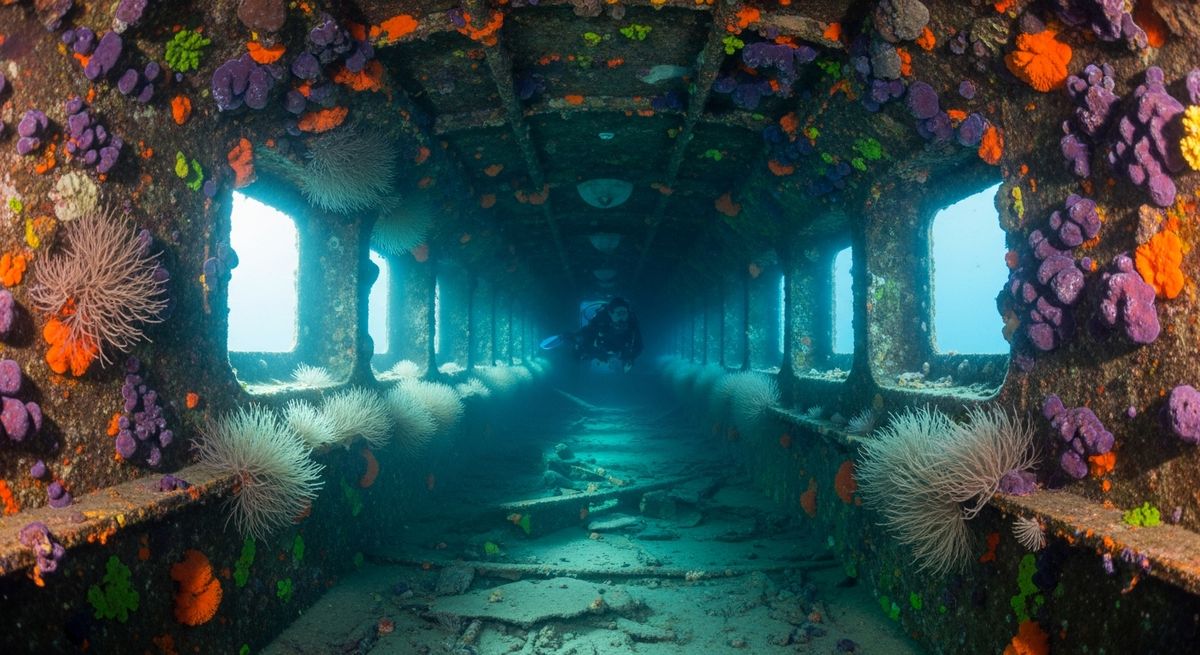
HMS Myrtle
Why dive here
With 50+ marine species recorded in the area - including dwarf minke whales and jellyfish lake - HMS Myrtle offers some of Baltic Coast's richest wreck diving. Water ranges 1-17°C, warmest July, August, September.
The HMS Myrtle isn't just a hunk of metal on the seabed, it’s a portal to a very specific moment in history. We love that it's a real piece of the post-WWI Baltic scramble, a sloop sunk by a mine in 1919 while operating against Bolshevik forces. Dropping down to 33 metres, you immediately get a sense of its scale. At 81.7 metres long, the wreck is broken in two, but both sections are still impressive. We usually start our dive exploring the stern, where the gun mount is a clear reminder of its purpose. The triple-expansion engines, despite over a century underwater, are remarkably intact and make for a fascinating swim-through – just watch your buoyancy. The hold is also accessible, dark and silty, but worth a quick peek for the adventurous. Visibility here can vary, but on a good day, the light filtering through the broken hull sections is genuinely atmospheric. Despite the cold, the sheer sense of history makes it one of our favourites in the Baltic, particularly for those who appreciate wrecks with a story. Look for the small cod and blennies that have made this artificial reef their home; they add a splash of life to the steel.
Typical HMS Myrtle Dive Profile
Illustrative profile based on site depth and type. Actual dive profiles vary - always follow your dive computer and training.
Safety Notes
Deep dive (33m) - monitor air consumption closely. Advanced certification recommended.
Wreck site - avoid penetration without wreck diving certification. Watch for sharp metal and entanglement hazards.
Cold water this month (avg 11°C). Drysuit or thick wetsuit (7mm+) recommended.
Always perform a 3-minute safety stop at 5m before surfacing.
Reviews for HMS Myrtle
Conditions
Ocean conditions, forecast and tides for HMS Myrtle
HMS Myrtle Ocean Conditions
Monthly averages for HMS Myrtle, sourced from Open-Meteo marine data - nearest station: Open-Meteo marine grid (59.85, 20.79) (4km away)
October Averages
Sea Temperature
11°C
53°F · Range: 7.3–14.8°C
Air Temperature
8°C
47°F
Wind Speed
5.57 m/s
10.8 knots
Atmospheric Pressure
1010.6 hPa
Based on 4 years of monitoring data · Data sources: Open-Meteo marine data
Plan & book
Ways to dive Baltic Coast, from day trips to liveaboards.
Day trips & courses
via GetYourGuideGuided dives, courses and snorkel trips with instant booking.
Find dive trips in Baltic CoastPlaces to stay
via Booking.comHotels and dive resorts near Baltic Coast.
Search stays in Baltic CoastDive insurance
Most travel insurance excludes or limits scuba. Check what you need before you go.
Dive insurance explainedPartner links: we may earn a commission if you book, at no extra cost to you. How we make money
Where to Stay near HMS Myrtle
Prices from Booking.com. We may earn a commission at no extra cost to you.