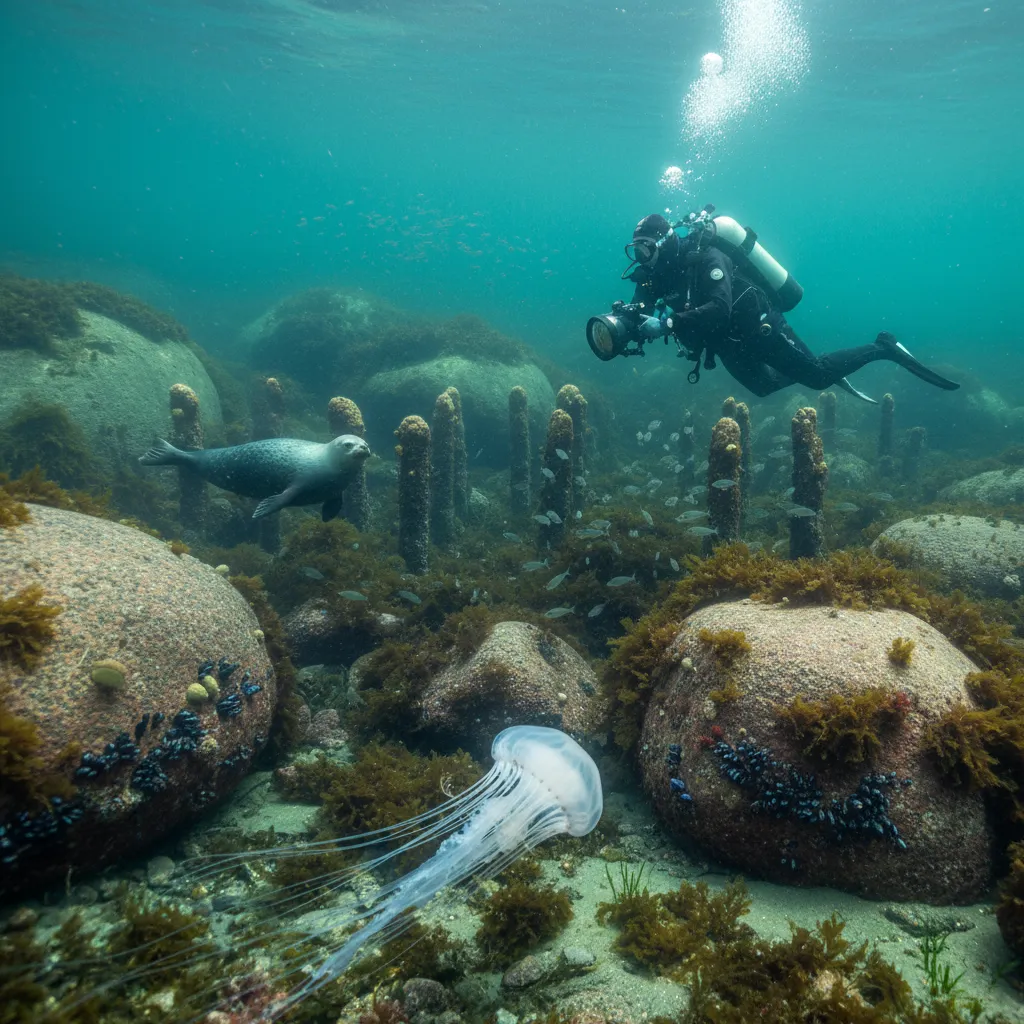
Diving in Baltic Coast
Why dive here
Baltic Coast offers some of Sweden's richest diving, with 50+ marine species recorded in the area - including dwarf minke whales and jellyfish lake. Water sits around 1°C.
Diving the Baltic Coast in Sweden means trading colourful reefs for something altogether more hauntingly beautiful. This isn't your typical tropical escape, and we love it for that. The real draw here is the phenomenal preservation of wooden wrecks. Think about it: cold, brackish water means shipworms don't thrive, leaving timbers intact for centuries. Dropping down onto a site, you'll feel that incredible chill that preserves history so well. We've seen wrecks so well-preserved you can still spot the rigging blocks and deck planks as if they sank last year, not hundreds of years ago. Visibility can be a bit variable, but when it’s good, it’s truly spectacular, offering clear views of these historical time capsules. Keep an eye out for the odd burbot lurking in a shadowy corner, or a broadnosed pipefish drifting past. We'd suggest aiming for late summer or early autumn for the most settled conditions, though it's always worth checking local reports for current and visibility. This area isn't about tropical fish; it's about history, cold water, and an experience you won't find anywhere else.
Baltic Coast Dive Site Map
Dive sites and dive centres in Baltic Coast
Baltic Coast Dive Sites
77 dive sites in Baltic Coast
AID
The AID wreck on the Baltic Coast sits at 30 metres, a stark, upright structure on the silty seabed. It’s a dive for those comfortable with deeper wrecks, offering penetrable sections into cargo holds and engine rooms. Over the years, small crabs and blennies have found homes in the exposed metalwork, a sparse but tenacious colonisation. We’d suggest this dive for experienced wreck enthusiasts looking for a quiet, challenging exploration.
Akula
The Akula wreck, sitting at 30 metres on the Baltic Coast, is a serious dive for experienced wreck enthusiasts. It's a dangerous wreck, no question, so come prepared with the right training and gear. Down there, you'll find an old submarine, its form well-preserved by the cold, dark water. It’s a challenging but rewarding site, where the thrill is in exploring the vessel itself, rather than abundant marine life.
Alfred
Alfred isn't your typical colourful reef dive, but we absolutely love it for its sheer character. This isn't just a wreck; it's a moody, atmospheric journey back in time. You’ll find her resting upright at a comfortable 12 metres, often with visibility that hovers around 5-10 metres. We'd suggest going on a calm day, as even a slight chop on the surface can really stir up the bottom here. What you lose in tropical fish, you gain in the drama of an old vessel, slowly being reclaimed. The structure itself is a fascinating jumble of metal and wood, and we particularly enjoy navigating through the collapsed holds. Keep an eye out for the resident cod, often lurking in the darker corners, and the occasional flatfish camouflaged against the silt. It’s a dive that rewards slow exploration, taking your time to absorb the history. This is definitely one for wreck enthusiasts who appreciate a story over a kaleidoscope of colours.
Altair
The Altair is one of our favourite wreck dives along the Baltic Coast, a non-dangerous site that really lets you settle in and explore. It sits upright at 25 metres, giving it a commanding presence on the seabed. We love the way the light filters down through the green water, illuminating the deck in ghostly shafts. You'll find schools of small fish, often cod and blennies, darting in and out of the superstructure, completely at home amongst the rusted steel. What makes Altair special is its accessibility and how intact it still feels. We'd suggest taking your time to penetrate the holds if you're comfortable with wreck diving; the antechambers are dark, but torches cut through the gloom to reveal the ship’s internal workings. The wreck’s historical context adds another layer, making you wonder about its journey and its final resting place. This is a dive for those who appreciate history and the slow reclamation of man-made objects by the ocean. It’s also a good spot for photographers looking for dramatic, moody shots. Visibility can vary, so check local reports, but even in moderate visibility, the Altair delivers.
ANNA
The Anna wreck sits at 42 metres, a yacht resting upright on the seabed off the Baltic coast. While the vessel itself isn’t huge, its relatively intact structure makes for a good penetration dive for those with the right training. Expect typical Baltic marine life, mostly small bottom dwellers and the occasional schooling fish seeking shelter. It’s a solid pick for experienced wreck divers looking to add another name to their logbook.
Astrahan
Astrahan. The name alone hints at forgotten stories, and this Baltic Coast wreck delivers. Lying in just 4 metres of water, this isn't a deep dive, but it's an atmospheric one. We love Astrahan because it’s so accessible, yet feels like a proper exploration. The wooden hull is collapsing gently, creating a maze of beams and ribs, a real playground for light and shadow. You’ll fin through corridors where the planks have rotted away, revealing the ship's skeleton. Sunlight filters down, illuminating clouds of tiny silvery fish that dart in and out of the wreckage. Keep an eye out for the big Baltic mussels clinging to every surface, their dark shells a contrast against the decaying timber. Our favourite moments here are often just hovering, listening to the gentle creaks of the wreck settling and feeling the subtle surge, a reminder of the sea’s constant work. It’s a site that rewards slow, deliberate finning, letting the details emerge. Perfect for photographers, or anyone who enjoys the quiet contemplation of history beneath the waves.
Äventyrsgruvan
Äventyrsgruvan offers a unique dive into an old mining cave system. Expect narrow passages, some with ropes to guide you through the darkness, and a constant cool temperature. It’s a specialized dive, best suited for experienced cave divers comfortable in overhead environments and low visibility. You'll see the remnants of human activity, not marine life, making it more of an exploratory dive than a wildlife encounter.
BEATRIS
Diving the Beatris feels like stepping into a snapshot of maritime history. This 42.7-meter motor vessel went down in heavy weather back in 1982, and she now rests upright at 31 meters, largely intact. You can swim around her superstructure, peering into the open holds and imagining the final moments. We've seen a surprising number of blennies tucked into the nooks and crannies, and sometimes a curious cod will cruise past the bridge. It’s a good dive for those comfortable with deeper wrecks and keen to experience a Baltic Sea wreck that tells a clear story.
Belliver
Belliver offers a straightforward dive on the Baltic Coast, dropping to 29 metres. It's a site suited for intermediate divers looking for a simple wreck experience in these cooler waters. Expect to explore the structure of the wreck, observing the typical Baltic inhabitants like various small fish and crustaceans that call it home. It’s a solid option for ticking off a Swedish wreck dive without major challenges.
Björkviks brygga
Björkviks brygga, on Sweden's Baltic Coast, offers a different kind of dive. Think less vibrant coral, more cool water exploration. We found bladder wrack swaying gently, creating miniature forests where pike lurked, camouflaged and still. It’s a good spot for a relaxed shallow dive, probably not a place for big pelagic hunters, but ideal if you’re keen on macro life or just enjoy the peaceful calm of a freshwater-ish environment. Keep an eye out for the tiny New Zealand mudsnails and clusters of blue mussels clinging to the rocks.
BRITA DAN
The Brita Dan sits on her side, mostly intact, an impressive skeleton of a motor vessel sunk way back in '65. We love how accessible she is, resting in just 10 metres of water, making her a perfect long dive for newer wreck divers or a leisurely exploration for those with more experience. You can spend a good hour tracing her length, from the stern, where the prop is often silhouetted against the ambient light, right up to the bow that points towards the shore. Inside, the engine room is fairly open, filled with light filtering through the hatches, and it’s always interesting to poke around the superstructure, imagining the crew's final moments. We’ve found wolfish tucked into crevices here, and often seen schools of cod milling about the deck. The visibility can vary, as with most Baltic sites, but on a good day, the sheer scale of her really comes into its own. Our advice? Go on a weekday morning to beat any local boat traffic and catch the best light.
Caskelot/Nederland
We absolutely love the Caskelot and Nederland wreck combo off the Baltic Coast. These two sailing ships, a carvel-built merchantman and a smaller Dutch galliot, went down in a storm way back in 1845. They’re side-by-side on a silty seabed at 24 metres, relatively intact and ripe for exploration. Dropping down, the silhouettes emerge quickly from the green-blue, a classic Baltic wreck dive. The Caskelot, the bigger of the two, still has its sterncastle and parts of its hull standing proud. You can peek into the hold, imagining the cargo, now home to clouds of small blennies and the occasional lurking cod. The Nederland, though smaller, is charming in its own right, with its timbers more spread out, creating a lovely habitat for anemones and hydroids. Our favourite part? The sheer sense of history. It's a proper cold-water wreck dive, ideal for those who appreciate maritime heritage over colourful reefs. Visibility can vary, so we'd suggest picking a calm day after a period of settled weather to make the most of it.
Show all 77 dive sites in Baltic Coast
- DONNA
- DORIS H
- Dykhuset
- Eevi
- EIRA
- E RUSS
- ESTONIA
- FORTUNA
- GAVLE
- HANNA MARJUT
- HARBURG
- HARDING
- HARM
- Hilloisten Louhos
- HINDENBURG
- HMS Cassandra
- HMS Gentian
- HMS GENTIAN
- HMSM E18
- HMS Myrtle
- Järppilän louhos
- JM-PM
- Korven Louhos
- Liisa
- MALON
- MARTINA B
- MEDINA
- META
- MOTILAN
- MUNDOGAS OSLO
- NEDJAN
- NIMETU-409
- NIMETU-414
- Ojamon kaivoslampi
- OSTERSJON
- PLUS
- P. MARJAANA
- RHEIN
- Riksapplet Wreck
- ROSAFRED (POSSIBLY)
- Royal Minstrel
- RUSTON
- SCHIT
- SEINE
- SIMSON
- SKIFTET
- SKUTSKAR
- Snorkelled
- Söderskärs Norrbådan
- SOKAREN
- S/S Hindenburg
- S/S Plus
- Stora Hultö
- SVANEN
- Svarta Stenarna
- TANKBORG
- TUVINETS
- Valeria
- VELI
- Vetokannas
- Vrotslav
- Wreck of Ilmarinen
- Wreck of Maasilinn ship
- Wreck of MS Estonia
- Wreck of SMS Schleswig-Holstein
Baltic Coast Dive Centres
7 dive shops and operators in Baltic Coast
Ocean Wildlife in Baltic Coast
50 species recorded in Baltic Coast
Baltic Coast Daylight & Sunrise/Sunset
Sunrise and sunset times for Baltic Coast, calculated from coordinates
Today - Sunday 11 October
Sunrise
06:05
Sunset
16:43
Daylight
10h 37m
Golden Hour
15:46
First light (dawn) at 05:24 · Last light (dusk) at 17:24
Monthly Averages
| Month | Sunrise | Sunset | Daylight |
|---|---|---|---|
| Jan | 08:23 | 15:10 | 6h 46m |
| Feb | 07:16 | 16:28 | 9h 12m |
| Mar | 05:55 | 17:38 | 11h 43m |
| Apr | 04:25 | 18:50 | 14h 25m |
| May | 03:05 | 20:03 | 16h 58m |
| JunLongest | 02:17 | 20:58 | 18h 41m |
| Jul | 02:41 | 20:45 | 18h 4m |
| Aug | 03:50 | 19:35 | 15h 44m |
| Sep | 05:03 | 18:04 | 13h 1m |
| OctNow | 06:13 | 16:34 | 10h 21m |
| Nov | 07:33 | 15:11 | 7h 38m |
| DecShortest | 08:32 | 14:33 | 6h 2m |
Times are approximate local times based on longitude. Actual times may vary slightly depending on the exact timezone observed in Baltic Coast.
Where to Stay near Baltic Coast
Prices from Booking.com. We may earn a commission at no extra cost to you.
Marine Protected Areas near Baltic Coast
349 protected areas near Baltic Coast - please respect local regulations when diving
Gräsö/Singö Archipelago
2002199 Svenska Högarna
Kopparstenarna/Gotska Sandön/Salvorev Area
Gotska Sandön-Salvorev
Gotska Sandön-Salvorev
2000443 Salvorev-Kopparstenarna
2027089 Gräsö östra skärgård
Stora Nassa-Sv. Högarna
Finngrundet-Östra banken
Finngrundet-Östra banken
Finngrund-Östra Banken
Stockholm, outer archipelago
Showing 12 largest of 349
Getting to Baltic Coast
Mariehamn
Turku
Stockholm
Plan & book
Ways to dive Baltic Coast, from day trips to liveaboards.
Day trips & courses
via GetYourGuideGuided dives, courses and snorkel trips with instant booking.
Find dive trips in Baltic CoastPlaces to stay
via Booking.comHotels and dive resorts near Baltic Coast.
Search stays in Baltic CoastDive insurance
Most travel insurance excludes or limits scuba. Check what you need before you go.
Dive insurance explainedPartner links: we may earn a commission if you book, at no extra cost to you. How we make money