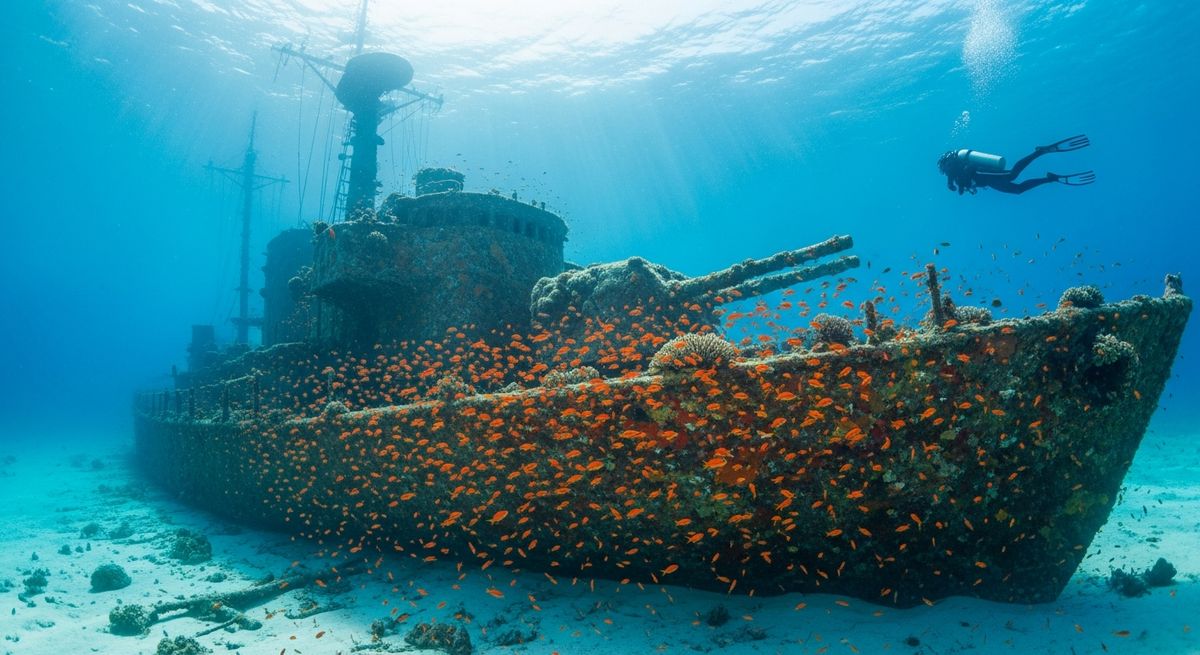
MARIA BRES
Protected Area
Koster
Why dive here
With 121+ marine species recorded in the area - including dolphins, dwarf minke whales, humpback whales, orcas and seals & sea lions - MARIA BRES offers some of West Coast (Gothenburg)'s richest wreck diving. Water ranges 3-18°C, warmest July, August, September.
Maria Bres isn't your average Swedish wreck dive. Forget deep, dark, and featureless. This former motor vessel, lying at a comfortable 21 metres, feels surprisingly vibrant for a site in our cooler waters. We love how the hull has become a canvas for life; the deck plating is a patchwork of colourful anemones and dead man’s fingers, swaying gently with any surge. The stern section is particularly photogenic, with the propeller still largely intact and barnacle-encrusted, drawing in curious cod and wrasse. Our pick for exploration is the bridge area, now a skeletal frame, but still evocative of its past. You can fin through open doorways, imagining the crew's last moments before it ran aground in '74 and eventually broke up. Visibility here can be excellent, especially in late summer, giving you clear views across the entire 64-metre length. It’s a comfortable dive for those with some wreck experience – no tricky penetrations, just good, honest exploration of a well-preserved piece of maritime history. Dive it on a calm day; it’s exposed, and a little swell makes the journey out less fun.
Typical MARIA BRES Dive Profile
Illustrative profile based on site depth and type. Actual dive profiles vary - always follow your dive computer and training.
Safety Notes
Depth of 21m - Advanced Open Water certification recommended.
Wreck site - avoid penetration without wreck diving certification. Watch for sharp metal and entanglement hazards.
Cold water this month (avg 13°C). Drysuit or thick wetsuit (7mm+) recommended.
Always perform a 3-minute safety stop at 5m before surfacing.
Nearest Dive Centres to MARIA BRES
Dive shops near MARIA BRES
View all dive centres in West Coast (Gothenburg)Reviews for MARIA BRES
Conditions
Ocean conditions, forecast and tides for MARIA BRES
MARIA BRES Ocean Conditions
Monthly averages for MARIA BRES, sourced from Open-Meteo marine data - nearest station: Open-Meteo marine grid (57.57, 11.03) (3km away)
October Averages
Sea Temperature
13°C
56°F · Range: 10.6–15.8°C
Air Temperature
10°C
50°F
Wind Speed
6.56 m/s
12.8 knots
Atmospheric Pressure
1010.2 hPa
Based on 4 years of monitoring data · Data sources: Open-Meteo marine data
Plan & book
Ways to dive West Coast (Gothenburg), from day trips to liveaboards.
Day trips & courses
via GetYourGuideGuided dives, courses and snorkel trips with instant booking.
Find dive trips in West Coast (Gothenburg)Places to stay
via Booking.comHotels and dive resorts near West Coast (Gothenburg).
Search stays in West Coast (Gothenburg)Dive insurance
Most travel insurance excludes or limits scuba. Check what you need before you go.
Dive insurance explainedPartner links: we may earn a commission if you book, at no extra cost to you. How we make money
Where to Stay near MARIA BRES
Prices from Booking.com. We may earn a commission at no extra cost to you.