ELEANOR
Protected Area
St Gothian Sands
Why dive here
With 176+ marine species recorded in the area - including blue sharks, dolphins, dwarf minke whales, humpback whales and ocean sunfish (mola mola) - ELEANOR offers some of Cornwall & Devon's richest wreck diving. Water ranges 10-18°C, warmest July, August, September.
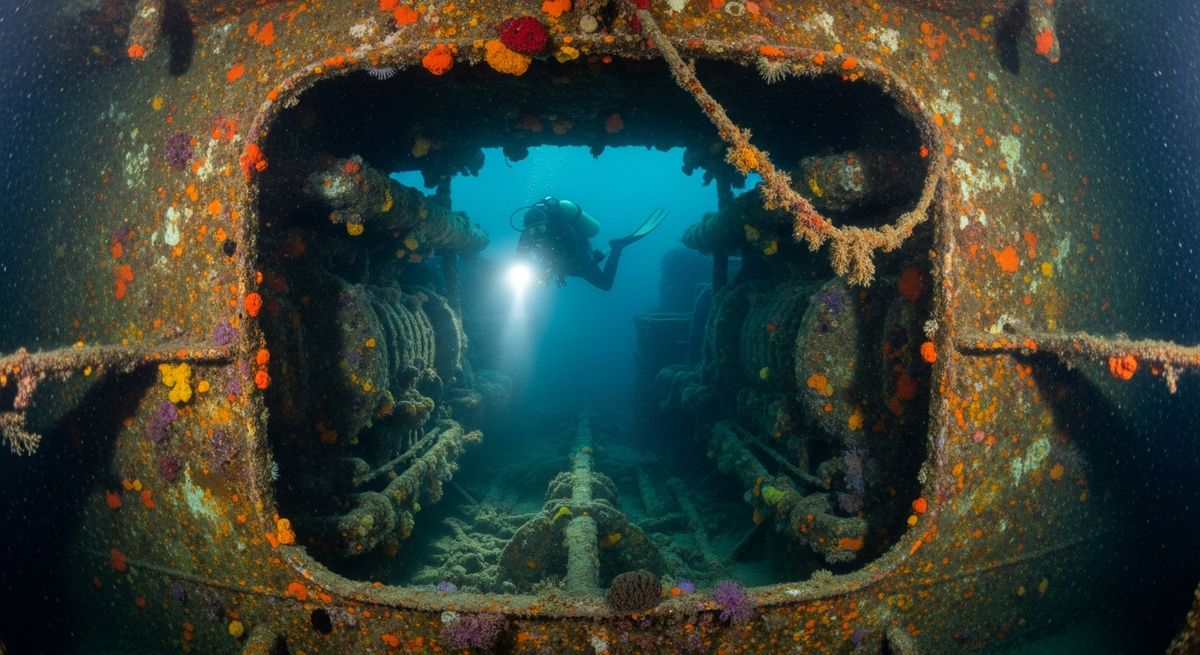
The *Eleanor* in Cornwall is one of those wrecks that just oozes history, even if she’s broken up now. She ran aground in 1922, a steamship carrying coal, and the remnants are scattered across the seabed at a very forgiving maximum depth of 12 metres. We love diving her on a calm day, when the light penetrates right down, illuminating the twisted metal and the two massive boilers that are still a focal point. You can poke around the debris field, imagining the force of the waves that tore her apart. What truly makes the *Eleanor* special for us is how marine life has absolutely taken over. You’ll find wrasse darting between the plates, conger eels tucked into any dark crevice, and plumose anemones waving gently from every surface. It’s a site that really rewards slow exploration; take your time to peer under ledges and into cracks. For photographers, the way the light filters through the kelp and across the encrusted wreck can be stunning, especially late morning. Just watch for surge if the tide is turning; it can get a bit sporty. It’s a perfect site for newer wreck divers or anyone who appreciates the beauty of an artificial reef teeming with life.
Typical ELEANOR Dive Profile
Illustrative profile based on site depth and type. Actual dive profiles vary - always follow your dive computer and training.
Safety Notes
Wreck site - avoid penetration without wreck diving certification. Watch for sharp metal and entanglement hazards.
Nearest Dive Centres to ELEANOR
Dive shops near ELEANOR
Seaways Diving
Wavecrest Scuba
DiveUK
Dive Newquay
Porthkerris Divers
Karleyth Diving Ltd.
Reviews for ELEANOR
Conditions
Ocean conditions, forecast and tides for ELEANOR
ELEANOR Ocean Conditions
Monthly averages for ELEANOR, sourced from Open-Meteo marine data - nearest station: Open-Meteo marine grid (50.44, -2.73) (3km away)
October Averages
Sea Temperature
17°C
62°F · Range: 15.1–17.5°C
Air Temperature
13°C
56°F
Wind Speed
8.14 m/s
15.8 knots
Atmospheric Pressure
1011 hPa
Based on 4 years of monitoring data · Data sources: Open-Meteo marine data
Plan & book
Ways to dive Cornwall & Devon, from day trips to liveaboards.
Day trips & courses
via GetYourGuideGuided dives, courses and snorkel trips with instant booking.
Find dive trips in Cornwall & DevonPlaces to stay
via Booking.comHotels and dive resorts near Cornwall & Devon.
Search stays in Cornwall & DevonDive insurance
Most travel insurance excludes or limits scuba. Check what you need before you go.
Dive insurance explainedPartner links: we may earn a commission if you book, at no extra cost to you. How we make money
Where to Stay near ELEANOR
Prices from Booking.com. We may earn a commission at no extra cost to you.