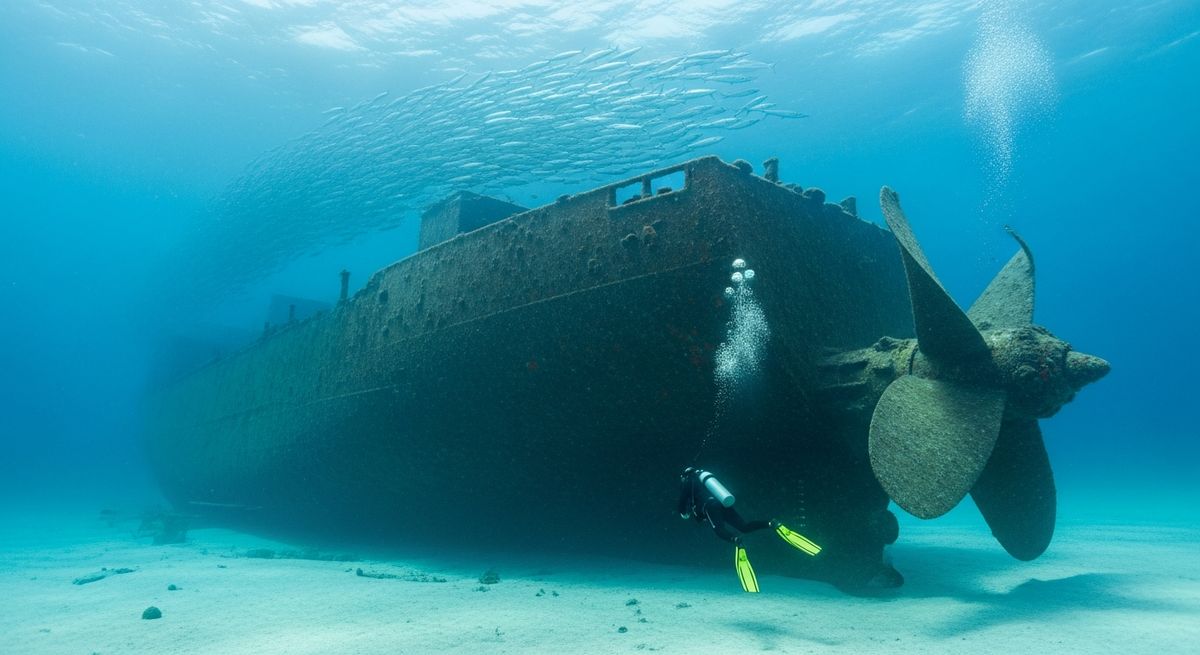
HMS HIND
Protected Area
Jersey Coast
Why dive here
With 176+ marine species recorded in the area - including blue sharks, dolphins, dwarf minke whales, humpback whales and ocean sunfish (mola mola) - HMS HIND offers some of Cornwall & Devon's richest wreck diving. Water ranges 10-18°C, warmest July, August, September.
HMS Hind isn't a deep dive, not by a long shot. In fact, it’s barely a dive at all, more of a snorkel or a paddle at low tide, sitting in just one metre of water on Hinguette Reef. But don’t let that put you off. What you lose in depth, you gain in historical resonance and accessibility. We love coming here with a mask and fins on a calm day, just after slack low water, when the sea is clear and the sun filters through the surface. You’re essentially exploring the skeletal remains of an 18th-century sailing vessel, wrecked due to a pilotage error back in 1721. The timbers are still there, surprisingly intact in places, a dark silhouette against the sandy bottom. You can trace the outline of the hull, feeling the rough texture of the ancient wood. Our favourite part is spotting the crabs scuttling amongst the frames, and the small shoals of pollack that dart in and out of the shadows cast by the timbers. It’s a powerful, tangible link to maritime history, a quiet, reflective spot that suits anyone who appreciates a wreck with a story, even if you’re only getting your knees wet.
Typical HMS HIND Dive Profile
Illustrative profile based on site depth and type. Actual dive profiles vary - always follow your dive computer and training.
Safety Notes
Wreck site - avoid penetration without wreck diving certification. Watch for sharp metal and entanglement hazards.
Nearest Dive Centres to HMS HIND
Dive shops near HMS HIND
View all dive centres in Cornwall & DevonReviews for HMS HIND
Conditions
Ocean conditions, forecast and tides for HMS HIND
HMS HIND Ocean Conditions
Monthly averages for HMS HIND, sourced from Open-Meteo marine data - nearest station: Open-Meteo marine grid (50.44, -2.73) (3km away)
October Averages
Sea Temperature
17°C
62°F · Range: 15.1–17.5°C
Air Temperature
13°C
56°F
Wind Speed
8.14 m/s
15.8 knots
Atmospheric Pressure
1011 hPa
Based on 4 years of monitoring data · Data sources: Open-Meteo marine data
Plan & book
Ways to dive Cornwall & Devon, from day trips to liveaboards.
Day trips & courses
via GetYourGuideGuided dives, courses and snorkel trips with instant booking.
Find dive trips in Cornwall & DevonPlaces to stay
via Booking.comHotels and dive resorts near Cornwall & Devon.
Search stays in Cornwall & DevonDive insurance
Most travel insurance excludes or limits scuba. Check what you need before you go.
Dive insurance explainedPartner links: we may earn a commission if you book, at no extra cost to you. How we make money
Where to Stay near HMS HIND
Prices from Booking.com. We may earn a commission at no extra cost to you.