JOHANNA - Cornwall & Devon

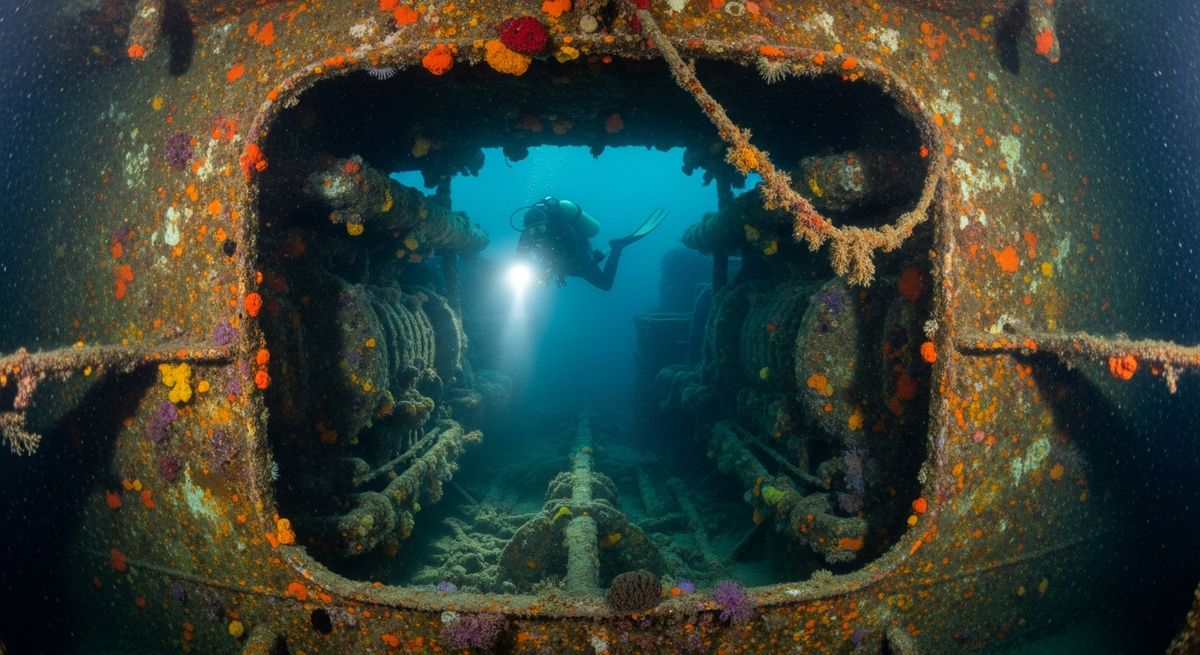
The Johanna, a carrier vessel lost off Hartland Point on New Year's Eve, 1982, offers a proper Cornish wreck dive when conditions align. She ran aground hard, 200 yards south of the point, breaking up over time. We've seen her in varying states, but there’s always something new exposed, a different way the light catches the twisted metal. Dropping down, you're looking at a vessel around 64 metres long. The stern section is often the most intact, with the bow more scattered. Our favourite moments here are when the vis pushes to 8-10 metres, allowing you to appreciate the scale of the holds, imagining her journey from Rotterdam to Barry. Ling often peek out from under plates, and the resident conger eels are truly impressive, thick as your thigh. Sometimes, if you catch the dive just right, the kelp fronds sway in rhythm with the surge, creating an eerie, almost cathedral-like feel over the deeper, more broken sections. This site is definitely one for the experienced UK diver, comfortable with a bit of swell and the unique challenges of the Bristol Channel. Pick a slack tide; it makes all the difference.

Location
Cornwall & Devon, United Kingdom, Mediterranean & Europe
Coordinates
51.019670, -4.525564
Type
wreck
Maximum Depth
0m

Marine Protected Area: Brownsham

Best Time to Dive in Cornwall & Devon

The warmest water temperatures in Cornwall & Devon occur in January, averaging 9.6°C. The coolest conditions are in December at 9.6°C.

Monthly Water Temperatures

  • January: 9.6°C (air: 7.3°C)
  • February: 9.6°C (air: 8.4°C)
  • March: 9.6°C (air: 8.6°C)
  • April: 9.6°C (air: 10.1°C)
  • May: 9.6°C (air: 12.6°C)
  • June: 9.6°C (air: 15.2°C)
  • July: 9.6°C (air: 16.6°C)
  • August: 9.6°C (air: 17.1°C)
  • September: 9.6°C (air: 15.9°C)
  • October: 9.6°C (air: 13.5°C)
  • November: 9.6°C (air: 10.7°C)
  • December: 9.6°C (air: 8.7°C)

Nearby Dive Sites in Cornwall & Devon

Nearest Dive Centres to JOHANNA

Marine Life in Cornwall & Devon

Home to 192 recorded species including 93 reef fish, 18 sharks & rays, 13 whales & dolphins, 11 crabs & lobsters, 11 other, 10 seagrass & algae.

Notable Species

Recommended Packing List for JOHANNA

Based on average water temperature of 9.6°C.

  • Drysuit - water at 10°C demands a drysuit with thermal undergarments
  • Hood & Gloves (7mm+) - critical to prevent heat loss
  • Mask - essential for every dive
  • Fins
  • BCD - buoyancy compensator
  • Regulator - your most safety-critical piece of gear
  • Dive Computer - tracks depth, time, and NDL
  • Surface Marker Buoy (SMB) - essential for boat pickups
  • Dive Torch - useful for crevices and colour at depth
  • Underwater Camera - capture your diving memories

Frequently Asked Questions

What are the typical depths for scuba diving in the Finnish lakes associated with Johanna Nordblad's ice diving, such as Lake Öllöri or Lake Päijänne?
Our current data context focuses on the JOHANNA wreck in Cornwall & Devon, United Kingdom, which has a reported depth of 0m. We do not have specific information regarding the typical depths for scuba diving in Finnish lakes like Lake Öllöri or Lake Päijänne, nor any details related to Johanna Nordblad's ice diving activities. The provided data is solely about the carrier vessel JOHANNA, sunk in 1982.
What kind of underwater features and marine life can scuba divers expect to see in the clear, cold waters of the dive sites where Johanna Nordblad trains?
The provided data describes the JOHANNA, a 64m x 10.7m carrier vessel wreck located off Hartland Point in the United Kingdom. This context does not include information about underwater features or marine life in Finnish lakes, nor any details about the dive sites where Johanna Nordblad trains. For general marine life information, you might explore our wildlife database.
How challenging is scuba ice diving or cold-water lake diving in the regions where Johanna Nordblad is known to dive, and what are the main difficulties?
Our available data is specific to the JOHANNA wreck, classified as an 'intermediate' difficulty dive site in Cornwall & Devon, UK. This context does not provide any information regarding the challenges or difficulties associated with scuba ice diving or cold-water lake diving in the regions where Johanna Nordblad is known to dive. The JOHANNA itself ran aground on rocks and is a wreck showing portions of its hull or superstructure.
When is the best time of year for scuba divers to experience the unique ice diving conditions found in the Finnish lakes associated with Johanna Nordblad?
The provided data pertains exclusively to the JOHANNA wreck in the United Kingdom, which was sunk on December 31, 1982. This context does not offer any information about the best time of year for ice diving conditions in Finnish lakes or any activities related to Johanna Nordblad. For general guidance on dive seasons, please consult our when to dive section.
What specific certifications or experience levels are recommended for scuba divers interested in the ice or cold-water diving experiences similar to those of Johanna Nordblad?
Based on the provided data, the JOHANNA wreck in Cornwall & Devon, UK, is categorized as an 'intermediate' difficulty dive. However, this context does not contain any information about recommended certifications or experience levels for ice or cold-water diving experiences, nor does it mention Johanna Nordblad's specific training or diving requirements. Divers interested in specialized diving should always seek appropriate training.
What are the typical water temperatures, visibility, and current conditions for scuba diving in the Finnish lakes where Johanna Nordblad performs her dives?
The data provided details the JOHANNA wreck, a carrier vessel located in Cornwall & Devon, United Kingdom. This context does not include any information about typical water temperatures, visibility, or current conditions for scuba diving in Finnish lakes, nor does it mention Johanna Nordblad's diving locations or conditions. The JOHANNA is a wreck site, built in 1958 and sunk in 1982.