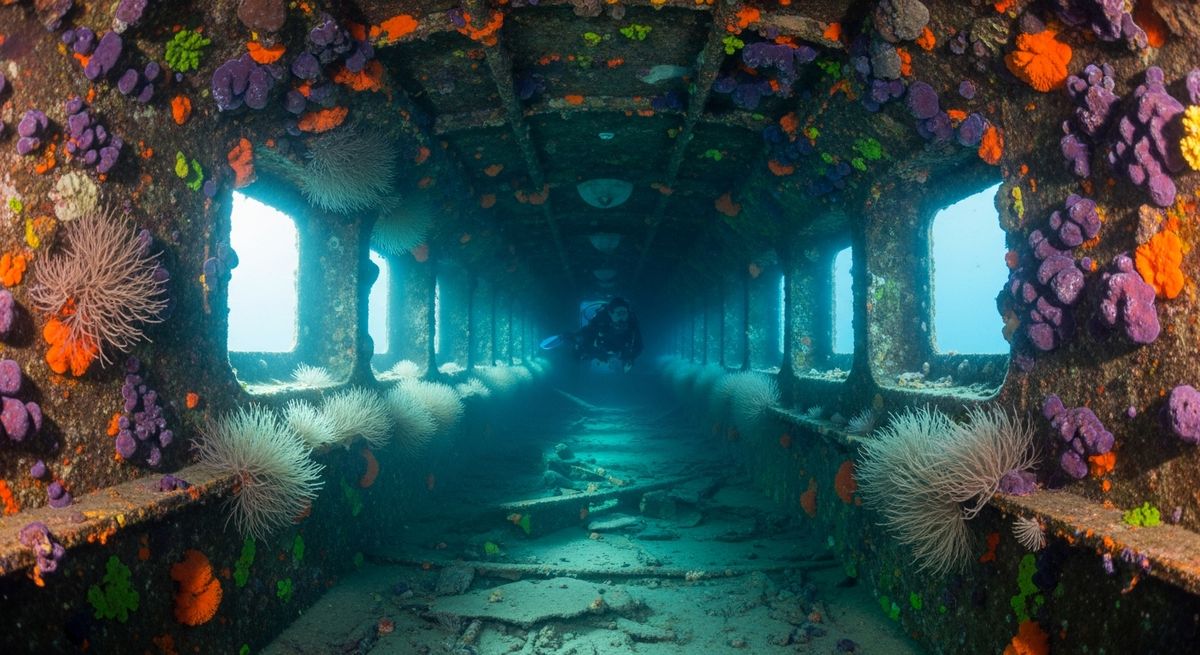
STROMBUS (PART OF)(PROBABLY) - Cornwall & Devon

The Strombus, or what’s left of her, offers a classic Cornish wreck dive. This steamship, sunk in 1940, now lies broken, her 125-meter frame scattered across the seabed. We often find her plates and ribs forming mini-canyons and overhangs, perfect for sheltering lobster and conger eels. Visibility can be a typical UK lottery, but on a good day, exploring the remains of her engine room or boiler section feels like stepping back into maritime history. It’s a site that rewards multiple dives, each one revealing a new detail or a different resident school of bib. We'd suggest this one for divers comfortable with colder water and perhaps a touch of current, looking for a bit of exploration rather than a pristine intact wreck.

Location
Cornwall & Devon, United Kingdom, Mediterranean & Europe
Coordinates
51.577670, -3.978131
Type
wreck
Maximum Depth
0m

Marine Protected Area: Blackpill, Swansea

Best Time to Dive in Cornwall & Devon

The warmest water temperatures in Cornwall & Devon occur in January, averaging 9.6°C. The coolest conditions are in December at 9.6°C.

Monthly Water Temperatures

  • January: 9.6°C (air: 7.3°C)
  • February: 9.6°C (air: 8.4°C)
  • March: 9.6°C (air: 8.6°C)
  • April: 9.6°C (air: 10.1°C)
  • May: 9.6°C (air: 12.6°C)
  • June: 9.6°C (air: 15.2°C)
  • July: 9.6°C (air: 16.6°C)
  • August: 9.6°C (air: 17.1°C)
  • September: 9.6°C (air: 15.9°C)
  • October: 9.6°C (air: 13.5°C)
  • November: 9.6°C (air: 10.7°C)
  • December: 9.6°C (air: 8.7°C)

Nearby Dive Sites in Cornwall & Devon

Nearest Dive Centres to STROMBUS (PART OF)(PROBABLY)

Marine Life in Cornwall & Devon

Home to 192 recorded species including 93 reef fish, 18 sharks & rays, 13 whales & dolphins, 11 crabs & lobsters, 11 other, 10 seagrass & algae.

Notable Species

Recommended Packing List for STROMBUS (PART OF)(PROBABLY)

Based on average water temperature of 9.6°C.

  • Drysuit - water at 10°C demands a drysuit with thermal undergarments
  • Hood & Gloves (7mm+) - critical to prevent heat loss
  • Mask - essential for every dive
  • Fins
  • BCD - buoyancy compensator
  • Regulator - your most safety-critical piece of gear
  • Dive Computer - tracks depth, time, and NDL
  • Surface Marker Buoy (SMB) - essential for boat pickups
  • Dive Torch - useful for crevices and colour at depth
  • Underwater Camera - capture your diving memories

Frequently Asked Questions

What is the typical diving depth at STROMBUS (PART OF)(PROBABLY)?
The data indicates a depth of 0m for the STROMBUS (PART OF)(PROBABLY) dive site. However, as a significant steamship wreck measuring 125m x 15.9m, it is classified as a "Wreck showing any portion of hull or superstructure," implying it is submerged. Given its intermediate difficulty, divers should expect to explore the wreck underwater, with parts potentially shallower or deeper than the stated 0m.
What kind of marine life and underwater features can be expected when diving STROMBUS (PART OF)(PROBABLY)?
The primary underwater feature at STROMBUS (PART OF)(PROBABLY) is the historical steamship wreck itself. This substantial vessel, built in 1900 and sunk in 1940, measures 125m x 15.9m and offers an intriguing structure to explore. While specific marine life is not detailed in the provided data, wrecks typically become artificial reefs, attracting a diverse array of marine species; you can learn more about common species on our wildlife database.
How difficult is the STROMBUS (PART OF)(PROBABLY) dive site, and is it suitable for beginners?
The STROMBUS (PART OF)(PROBABLY) dive site is classified as intermediate difficulty. This means it is generally not suitable for absolute beginners or those without prior experience in similar conditions. Divers should possess adequate training and experience to safely navigate the complexities of a wreck dive.
What is the best time of year or season to dive at STROMBUS (PART OF)(PROBABLY) for optimal conditions?
The provided data does not specify the best time of year or season for optimal diving conditions at the STROMBUS (PART OF)(PROBABLY) dive site. For the most current information on seasonal conditions, we recommend consulting local dive operators in Cornwall & Devon. You can also find general guidance on when to dive on DivePlnr.
What diving certifications are required to dive at STROMBUS (PART OF)(PROBABLY)?
Specific diving certifications required for the STROMBUS (PART OF)(PROBABLY) dive site are not detailed in the provided information. Given its intermediate difficulty and status as a wreck dive, it is highly advisable to have advanced open water certification or a specialty wreck diving certification. Always consult with local dive centers in Cornwall & Devon to confirm exact requirements before planning your dive.
What are the typical current conditions and visibility like at the STROMBUS (PART OF)(PROBABLY) dive site?
The provided data does not include specific information regarding the typical current conditions or visibility at the STROMBUS (PART OF)(PROBABLY) dive site. As conditions can vary, especially for wreck sites, it is always best to check with local dive operators or guides in Cornwall & Devon for the most up-to-date reports before your dive.