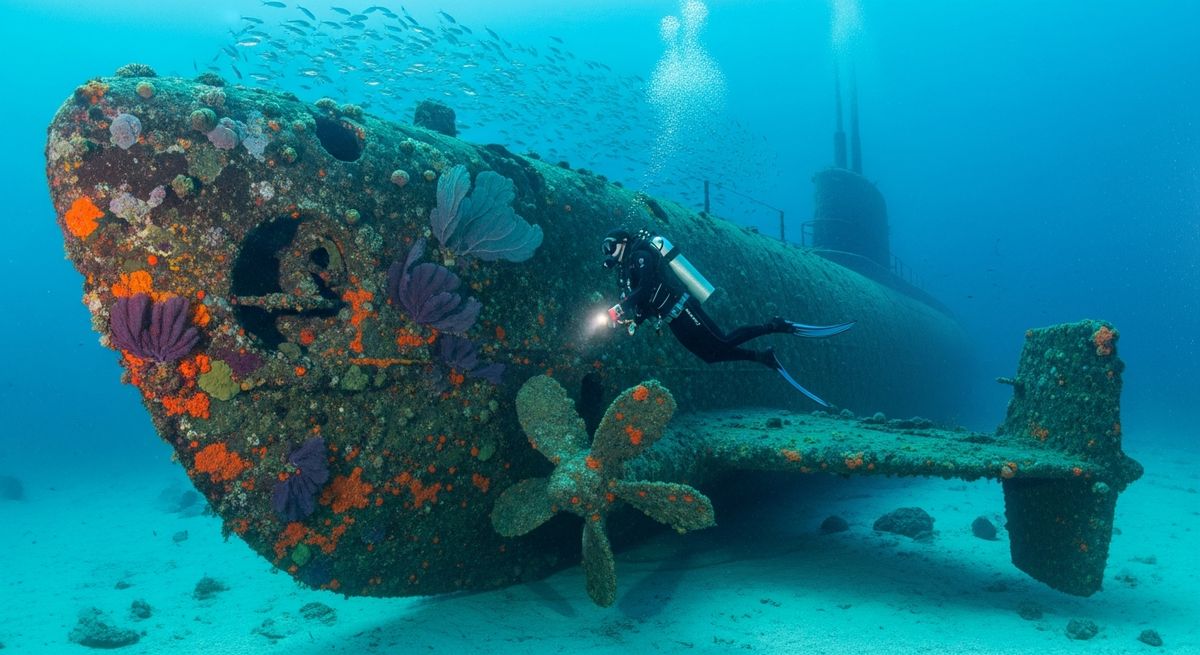
HMS BONIFACE
Why dive here
With 112+ marine species recorded in the area - including blue whales, dolphins, dwarf minke whales, humpback whales and ocean sunfish (mola mola) - HMS BONIFACE offers some of Scottish West Coast's richest wreck diving.
The HMS Boniface, a 108-meter liner requisitioned for government use, sits at 52 meters in the cold, clear waters off Scotland’s west coast. She went down in 1917, and time has been kind, though the strong currents that sometimes sweep through here have helped keep her well-scoured. We love a deep wreck, and this one delivers that satisfying sense of historical exploration. Descending onto the Boniface, you’re greeted by the sheer scale of her. Her two boilers and triple-expansion engine are still very much in evidence, drawing you into the guts of the vessel. We’ve found the stern section particularly engaging, with the massive propeller still largely intact – a real photographic opportunity if the visibility is playing ball. Look closely at the superstructure and you’ll find it cloaked in plumose anemones, their white tentacles waving gently in the surge. Ling and conger eels are often spotted lurking in the shadowy nooks and crannies, and it’s not uncommon to see a huge shoal of saithe circling the mast structure, creating a living curtain that momentarily blocks out the ambient light. This is a dive for experienced wreck enthusiasts, those comfortable with deep stops and the occasional strong current. Our advice? Pick your slack water window carefully; it makes all the difference.
Typical HMS BONIFACE Dive Profile
Illustrative profile based on site depth and type. Actual dive profiles vary - always follow your dive computer and training.
Safety Notes
Maximum depth 52m exceeds recreational limits (40m). Technical diving certification and equipment required.
Wreck site - avoid penetration without wreck diving certification. Watch for sharp metal and entanglement hazards.
Always perform a 3-minute safety stop at 5m before surfacing.
Nearest Dive Centres to HMS BONIFACE
Dive shops near HMS BONIFACE
View all dive centres in Scottish West CoastReviews for HMS BONIFACE
Conditions
Ocean conditions, forecast and tides for HMS BONIFACE
Plan & book
Ways to dive Scottish West Coast, from day trips to liveaboards.
Day trips & courses
via GetYourGuideGuided dives, courses and snorkel trips with instant booking.
Find dive trips in Scottish West CoastPlaces to stay
via Booking.comHotels and dive resorts near Scottish West Coast.
Search stays in Scottish West CoastDive insurance
Most travel insurance excludes or limits scuba. Check what you need before you go.
Dive insurance explainedPartner links: we may earn a commission if you book, at no extra cost to you. How we make money
Where to Stay near HMS BONIFACE
Prices from Booking.com. We may earn a commission at no extra cost to you.