Mirlo
Protected Area
Povilla Forest Reserve
Why dive here
With 116+ marine species recorded in the area - including dugongs, eagle rays, great white sharks, manta rays and mobula rays (devil rays) - Mirlo offers some of Loyalty Islands's richest wall diving. Water ranges 24-29°C, warmest January, February, March.
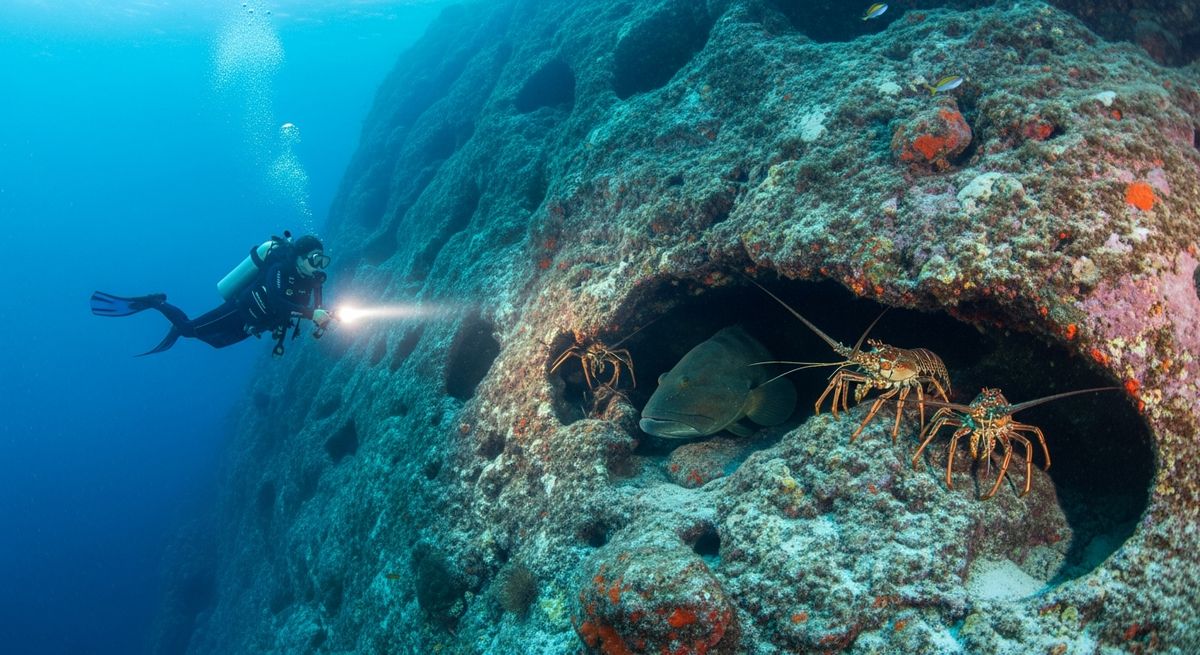
Mirlo. If you're going to dive in the Loyalty Islands, make this one a priority. We love a good channel dive, and Mirlo delivers with serious style. Forty-five minutes out into Bayes Pass, and you're dropping into a world of big fish and even bigger gorgonian fans. We’re talking about faults in the reef so wide you could drive a truck through them, lined with these ancient, purple-red giants. Keep your eyes peeled, because Mirlo is all about the pelagics. Schools of fusiliers are usually so thick they shimmer like liquid silver, parting only for the grey sharks that cruise through. We often see huge jacks and barracudas, sometimes even a tiger shark if you hit it right. The current can be brisk, which keeps the water moving and the visibility hovering around 30 metres, so it’s a site best suited for confident divers comfortable with a drift. You'll spend most of your time mesmerised by the sheer scale of the reef and the density of the schooling fish.
Typical Mirlo Dive Profile
Illustrative profile based on site depth and type. Actual dive profiles vary - always follow your dive computer and training.
Safety Notes
Always perform a 3-minute safety stop at 5m before surfacing.
Nearest Dive Centres to Mirlo
Dive shops near Mirlo
View all dive centres in Loyalty IslandsReviews for Mirlo
Conditions
Ocean conditions, forecast and tides for Mirlo
Mirlo Ocean Conditions
Monthly averages for Mirlo, sourced from Open-Meteo marine data + Copernicus Marine (EU) - nearest station: Open-Meteo marine grid (-20.94, 165.47) (8km away)
October Averages
Sea Temperature
25°C
77°F · Range: 23.4–27.1°C
Current Speed
8.06 cm/s
Direction: S (187.1°)
Chlorophyll-a
0.052 mg/m³
Very clear (oligotrophic)
Salinity
35.08 PSU
Based on 4 years of monitoring data · Data sources: Open-Meteo marine data + Copernicus Marine (EU)
Plan & book
Ways to dive Loyalty Islands, from day trips to liveaboards.
Day trips & courses
via GetYourGuideGuided dives, courses and snorkel trips with instant booking.
Find dive trips in Loyalty IslandsPlaces to stay
via Booking.comHotels and dive resorts near Loyalty Islands.
Search stays in Loyalty IslandsDive insurance
Most travel insurance excludes or limits scuba. Check what you need before you go.
Dive insurance explainedPartner links: we may earn a commission if you book, at no extra cost to you. How we make money
Where to Stay near Mirlo
Prices from Booking.com. We may earn a commission at no extra cost to you.