ARGUS (PROBABLY)
Protected Area
Stenrev sydøst for Langeland
Why dive here
With 95+ marine species recorded in the area - including seals & sea lions, sea turtles and jellyfish lake - ARGUS (PROBABLY) offers some of North Sea Coast's richest wreck diving. Water ranges 3-19°C, warmest July, August, September.
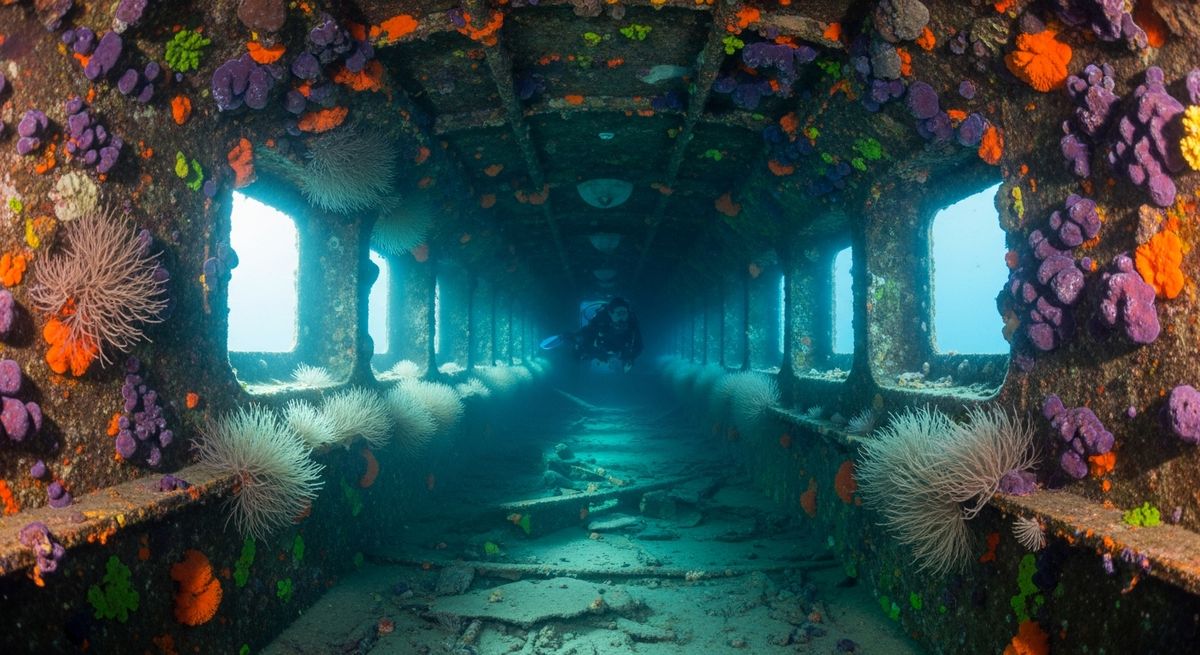
The Argus, or what we strongly suspect is the Argus, is a proper North Sea wreck. Not much remains of the original steamship, sunk by a mine in 1919, but that’s precisely what we love about it. It’s a low-profile scatter, essentially a debris field spread across the seabed at a consistent 16 metres. Think twisted metal plates, sections of hull, and machinery parts, all completely overgrown. What you get here is a massive, artificial reef system, a magnet for local fish. We've seen some impressive cod lurking in the deeper crevices, and the sheer volume of crabs and lobsters scuttling among the wreckage is always a treat. Visibility can be a typical North Sea lottery, but even in murkier conditions, the structure is easy to follow. Our favourite approach is to pick a section and just really slow down, poking around the nooks and crannies. It’s perfect for divers who appreciate the history, enjoy a good scavenger hunt, and want to observe how a century of being underwater transforms a vessel into a living habitat.
Typical ARGUS (PROBABLY) Dive Profile
Illustrative profile based on site depth and type. Actual dive profiles vary - always follow your dive computer and training.
Safety Notes
Wreck site - avoid penetration without wreck diving certification. Watch for sharp metal and entanglement hazards.
Cold water this month (avg 13°C). Drysuit or thick wetsuit (7mm+) recommended.
Always perform a 3-minute safety stop at 5m before surfacing.
ARGUS (PROBABLY) Wreck History
Year Sunk
1919
Vessel Type
cargo ship
Cause
mine
Tonnage
641 GRT
The SS Argus was a Swedish steamship built in 1883, a typical workhorse vessel of its time. For over 35 years, it plied the trade routes of the Baltic and North Seas, carrying cargo between European ports. In late 1919, just a year after the official end of World War I, the seas remained a perilous place, littered with the explosive remnants of the conflict.
On November 30, 1919, while on a passage from Lübeck, Germany, to Christiania (now Oslo), Norway, with a cargo of salt, the Argus met a tragic fate. She struck a stray mine left over from the war, and the resulting explosion sent her to the bottom of the Danish North Sea. The sinking was a stark reminder that even in peacetime, the legacy of war continued to claim victims.
Resting at a shallow depth of 16 meters, the Argus is an accessible wreck but is classified as dangerous, likely due to its state of decay and the tangled nature of the wreckage. Divers can explore the remains of this post-war casualty, with key features like the ship's boiler and engine still identifiable. It serves as a poignant memorial to the lingering dangers that sailors faced long after the armistice was signed.
Nearest Dive Centres to ARGUS (PROBABLY)
Dive shops near ARGUS (PROBABLY)
View all dive centres in North Sea CoastReviews for ARGUS (PROBABLY)
Conditions
Ocean conditions, forecast and tides for ARGUS (PROBABLY)
ARGUS (PROBABLY) Ocean Conditions
Monthly averages for ARGUS (PROBABLY), sourced from Open-Meteo marine data - nearest station: Open-Meteo marine grid (55.31, 9.86) (1km away)
October Averages
Sea Temperature
13°C
56°F · Range: 10.7–16.8°C
Air Temperature
11°C
52°F
Wind Speed
7.69 m/s
14.9 knots
Atmospheric Pressure
1010.5 hPa
Based on 4 years of monitoring data · Data sources: Open-Meteo marine data
Plan & book
Ways to dive North Sea Coast, from day trips to liveaboards.
Day trips & courses
via GetYourGuideGuided dives, courses and snorkel trips with instant booking.
Find dive trips in North Sea CoastPlaces to stay
via Booking.comHotels and dive resorts near North Sea Coast.
Search stays in North Sea CoastDive insurance
Most travel insurance excludes or limits scuba. Check what you need before you go.
Dive insurance explainedPartner links: we may earn a commission if you book, at no extra cost to you. How we make money
Where to Stay near ARGUS (PROBABLY)
Prices from Booking.com. We may earn a commission at no extra cost to you.