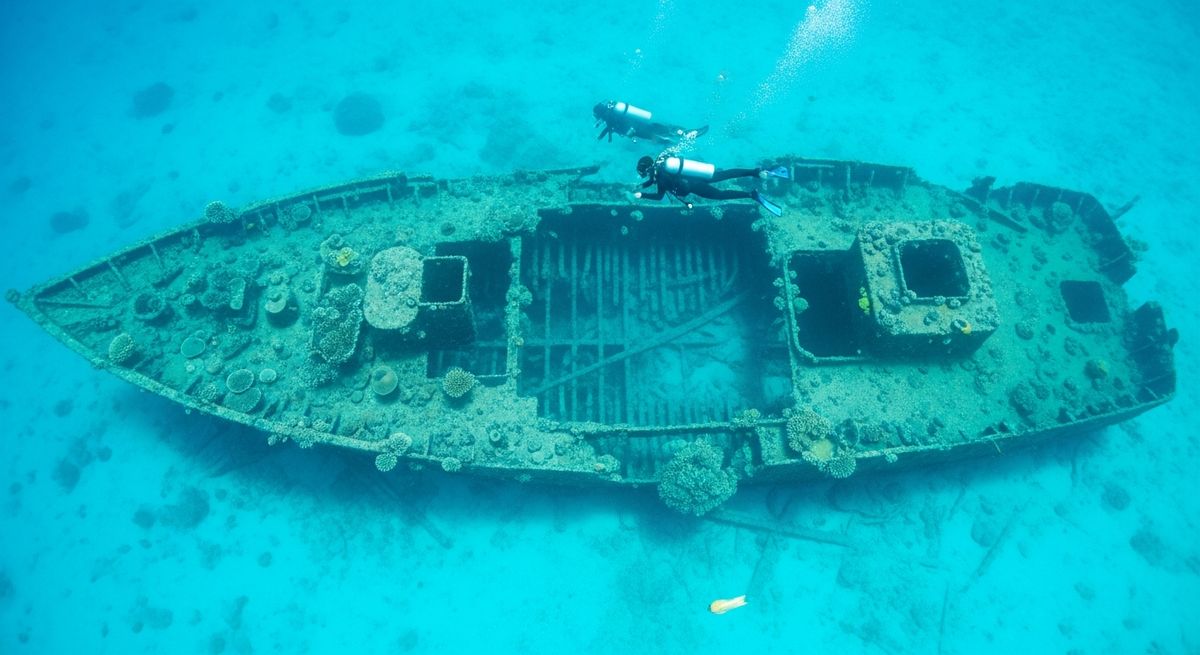
AUGUST LEONHARDT
Protected Area
Lysegrund
Why dive here
With 95+ marine species recorded in the area - including seals & sea lions, sea turtles and jellyfish lake - AUGUST LEONHARDT offers some of North Sea Coast's richest wreck diving. Water ranges 3-19°C, warmest July, August, September.
The *August Leonhardt* sits upright at 31 metres, a solid chunk of history on the North Sea floor. We love this wreck for its sheer size and how much of it remains intact. You drop down, and suddenly this 100-metre long steamship just appears, the visibility often surprisingly good despite the North Sea’s reputation. She went down in 1940, torpedoed by a British submarine, and you can still feel that story as you glide along her decks. We always make a point of heading for the bow first, then working our way aft, past the massive triple-expansion engines. There’s a beautiful density to the life here, too. Expect to see plump cod hanging out in the holds, conger eels peeking from crevices, and the whole structure draped in anemones, their tentacles waving in the mild current. It’s a proper expedition, a long dive, so definitely bring a pony bottle and plan for decompression. This isn’t a quick dip; it’s a dive where you can truly get lost in the past.
Typical AUGUST LEONHARDT Dive Profile
Illustrative profile based on site depth and type. Actual dive profiles vary - always follow your dive computer and training.
Safety Notes
Deep dive (31m) - monitor air consumption closely. Advanced certification recommended.
Wreck site - avoid penetration without wreck diving certification. Watch for sharp metal and entanglement hazards.
Cold water this month (avg 13°C). Drysuit or thick wetsuit (7mm+) recommended.
Always perform a 3-minute safety stop at 5m before surfacing.
AUGUST LEONHARDT Wreck History
Year Sunk
1940
Vessel Type
cargo ship
Cause
torpedo
The August Leonhardt was a relatively new steamship, built just four years prior to its loss in 1936 by Stettiner Oderwerke for the shipping company Leonhardt & Blumberg. Powered by triple-expansion engines, it was a typical example of the cargo vessels plying the North Sea routes in the turbulent years leading up to and during the Second World War.
Its career was cut short on April 11, 1940, during the early stages of the war. While navigating the waters off the Danish coast, the August Leonhardt was spotted by the British submarine HMS Sealion. A torpedo strike sealed the freighter's fate, sending it to the seabed and making it one of the many maritime casualties of the conflict in the North Sea.
Today, the wreck rests at a depth of 31 meters, making it an exciting dive for advanced and technical divers. The structure is largely intact, allowing explorers to identify key features of a pre-war steamship. Divers can marvel at the large engine block, explore the cargo holds, and witness the torpedo damage that sent this historic vessel on its final journey to the bottom.
Reviews for AUGUST LEONHARDT
Conditions
Ocean conditions, forecast and tides for AUGUST LEONHARDT
AUGUST LEONHARDT Ocean Conditions
Monthly averages for AUGUST LEONHARDT, sourced from Open-Meteo marine data - nearest station: Open-Meteo marine grid (55.31, 9.86) (1km away)
October Averages
Sea Temperature
13°C
56°F · Range: 10.7–16.8°C
Air Temperature
11°C
52°F
Wind Speed
7.69 m/s
14.9 knots
Atmospheric Pressure
1010.5 hPa
Based on 4 years of monitoring data · Data sources: Open-Meteo marine data
Plan & book
Ways to dive North Sea Coast, from day trips to liveaboards.
Day trips & courses
via GetYourGuideGuided dives, courses and snorkel trips with instant booking.
Find dive trips in North Sea CoastPlaces to stay
via Booking.comHotels and dive resorts near North Sea Coast.
Search stays in North Sea CoastDive insurance
Most travel insurance excludes or limits scuba. Check what you need before you go.
Dive insurance explainedPartner links: we may earn a commission if you book, at no extra cost to you. How we make money
Where to Stay near AUGUST LEONHARDT
Prices from Booking.com. We may earn a commission at no extra cost to you.