BORINGIA
Protected Area
Lysegrund
Why dive here
With 95+ marine species recorded in the area - including seals & sea lions, sea turtles and jellyfish lake - BORINGIA offers some of North Sea Coast's richest wreck diving. Water ranges 3-19°C, warmest July, August, September.
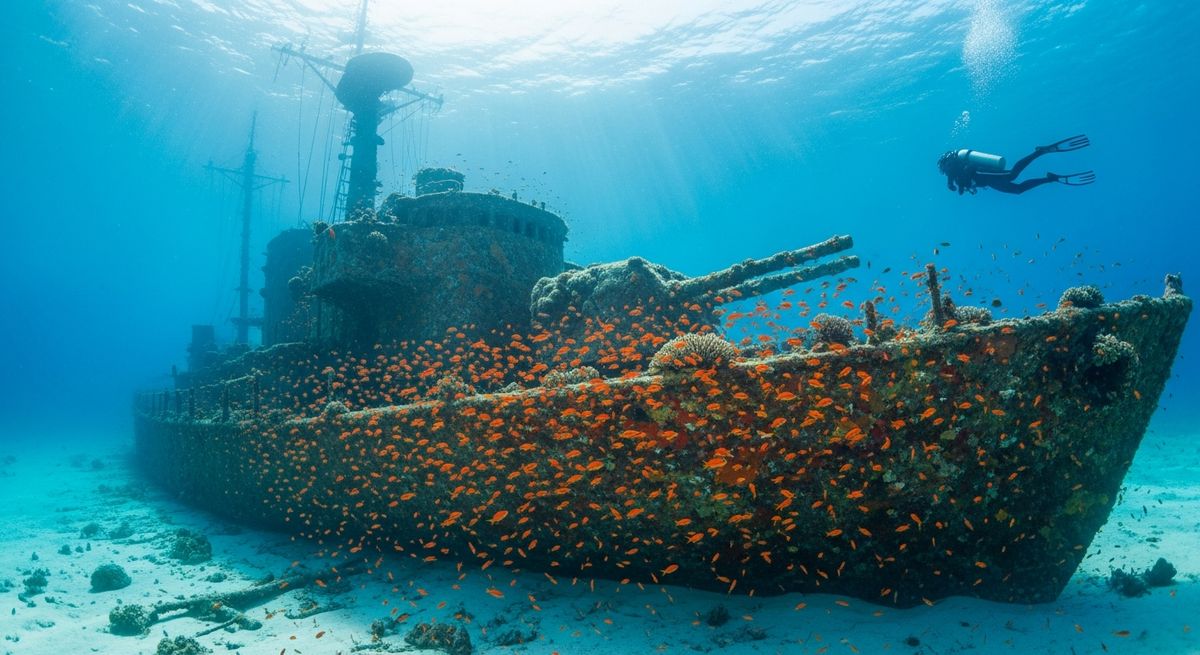
The Boringia, a cement carrier that went down in 1975, isn't your typical pretty wreck dive. We're talking North Sea, so manage your expectations about tropical colours. But what it lacks in visual flair, it makes up for in atmosphere and sheer size. Lying upright at 28 metres, she’s largely intact and you can really get a sense of her working life. We love dropping down onto the main deck, often enveloped in a greenish glow that filters through the water. The visibility can be fickle out here, but when it’s good, the structure feels enormous. Our favourite part is navigating the cargo holds, where schools of cod and pollock often hover like shadowy sentinels. The cement cargo is long gone, but the ship's bones are a fantastic habitat for crabs and lobsters. Look closely amongst the twisted metal – we’ve often spotted some surprisingly large flatfish tucked into crevices. This is a dive for those who appreciate history and a bit of a challenge, definitely not for the faint of heart or those new to wrecks. Go on a slack tide, if you can, to really savour the exploration.
Typical BORINGIA Dive Profile
Illustrative profile based on site depth and type. Actual dive profiles vary - always follow your dive computer and training.
Safety Notes
Depth of 28m - Advanced Open Water certification recommended.
Wreck site - avoid penetration without wreck diving certification. Watch for sharp metal and entanglement hazards.
Cold water this month (avg 13°C). Drysuit or thick wetsuit (7mm+) recommended.
Always perform a 3-minute safety stop at 5m before surfacing.
BORINGIA Wreck History
Year Sunk
1975
Vessel Type
cargo ship
Cause
unknown
Unlike many of her neighbours on the seabed, the Boringia is a modern casualty of the sea, not a victim of war. This motor vessel was on a routine passage from Aalborg to Nekso on August 13, 1975, her holds filled with a cargo of cement. During the early morning hours, the crew discovered the ship was taking on water due to a serious leak. Unable to stem the flow, the order was given to abandon ship, and the crew were all rescued safely before the Boringia slipped beneath the waves.
Today, the Boringia rests at a depth of 28 metres off the Danish coast. Her cargo of cement has long since hardened, creating unique, almost sculptural formations throughout her holds and superstructures. This gives the wreck a ghostly and fascinating character unlike older, more conventional wrecks. The site is classified as a 'Dangerous Wreck,' so divers should be mindful of the potential for entanglement and shifting structures while exploring this intriguing piece of recent maritime history.
Reviews for BORINGIA
Conditions
Ocean conditions, forecast and tides for BORINGIA
BORINGIA Ocean Conditions
Monthly averages for BORINGIA, sourced from Open-Meteo marine data - nearest station: Open-Meteo marine grid (55.31, 9.86) (1km away)
October Averages
Sea Temperature
13°C
56°F · Range: 10.7–16.8°C
Air Temperature
11°C
52°F
Wind Speed
7.69 m/s
14.9 knots
Atmospheric Pressure
1010.5 hPa
Based on 4 years of monitoring data · Data sources: Open-Meteo marine data
Plan & book
Ways to dive North Sea Coast, from day trips to liveaboards.
Day trips & courses
via GetYourGuideGuided dives, courses and snorkel trips with instant booking.
Find dive trips in North Sea CoastPlaces to stay
via Booking.comHotels and dive resorts near North Sea Coast.
Search stays in North Sea CoastDive insurance
Most travel insurance excludes or limits scuba. Check what you need before you go.
Dive insurance explainedPartner links: we may earn a commission if you book, at no extra cost to you. How we make money
Where to Stay near BORINGIA
Prices from Booking.com. We may earn a commission at no extra cost to you.