AGHIA ANASTASIA
Protected Area
Buccoo Reef / Bon Accord Lagoon Complex
Why dive here
With 343+ marine species recorded in the area - including barracuda, dolphins, humpback whales, sea turtles and frogfish - AGHIA ANASTASIA offers some of Tobago's richest wreck diving. Water ranges 28-30°C, warmest August, September, October.
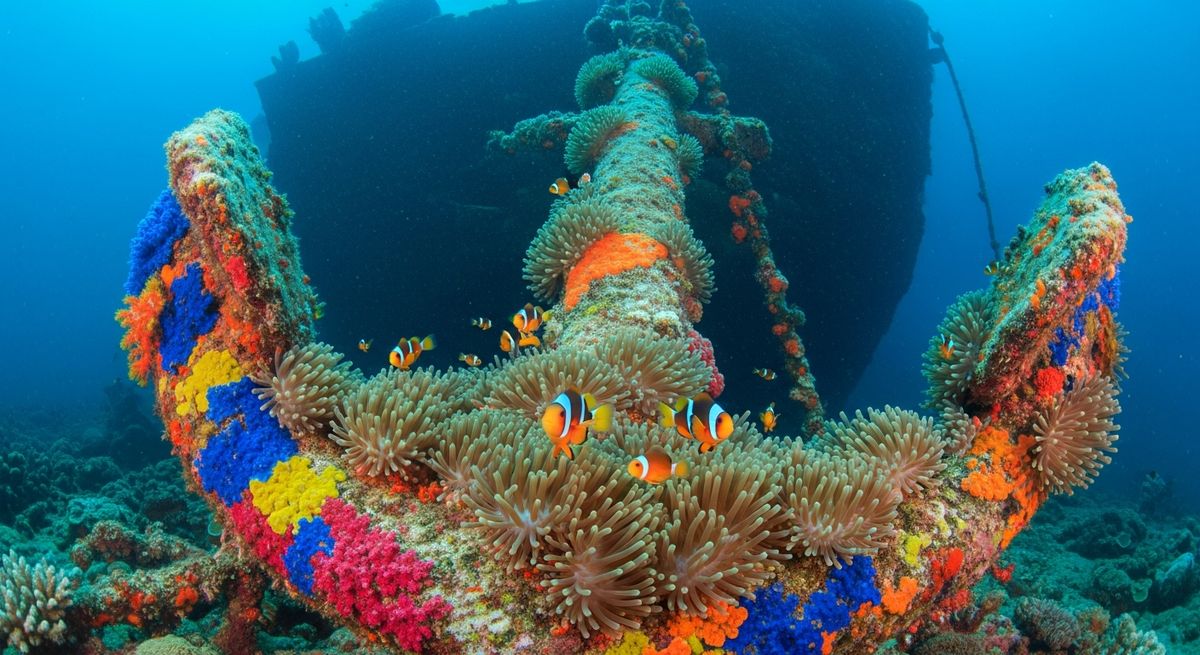
The Aghia Anastasia isn't just a wreck; it's a colossal piece of history brought to life by the Caribbean Sea. We dive it again and again because of its sheer scale, a 134-meter steamship, now utterly covered in growth. Dropping down, the bow looms first, then you follow the deck structure, seeing where the ocean has peeled back sections, revealing ribs and cargo holds. Schools of grunts and snapper hang in the shadows of the deeper sections, particularly towards the stern, where the light struggles to reach. Our favourite part has to be the engine room access, if conditions allow penetration. The sunlight filters through the gaps above, creating these ethereal shafts of light that illuminate the machinery below, now fused with coral. You’ll spot plenty of barracuda too, often just hovering motionless, watching you with that blank stare. Current can be a factor here, so we’d suggest timing your dive for slack tide to properly explore the deeper sections without fighting a surge. It’s a dive for those who appreciate wrecks with a strong sense of place, a solid challenge, and plenty of opportunities to just drift and absorb the sheer magnitude of it all.
Typical AGHIA ANASTASIA Dive Profile
Illustrative profile based on site depth and type. Actual dive profiles vary - always follow your dive computer and training.
Safety Notes
Deep dive (36m) - monitor air consumption closely. Advanced certification recommended.
Wreck site - avoid penetration without wreck diving certification. Watch for sharp metal and entanglement hazards.
Always perform a 3-minute safety stop at 5m before surfacing.
AGHIA ANASTASIA Wreck History
Year Sunk
1950
Vessel Type
cargo ship
Cause
grounding
The Aghia Anastasia, a steamship built during the height of World War II in 1943, survived the conflict only to be lost to the sea in a dramatic two-act tragedy. In June 1950, the 134-meter vessel ran hard aground off the coast of Tobago. A salvage operation was mounted, and crews successfully managed to refloat the massive ship. However, the victory was short-lived; the damage sustained was too great, and the Aghia Anastasia succumbed to its injuries, sinking shortly after being pulled free.
Today, she rests at 36 meters, offering an impressive and atmospheric dive. Her sheer size is the first thing that strikes you as you descend through the blue Tobagonian water. The wreck is largely intact, with her wartime-era superstructure, cargo holds, and deck machinery providing a complex and fascinating environment to explore. The ship has become a well-established artificial reef, attracting large schools of fish, barracuda, and the occasional turtle, making a dive on the Aghia Anastasia a journey through both maritime history and a vibrant underwater ecosystem.
Nearest Dive Centres to AGHIA ANASTASIA
Dive shops near AGHIA ANASTASIA
View all dive centres in TobagoReviews for AGHIA ANASTASIA
Conditions
Ocean conditions, forecast and tides for AGHIA ANASTASIA
AGHIA ANASTASIA Ocean Conditions
Monthly averages for AGHIA ANASTASIA, sourced from Open-Meteo marine data - nearest station: Open-Meteo marine grid (10.64, -61.51) (19km away)
October Averages
Sea Temperature
30°C
86°F · Range: 29.2–31.2°C
Air Temperature
26°C
79°F
Wind Speed
4.75 m/s
9.2 knots
Atmospheric Pressure
1011.7 hPa
Based on 4 years of monitoring data · Data sources: Open-Meteo marine data
Plan & book
Ways to dive Tobago, from day trips to liveaboards.
Day trips & courses
via GetYourGuideGuided dives, courses and snorkel trips with instant booking.
Find dive trips in TobagoPlaces to stay
via Booking.comHotels and dive resorts near Tobago.
Search stays in TobagoDive insurance
Most travel insurance excludes or limits scuba. Check what you need before you go.
Dive insurance explainedPartner links: we may earn a commission if you book, at no extra cost to you. How we make money
Where to Stay near AGHIA ANASTASIA
Prices from Booking.com. We may earn a commission at no extra cost to you.