ATHELBRAE
Why dive here
With 343+ marine species recorded in the area - including barracuda, dolphins, humpback whales, sea turtles and frogfish - ATHELBRAE offers some of Tobago's richest wreck diving. Water ranges 28-30°C, warmest August, September, October.
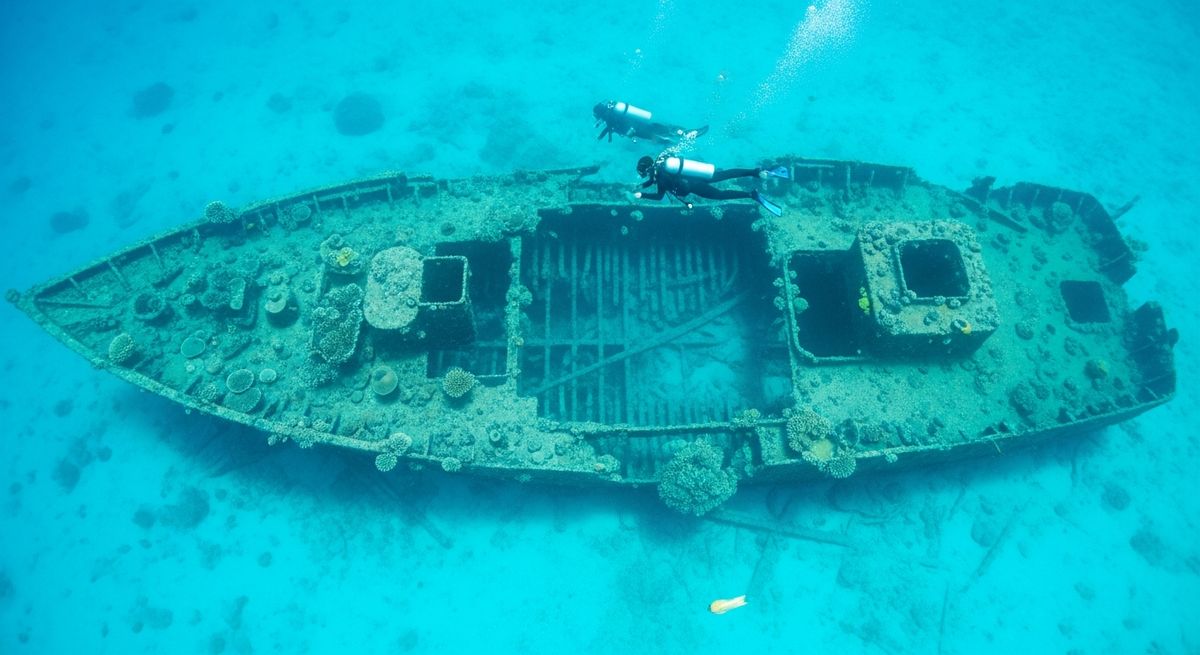
The *Athelbrae* is a wreck dive, but it's really more of a historical marker than a full penetration experience. Sitting in just six metres, it’s a perfect chill-out dive, especially if you’ve had a few days of battling currents elsewhere. What we love about it is how accessible the history feels; you can just fin around and imagine the stories. The tanker went down after hitting a mine in 1942, and while much of the hull is broken up, the sheer scale of the plates scattered across the seabed is impressive. You'll spend your time exploring the flattened ribs and plating, now completely encrusted with sponges and hard corals. We've often seen schools of snapper circling the larger metal sections, and our favourite find here is always the garden eels that pop up from the sand nearby. It's an ideal spot for macro photographers, too, with nudibranchs and small crabs hiding in the crevices. We’d suggest going in the morning; the light filtering through the shallow water really brings out the colours on the corals. Perfect for a relaxed last dive of the trip.
Typical ATHELBRAE Dive Profile
Illustrative profile based on site depth and type. Actual dive profiles vary - always follow your dive computer and training.
Safety Notes
Wreck site - avoid penetration without wreck diving certification. Watch for sharp metal and entanglement hazards.
ATHELBRAE Wreck History
Year Sunk
1942
Vessel Type
tanker
Cause
torpedo
Tonnage
5,420 GRT
The ATHELBRAE was a British tanker caught in the crosshairs of World War II's Battle of the Atlantic, which spilled over into the Caribbean. Tankers were a prime target for Axis forces, and the waters around Trinidad, a key Allied port, were notoriously dangerous. On October 4, 1942, while on a passage from Trinidad to Demerara, the ATHELBRAE's fate was sealed when it struck a German mine.
The explosion inflicted critical damage, but the crew didn't give up. They valiantly fought to save their ship, managing to ground it near Icacos Point in a desperate attempt to prevent it from sinking. Their efforts were in vain; the tanker was too heavily damaged and slipped beneath the waves the following day, becoming another casualty of the war at sea.
Resting in just 6 meters of water, the ATHELBRAE is now a fascinating shallow wreck dive and snorkel site. Its proximity to the surface means it has been broken up by wave action over the decades, but its scattered remains offer a playground for exploration. Divers can identify large sections of the hull, boilers, and other machinery, all of which are now colonized by vibrant coral and teeming with reef fish. It's a tangible piece of WWII history set in a beautiful, sunlit underwater landscape.
Reviews for ATHELBRAE
Conditions
Ocean conditions, forecast and tides for ATHELBRAE
ATHELBRAE Ocean Conditions
Monthly averages for ATHELBRAE, sourced from Open-Meteo marine data - nearest station: Open-Meteo marine grid (10.64, -61.51) (19km away)
October Averages
Sea Temperature
30°C
86°F · Range: 29.2–31.2°C
Air Temperature
26°C
79°F
Wind Speed
4.75 m/s
9.2 knots
Atmospheric Pressure
1011.7 hPa
Based on 4 years of monitoring data · Data sources: Open-Meteo marine data
Plan & book
Ways to dive Tobago, from day trips to liveaboards.
Day trips & courses
via GetYourGuideGuided dives, courses and snorkel trips with instant booking.
Find dive trips in TobagoPlaces to stay
via Booking.comHotels and dive resorts near Tobago.
Search stays in TobagoDive insurance
Most travel insurance excludes or limits scuba. Check what you need before you go.
Dive insurance explainedPartner links: we may earn a commission if you book, at no extra cost to you. How we make money
Where to Stay near ATHELBRAE
Prices from Booking.com. We may earn a commission at no extra cost to you.