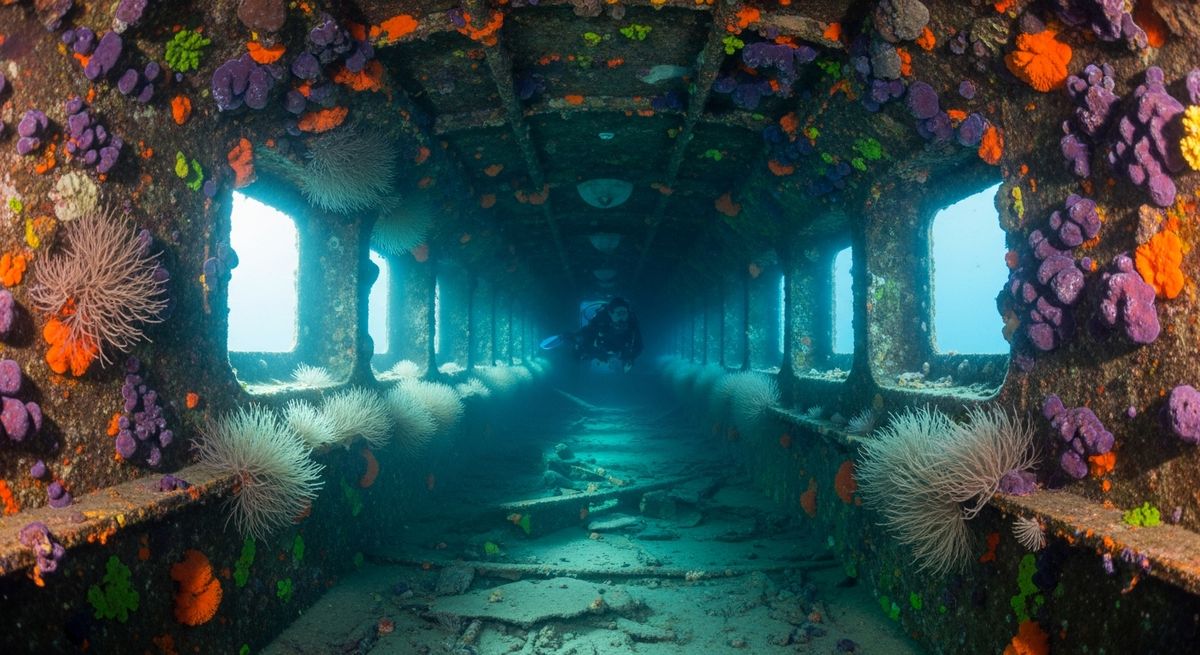
ALBACORE
Protected Area
Robben island Marine Protected Area
Why dive here
With 269+ marine species recorded in the area - including blue sharks, blue whales, dolphins, dwarf minke whales and great white sharks - ALBACORE offers some of Cape Town & Western Cape's richest wreck diving. Water ranges 14-16°C, warmest February, March, April.
Albacore is one of those wrecks we keep coming back to. She’s not massive, just 26.5m, a fishing trawler scuttled in 1975 off Green Point after springing a leak at the coal jetty. We love that backstory. The real draw here is the depth, sitting at 60m, making it a serious technical dive. Dropping down, you feel the chill of the Atlantic bite, even on a sunny day. The visibility can be temperamental, but when it’s good, the wreck appears out of the gloom, draped in anemones and sponges. What you'll find is a wreck that’s been thoroughly salvaged, with her 360hp engine long gone, but that only adds to her character. We find the stripped-down hull fascinating; you can really appreciate her skeleton. Look closely, and you’ll spot shy reef fish darting in and out of the plating and the occasional shy dogfish tucked away. It's a beautiful, challenging dive for experienced tech divers who appreciate a wreck with a story, and aren't afraid of the deep.
Typical ALBACORE Dive Profile
Illustrative profile based on site depth and type. Actual dive profiles vary - always follow your dive computer and training.
Safety Notes
Maximum depth 60m exceeds recreational limits (40m). Technical diving certification and equipment required.
Wreck site - avoid penetration without wreck diving certification. Watch for sharp metal and entanglement hazards.
Cold water this month (avg 15°C). Drysuit or thick wetsuit (7mm+) recommended.
Always perform a 3-minute safety stop at 5m before surfacing.
ALBACORE Wreck History
Year Sunk
1975
Vessel Type
fishing vessel
Cause
scuttled
The Albacore was a local Cape Town fishing vessel whose working days had come to an end. After sitting idle for three years, her aging wooden hull finally gave way in June 1975, springing a leak while she was moored alongside the coal jetty. With the vessel beyond saving, a decision was made to give her a burial at sea. Her 360hp engine was salvaged, and the old fishing boat was towed out from shore and deliberately scuttled off Green Point.
Lying at a depth of 60 meters, the Albacore is now a premier technical dive site for experienced trimix divers. The deep, cold, and often current-swept waters of the Atlantic make this a challenging dive that requires meticulous planning. For those qualified to make the descent, the reward is the sight of a largely intact fishing vessel, sitting upright on the seabed. She serves as a deep artificial reef, attracting marine life and offering a silent tribute to Cape Town's long-standing fishing heritage.
Nearest Dive Centres to ALBACORE
Dive shops near ALBACORE
Into the Blue Scuba
Two Oceans Aquarium
Coral Wetsuits
Dive Action
Best Kiteboarding Africa
UCT Underwater Club
Reviews for ALBACORE
Conditions
Ocean conditions, forecast and tides for ALBACORE
ALBACORE Ocean Conditions
Monthly averages for ALBACORE, sourced from Open-Meteo marine data - nearest station: Open-Meteo marine grid (-33.92, 18.46) (8km away)
October Averages
Sea Temperature
15°C
59°F · Range: 12.4–17.2°C
Air Temperature
17°C
62°F
Wind Speed
7.33 m/s
14.2 knots
Atmospheric Pressure
1018.1 hPa
Based on 4 years of monitoring data · Data sources: Open-Meteo marine data
Plan & book
Ways to dive Cape Town & Western Cape, from day trips to liveaboards.
Day trips & courses
via GetYourGuideGuided dives, courses and snorkel trips with instant booking.
Find dive trips in Cape Town & Western CapePlaces to stay
via Booking.comHotels and dive resorts near Cape Town & Western Cape.
Search stays in Cape Town & Western CapeDive insurance
Most travel insurance excludes or limits scuba. Check what you need before you go.
Dive insurance explainedPartner links: we may earn a commission if you book, at no extra cost to you. How we make money
Where to Stay near ALBACORE
Prices from Booking.com. We may earn a commission at no extra cost to you.