Diving in Cape Town & Western Cape
Why dive here
Cape Town & Western Cape offers some of South Africa's richest diving, with 269+ marine species recorded in the area - including blue sharks, blue whales, dolphins, dwarf minke whales and great white sharks. Water sits around 19°C.
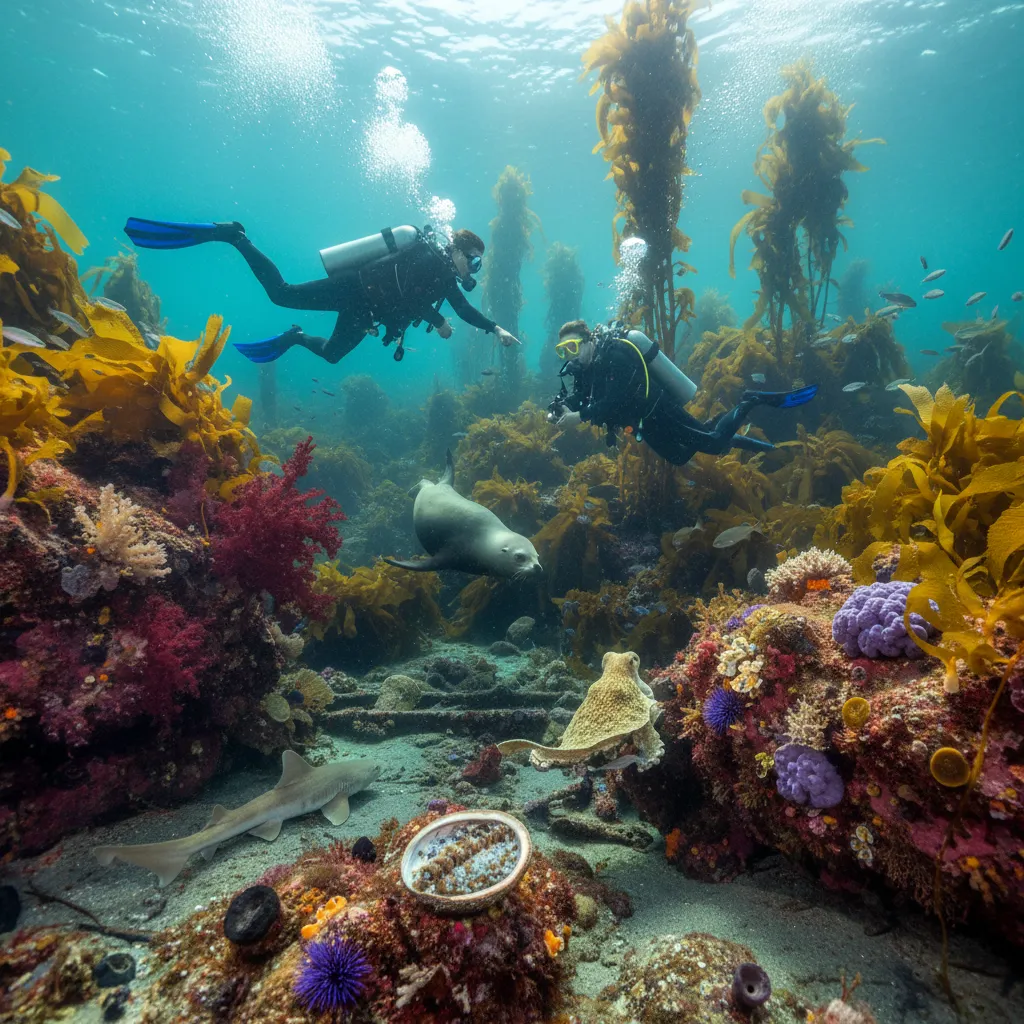
The diving around Cape Town is a different beast entirely. We’re talking proper cold water, usually around 10-14°C, so bring your drysuit or a thick wetsuit. But embrace the chill, because what you get in return is phenomenal: towering kelp forests, playful Cape fur seals, and some serious pelagic action. This isn’t your typical tropical reef experience, it’s raw, wild, and utterly captivating. We love the energy of a kelp forest dive, the way the light filters through the canopy, illuminating schools of hottentot and strepies. Our favourite has to be Partridge Point, especially if you can get in with the seals - they’re endlessly curious, nipping at fins and swirling around you like underwater puppies. Visibility can be a bit variable, often 5-15 metres, but when it’s good, it's magical. Keep an eye out for the shy pyjama sharks tucked away in crevices, or the occasional broadnose sevengill shark cruising by. For the wreck enthusiasts, there are plenty of options, from the relatively shallow SAS Pietermaritzburg to deeper, more challenging sites. The ocean here feels alive, full of powerful currents and dramatic topography, from pinnacles to walls that drop into the inky deep. It’s definitely a spot for the adventurous, and we think it rewards that bravery tenfold.
Cape Town & Western Cape Dive Site Map
Dive sites and dive centres in Cape Town & Western Cape
Cape Town & Western Cape Dive Sites
270 dive sites in Cape Town & Western Cape
13th Apostle
The 13th Apostle offers a good poke around an interesting reef structure just off the coast. It’s pretty shallow, topping out around 10 meters, so it’s a site where you can take your time. We like drifting along the broken ridge, looking into the smaller crevices and sand patches. On a good day, when visibility stretches past 15 meters, the light filters down beautifully, highlighting the gorgonian fans and the shy reef fish that dart between them. It's a relaxed dive, great for knocking out a long bottom time, particularly if you’re into exploring nooks and crannies without deep-dive pressures.
ADELFOTIS
The Adelfotis, just shy of 90 metres long, is one of those wrecks we keep coming back to. She’s a steamship, sunk in 1956, and despite the "dangerous wreck" classification, she’s a genuinely approachable dive at 15 metres. We love that you can spend a whole dive just exploring her bones, the triple-expansion engines still impressive even after all these years. The main deck is pretty broken up now, but the bow and stern sections are still distinct. You’ll find plenty of hottentot and strepies darting through the rusted metal, and the occasional shy puffadder shy shark tucked into a crevice. Our favourite detail is the way the light filters through the gaps in the hull, illuminating the clouds of tiny silversides that often hang suspended inside. It's a proper swim-through playground, perfect for divers who appreciate the history and the way the ocean reclaims these structures. Visibility can be a bit variable here, so we always aim for a calm, post-southerly wind day for the best experience.
A Frame
A Frame, on Cape Town's False Bay side, is a pretty straightforward shore dive. You'll find a rocky reef system, home to a scattering of colourful nudibranchs, shy octopus, and plenty of smaller reef fish like hottentot and strepies. It’s a good spot for a relaxed second dive or for divers new to shore entries, offering decent visibility on calm days. We often use it when other sites are blown out.
A-frame Cape Town
A-frame is one of our local favourites for a shallow, punchy dive when the conditions play ball. We like to drop in at the rocks on the left, then head out towards those two distinctive pinnacles. The smaller rock on the left is where we spend most of our time, ducking through its three swim-through entry points. It’s tight in places, a real squeeze, but then you pop out into a different world of light and shadows. The larger rock nearby also has plenty to explore along its walls. This isn’t a deep dive, maxing out at 8m, but don’t let that fool you into thinking it’s easy. You’ll want some experience under your belt for A-frame, especially with the surge that can whip through here. Visibility averages around 6m, which means you’re often diving in an intimate, slightly murky embrace, but that’s part of the charm. We’ve spotted shy sharks tucked into crevices, pyjama sharks gliding past, and inquisitive seals often pop by to say hello. Keep an eye out for octopus and nudibranchs clinging to the rocks. If you’re lucky, you might even spot a local clawless otter fishing around the rocks – we certainly have, and it’s a treat. It’s a dive for those who appreciate the smaller details and don't mind a bit of a workout.
A-frame Cape Town
A-frame is one of our local favourites for a shallow, punchy dive when the conditions play ball. We like to drop in at the rocks on the left, then head out towards those two distinctive pinnacles. The smaller rock on the left is where we spend most of our time, ducking through its three swim-through entry points. It’s tight in places, a real squeeze, but then you pop out into a different world of light and shadows. The larger rock nearby also has plenty to explore along its walls. This isn’t a deep dive, maxing out at 8m, but don’t let that fool you into thinking it’s easy. You’ll want some experience under your belt for A-frame, especially with the surge that can whip through here. Visibility averages around 6m, which means you’re often diving in an intimate, slightly murky embrace, but that’s part of the charm. We’ve spotted shy sharks tucked into crevices, pyjama sharks gliding past, and inquisitive seals often pop by to say hello. Keep an eye out for octopus and nudibranchs clinging to the rocks. If you’re lucky, you might even spot a local clawless otter fishing around the rocks – we certainly have, and it’s a treat. It’s a dive for those who appreciate the smaller details and don't mind a bit of a workout.
ALBACORE
Albacore is one of those wrecks we keep coming back to. She’s not massive, just 26.5m, a fishing trawler scuttled in 1975 off Green Point after springing a leak at the coal jetty. We love that backstory. The real draw here is the depth, sitting at 60m, making it a serious technical dive. Dropping down, you feel the chill of the Atlantic bite, even on a sunny day. The visibility can be temperamental, but when it’s good, the wreck appears out of the gloom, draped in anemones and sponges. What you'll find is a wreck that’s been thoroughly salvaged, with her 360hp engine long gone, but that only adds to her character. We find the stripped-down hull fascinating; you can really appreciate her skeleton. Look closely, and you’ll spot shy reef fish darting in and out of the plating and the occasional shy dogfish tucked away. It's a beautiful, challenging dive for experienced tech divers who appreciate a wreck with a story, and aren't afraid of the deep.
Albatross Rock
Albatross Rock is a solid dive when you're in the Cape Town area, offering a look at a fairly rugged sandstone reef. The top of the reef is mostly flat, but as you drop deeper, you’ll find gulleys and undercuts, bottoming out to sand around 12 metres. These gulleys generally run north to south, creating interesting swim-throughs and places for fish to shelter. We've seen plenty of local reef fish here, along with the occasional catshark tucked into the crevices. It’s a good spot for divers looking for a relaxed exploration rather than a high-octane drift.
ALCESTIS
The Alcestis isn't your average Cape Town wreck, and that's exactly why we love it. Forget the kelp forests and the chilly Atlantic; this steamship sits on the Agulhas Bank, offering a completely different vibe, warmer water, and an Indian Ocean feel. You’re looking at a deeper dive, hitting 31 metres, so it’s one for the experienced wreck enthusiasts. Dropping down, the first thing you notice is the sheer scale. She’s broken, yes, but recognisable as a substantial vessel. We always spend time exploring the boilers, enormous and almost completely encrusted now. Visibility here can be a bit variable; we’ve had days where it’s a stunning 20 metres, and others where it’s more like 8, so pick your day carefully. What makes this site special is the life: big shoals of red roman and hottentot dart through the structure, and we’ve spotted ragged-tooth sharks cruising by on a few occasions. The Alcestis is a proper expedition, a long boat ride out, but if you’re keen on a proper deep wreck dive with a hint of the wild Agulhas currents, this one’s a firm favourite.
Alpha Reef
Alpha Reef, off Cape Town’s coast, is one of those spots that really highlights the unique geology here. We're talking granite corestones forming two distinct sections, broken up by a sandy gully running east to west. The southern lobe is the more substantial part, sloping up from the south before flattening and then dropping into another gully. It’s a wall dive, but not in the typical tropical sense; think dramatic rock formations with corals clinging to the surfaces. We've seen a fair amount of smaller reef fish darting around here. Depths max out around 3 meters, making it a good choice for newer divers or for a longer, relaxed explore without deep deco stops. Visibility can vary, so we'd suggest picking a calmer day for the best experience.
AMERICA
The *America* wreck, sitting in just 12 meters of water, is one of our favourite easy dives in False Bay. We love it because it’s so accessible and offers a fantastic glimpse into Cape Town’s maritime history without needing advanced skills. Descending onto the wreck, you’ll find the remnants of a wooden sailing ship, slowly being reclaimed by the ocean. We’d suggest heading down on a calm day; the shallow depth means surge can be a factor, but a still morning makes for an incredibly peaceful dive. You can swim through parts of the hull, watch light filter through the timbers, and see how sea fans and anemones have taken hold. Look closely and you’ll often spot shy shy sharks tucked amongst the debris, along with playful schools of hottentot swimming overhead. It's a superb wreck dive for anyone keen on exploration without the pressure of deep water or strong currents, a real window into the past.
Ammunition Barges
Alright, let's talk about the Ammunition Barges. If you’re in False Bay and looking for a dive that’s a bit different, a bit eerie, this is one of our favourites. It’s not deep, just 9 metres, which makes for a lovely long bottom time, but don't let that fool you into thinking it's simple. You’ve got two steel barges, mostly broken up now, lying side-by-side on a flat sandy bottom. What we love here is the sheer density of life that has moved in. These wrecks, even in their fragmented state, are magnets. Expect to duck your head through schools of hottentot and strepies that swirl around the remains of the hulls. We've often found shy sharks tucked into crevices, their eyes watching you pass. The light here can be incredible, especially on a sunny day, filtering down through the kelp (if it's in season) and illuminating the metalwork. The atmosphere is definitely one of gentle decay; you can still make out the ribs of the barges, sections of plating, but they’re completely encrusted with sponges and soft corals. It's an easy dive for anyone comfortable in open water, and a fantastic site for photographers keen on marine macro life or moody wreck shots. Just keep an eye on the surge; it can get a bit bouncy if the south-easterly is up.
Andre se Gat
Andre se Gat is a regular for us when we're around Cape Town, especially if we're after something a bit different from the usual kelp forests. It's a rocky reef, mostly sandstone, with a good collection of gullies and ridges to poke around in. The draw here, though, are the small caves. They're not massive caverns, but more like swim-throughs and overhangs, perfect for a bit of exploration without needing advanced cave certs. You'll often find shy reef fish tucked into the crevices, and the light filtering through the openings can be quite pretty. Visibility can be a bit variable, as it often is in this region, so we'd suggest picking a calm day after a few days of settled weather for the best experience. It's a fun dive for those comfortable with navigating a bit of tight space.
Show all 270 dive sites in Cape Town & Western Cape
- AN HUNG NO.1
- Ankers
- Anvil Rock
- Ark Rock
- Ark Rock
- ATHENS
- Atlantis Reef Pinnacles
- Atlantis Reef Pinnacles
- Bakoven Rock
- Bantry Bay
- Barrack Rock
- Barrack Rock
- BARUTO COAST
- Batsata Rock
- BELLE-THERESA
- Bikini Beach
- Bill Liltved's Reef
- Billy's Reef
- Blouklip
- Blousteen Ridge
- Blow Hole
- Blow Hole
- Blue Flame Pinnacles
- Blue Rock Quarry
- BLUFF
- Boardroom pinnacle
- Boat Rock
- Bordjiesrif
- Boulders Beach
- Boulders Beach
- Boulder s Rock
- BOY FRANCIS
- BRITANNIA
- Bruce's Mark
- Buffels Bay
- CAPE MATAPAN
- Caster Rock
- Castle Rock Cape Town
- Castle Rocks
- Choirboys Reef
- CILICIA
- CITY OF LINCOLN
- CLAN MCGREGOR
- CLAN MONROE
- CLAN STUART
- Clan Stuart Wreck
- Cleeve's Tunnel
- Clifton Rocks
- CONQUEST
- Container Bay
- Coral Gardens (Oudekraal)
- Cow and Calf
- CYNTHIA
- DAEYANG FAMILY
- Dale Brook
- Deep Southeast Whittle Ridge
- Deep South Whittle Reef
- D-Frame
- Dial Rock
- Die Josie
- Die Perd
- DISA
- Di's Cracks
- Dome Rock
- Dreadlocks Reef
- Drop Zone
- Duiker Island
- DURNESS
- Dyer Island
- East Shoal
- False Bay Kelp Forest
- Fan Reef
- FELICIA
- FENG CHUNG NO.11
- Finlay's Deep
- Finlay's Point
- Fish Hoek Reef
- FONG SHONG (?FENG SHENG) NO 22
- Froggy Pond
- FYND SWONA
- GB Reef
- GENERAL BOTHA
- Giant's Castle
- GLADIATOR
- Glencairn Fan Garden
- GOEL NO.1
- Graeme's Spot and The Jambles
- GWENOLA
- HADDON HALL
- HALERIC
- HARVEST CAPELLA
- HARVEST NEPTUNE
- H.C. RICHARDS
- HERLILLE
- Highfields
- HMS Birkenhead
- HMS SYBILLE
- Humpback Ridge
- HYPATIA
- Insanity Reef
- Jackobs Klip (Rock)
- Josh's Reef
- Justin’s Caves, Cape Town, South Africa
- Jutten island
- KAKAPO
- Kalk Bay Harbour Wall
- KATSUEI MARU NO 58
- KATSU MARU NO 25
- KER YAR VOR
- Klein Pannekoek
- Klein Tafelberg
- Kruis
- langebaan divers wall
- Langebaan Main Beach - Cuttle Fish Alley
- Langebaan Training Area
- Ledges
- Livingstone Reef
- Llandudno Reef
- L. M. GEMSBOK
- Logies Bay
- Lonehill Reef
- Long Beach Simons Town
- Lorry Bay
- LOUISE MARLENE
- LUSITANIA
- Lynch Blinder
- Maidstone Rock
- MALMESBURY
- MARITZ
- MEISHO MARU NO.38
- MERESTEIJN
- MIDDELBURG
- Midway Ridge
- Mike's Point
- Millers Point
- Moddergat
- Muizenberg trawler wrecks
- MV Afrikaner
- MV Antipolis, wreck
- MV Gemsbok
- MV Treasure
- MV Winton
- NAMAQUE
- Needles
- NOLLOTH
- North cardinal wreck
- North Paw
- OCEANA POINT
- Offshore Barges
- Off-Whittle Ridge
- Omega Rock
- ORIENTAL PIONEER
- OTORI MARU NO 8
- Outer Castle
- Outer Photographers Reef
- OVAMBO COAST
- Paaltjies
- PANTELIS A. LEMOS
- Partridge Point
- Phil's Bay
- Photographer’s Reef
- PHYLLISIA
- Pinnacle
- Pyramid Rock
- Quarry
- Rambler Rock
- RAMBOK
- Random Rocks Reefs
- RMS Athens Wreck
- Robben Island steamer wreck
- ROCKEATER
- Rocky Bank
- Rocky Bay
- Roman Rock
- ROMELIA
- ROOIBOK
- Rooi-els Point
- RYENGEN
- Sandy Cove
- Sandy-top Ridge
- SAS Bloemfontein
- SAS Fleur
- SAS GELDERLAND
- SAS GOOD HOPE
- SAS Goodhope, wreck
- SAS Pietermaritzburg, wreck
- SAS TRANSVAAL
- SAS Transvaal (Wreck)
- Seal Island
- Seal Island Falsebay
- Sea Point Ridge Pinnacles
- SEA SERVICE
- SEA TRADER
- Seekombuis
- Sentinel
- Seven Blinders
- Shark Alley
- Shark Alley, Gansbaai
- Shark Diving and Slipway
- SHIAN FENG CHANG NO.12
- SHIR YIB
- Simon’s Town Harbor
- SLIEDRECHT
- Slipway Saldanha Bay
- Smits Cliff
- Smits Reef
- Smitswinkel Bay Wrecks
- South Island Reef
- South Paw
- Spaniard Rock
- SS Bia
- SS Clan Monroe
- SS Clan Stuart (Wreck)
- SS Maori, wreck
- SS Oakburn and MV Bos 400
- SS Oratava, wreck
- SS SA Seafarer
- SS Star of Africa
- SS Umhlali
- STANLEY D
- Star walls
- Steenbras Deep
- Steps
- Sterretjies Reef
- ST Godetia
- Stonehenge
- STORM-GANS
- Strawberry Rocks
- Sunfish Pinnacle
- Sunny Cove
- Tafelberg Deep
- Tafelberg Reef
- Target Reef
- The Aster
- The Canyon
- The Maori Wreck
- THOMAS T. TUCKER
- Three Anchor Bay
- Titties Bay
- Tony's Reef
- Troglodyte's Cove
- TUNAMAN
- Two Oceans Aquarium Predator Tank
- Two Oceans I & J Ocean Exhibit
- Two Oceans Kelp Tank
- Waters Edge
- Western Deep
- Whirlpool cove
- Whittle Rock
- Whittle Rock, Cape Town, South Africa
- WILHELMINA CORNELIA
- Wilhelm's Wall
- Windmill Beach
- Windmill Offshore Reefs
- Wreckless Ridge
- WUTA
- Yacht club
- York Shoal
Cape Town & Western Cape Dive Centres
34 dive shops and operators in Cape Town & Western Cape
Adventure Mania
Alpha Dive Centre
Alpha Dive Centre - Strand
Bellville Underwater Club
Best Kiteboarding Africa
Blue Flash
Cape Town Dive Centre
Coral Wetsuits
Show all 34 dive centres in Cape Town & Western Cape
- Dive Action
- Dive In Adventure Tours
- DiveInn Cape Town
- False Bay Underwater Club
- Garden Route Scuba
- Geko
- INDIGO SCUBA
- Into the Blue Scuba
- Just Africa Scuba
- Kelp Divers
- Langebaan Divers
- Learn to Dive Today
- Maties Underwater Club
- Neptune's Divers & Cruises
- Ollava
- Orca Diving Academy
- Pisces Divers
- Pro Dive - PE
- Reef Wetsuits
- Scuba.co.za
- Scuba Shack
- Scubaversity
- Sodwana Bay Lodge Scuba Centre
- Two Oceans Aquarium
- UCT Underwater Club
- University of Cape Town Underwater Club
Ocean Wildlife in Cape Town & Western Cape
269 species recorded in Cape Town & Western Cape
Cape Town & Western Cape Daylight & Sunrise/Sunset
Sunrise and sunset times for Cape Town & Western Cape, calculated from coordinates
Today - Sunday 11 October
Sunrise
05:11
Sunset
17:56
Daylight
12h 46m
Golden Hour
17:23
First light (dawn) at 04:45 · Last light (dusk) at 18:22
Monthly Averages
| Month | Sunrise | Sunset | Daylight |
|---|---|---|---|
| Jan | 04:51 | 19:01 | 14h 10m |
| Feb | 05:22 | 18:40 | 13h 19m |
| Mar | 05:46 | 18:06 | 12h 20m |
| Apr | 06:08 | 17:26 | 11h 17m |
| May | 06:31 | 16:55 | 10h 24m |
| JunShortest | 06:50 | 16:44 | 9h 54m |
| Jul | 06:50 | 16:55 | 10h 4m |
| Aug | 06:27 | 17:16 | 10h 49m |
| Sep | 05:48 | 17:37 | 11h 49m |
| OctNow | 05:07 | 17:59 | 12h 52m |
| Nov | 04:35 | 18:28 | 13h 53m |
| DecLongest | 04:30 | 18:54 | 14h 24m |
Times are approximate local times based on longitude. Actual times may vary slightly depending on the exact timezone observed in Cape Town & Western Cape.
Where to Stay near Cape Town & Western Cape
Prices from Booking.com. We may earn a commission at no extra cost to you.
Marine Protected Areas near Cape Town & Western Cape
22 protected areas near Cape Town & Western Cape - please respect local regulations when diving
Table Mountain National Park Marine Protected Area
Robben island Marine Protected Area
Cape Canyon Marine Protected Area
Walker Bay Whale Sanctuary Marine Protected Area
Sixteen Mile Beach Marine Protected Area
Langebaan Lagoon Marine Protected Area
West Coast National Park
Langebaan
Betty's Bay Marine Protected Area
Dassen Island Nature Reserve
Dyer Island Nature Reserve Complex
Helderberg Marine Protected Area
Showing 12 largest of 22
Getting to Cape Town & Western Cape
Cape Town
George
Langebaanweg
Plan & book
Ways to dive Cape Town & Western Cape, from day trips to liveaboards.
Day trips & courses
via GetYourGuideGuided dives, courses and snorkel trips with instant booking.
Find dive trips in Cape Town & Western CapePlaces to stay
via Booking.comHotels and dive resorts near Cape Town & Western Cape.
Search stays in Cape Town & Western CapeDive insurance
Most travel insurance excludes or limits scuba. Check what you need before you go.
Dive insurance explainedPartner links: we may earn a commission if you book, at no extra cost to you. How we make money