AMERICA
Protected Area
Duikerklip Provincial Nature Reserve
Why dive here
With 269+ marine species recorded in the area - including blue sharks, blue whales, dolphins, dwarf minke whales and great white sharks - AMERICA offers some of Cape Town & Western Cape's richest wreck diving. Water ranges 14-16°C, warmest February, March, April.
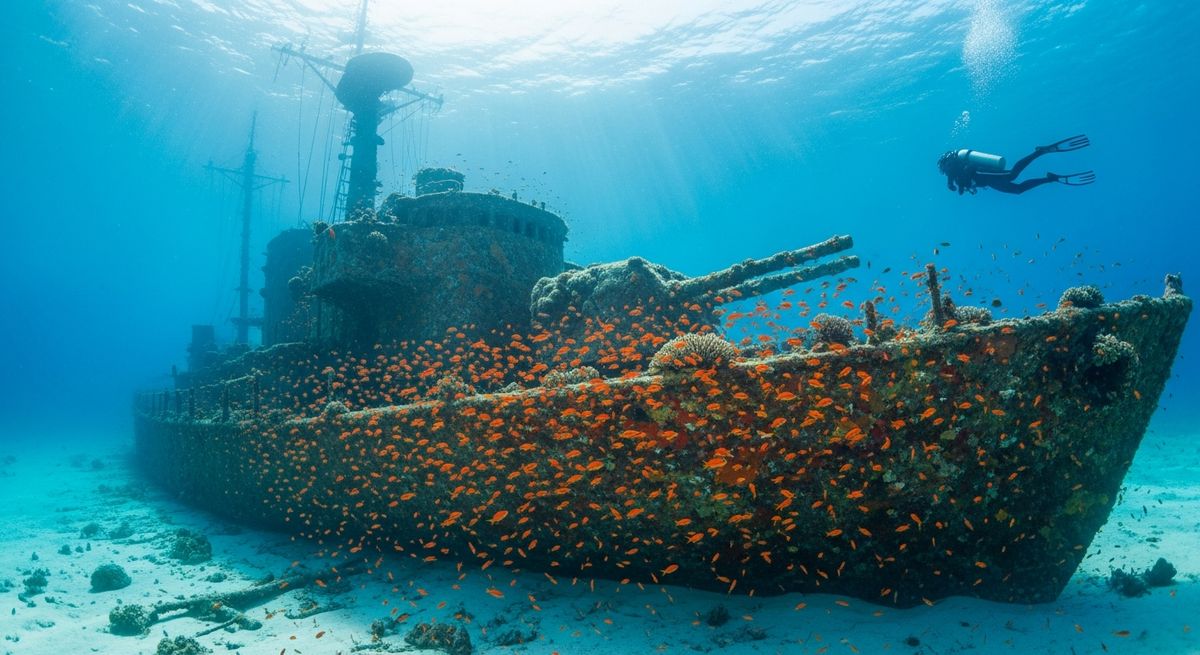
The *America* wreck, sitting in just 12 meters of water, is one of our favourite easy dives in False Bay. We love it because it’s so accessible and offers a fantastic glimpse into Cape Town’s maritime history without needing advanced skills. Descending onto the wreck, you’ll find the remnants of a wooden sailing ship, slowly being reclaimed by the ocean. We’d suggest heading down on a calm day; the shallow depth means surge can be a factor, but a still morning makes for an incredibly peaceful dive. You can swim through parts of the hull, watch light filter through the timbers, and see how sea fans and anemones have taken hold. Look closely and you’ll often spot shy shy sharks tucked amongst the debris, along with playful schools of hottentot swimming overhead. It's a superb wreck dive for anyone keen on exploration without the pressure of deep water or strong currents, a real window into the past.
Typical AMERICA Dive Profile
Illustrative profile based on site depth and type. Actual dive profiles vary - always follow your dive computer and training.
Safety Notes
Wreck site - avoid penetration without wreck diving certification. Watch for sharp metal and entanglement hazards.
Cold water this month (avg 15°C). Drysuit or thick wetsuit (7mm+) recommended.
Always perform a 3-minute safety stop at 5m before surfacing.
AMERICA Wreck History
Vessel Type
unknown
Cause
unknown
The wreck known only as the 'America' is an enigma resting in the cool waters off Cape Town. With no recorded date or cause of sinking, its history is a blank slate, leaving divers to speculate on its origins. Was it a merchant ship caught in one of the Cape of Storms' legendary gales, or perhaps an older vessel that simply succumbed to the sea? The name itself is the only clue, suggesting a possible link to the United States, but its true identity remains lost to time.
Lying at a shallow and accessible depth of 12 meters, the America is an ideal dive site for all certification levels. The wreckage, though scattered and broken, has become a vibrant artificial reef. Divers can explore the skeletal remains, now encrusted with colorful sponges and soft corals, while searching for the diverse marine life of the Western Cape, from shy shysharks to schools of reef fish. Its 'Dangerous Wreck' classification means caution is required around sharp metal, but it offers a fantastic and mysterious dive close to the city.
Nearest Dive Centres to AMERICA
Dive shops near AMERICA
Coral Wetsuits
Dive Action
Two Oceans Aquarium
University of Cape Town Underwater Club
Into the Blue Scuba
UCT Underwater Club
Reviews for AMERICA
Conditions
Ocean conditions, forecast and tides for AMERICA
AMERICA Ocean Conditions
Monthly averages for AMERICA, sourced from Open-Meteo marine data - nearest station: Open-Meteo marine grid (-33.92, 18.46) (8km away)
October Averages
Sea Temperature
15°C
59°F · Range: 12.4–17.2°C
Air Temperature
17°C
62°F
Wind Speed
7.33 m/s
14.2 knots
Atmospheric Pressure
1018.1 hPa
Based on 4 years of monitoring data · Data sources: Open-Meteo marine data
Plan & book
Ways to dive Cape Town & Western Cape, from day trips to liveaboards.
Day trips & courses
via GetYourGuideGuided dives, courses and snorkel trips with instant booking.
Find dive trips in Cape Town & Western CapePlaces to stay
via Booking.comHotels and dive resorts near Cape Town & Western Cape.
Search stays in Cape Town & Western CapeDive insurance
Most travel insurance excludes or limits scuba. Check what you need before you go.
Dive insurance explainedPartner links: we may earn a commission if you book, at no extra cost to you. How we make money
Where to Stay near AMERICA
Prices from Booking.com. We may earn a commission at no extra cost to you.