ANGELA PANDO (FWD PART)
Protected Area
Área marina de La Isleta
Why dive here
With 76+ marine species recorded in the area - including dolphins, octopuses, sea turtles, sperm whales and cuttlefish - ANGELA PANDO (FWD PART) offers some of Canary Islands's richest wreck diving. Water ranges 20-24°C, warmest August, September, October.
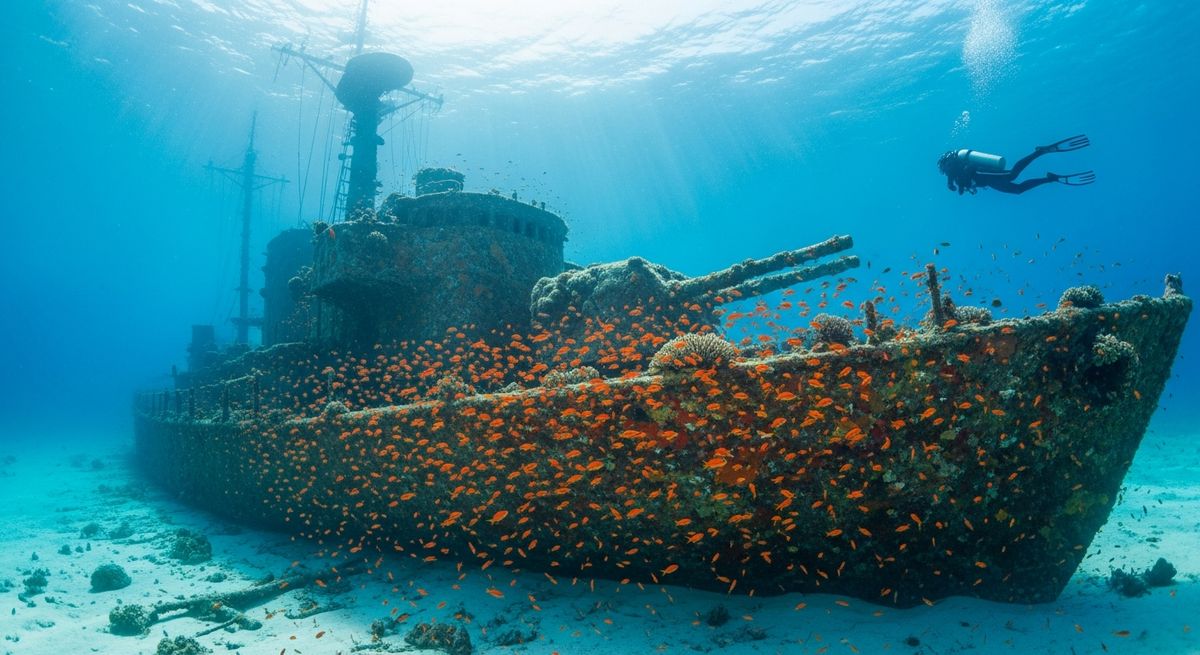
The forward section of the *Angela Pando* is a proper wreck dive, sitting upright at 20 metres. We love how the bow points majestically towards the surface, a real sense of its former grandeur even broken in half. Dropping down, you’re straight onto the expansive deck, which is now home to schools of barracuda and amberjacks that cruise past. Inside, the holds are open, allowing for easy, shallow penetration – just enough to feel like you're exploring without getting too deep into trouble. Look for the swim-throughs around the superstructure too; they’re often filled with glassy sweepers, their eyes reflecting your torch beam. This half of the *Angela Pando* offers a solid hour of exploration for divers comfortable with a spacious wreck.
Typical ANGELA PANDO (FWD PART) Dive Profile
Illustrative profile based on site depth and type. Actual dive profiles vary - always follow your dive computer and training.
Safety Notes
Depth of 20m - Advanced Open Water certification recommended.
Wreck site - avoid penetration without wreck diving certification. Watch for sharp metal and entanglement hazards.
Always perform a 3-minute safety stop at 5m before surfacing.
ANGELA PANDO (FWD PART) Wreck History
Year Sunk
1986
Vessel Type
cargo ship
Cause
storm
Tonnage
29,997 GRT
The Angela Pando was a colossal Spanish bulk carrier, built in 1970 and measuring an impressive 29,997 gross register tons. For sixteen years, she reliably transported bulk cargo across the world's oceans, a testament to the Spanish shipbuilding industry of the time.
In July 1986, her career came to a dramatic end. While on passage from Buchanan, Liberia, to Gijon, Spain, the Angela Pando sailed into a severe storm off the Canary Islands. The immense power of the waves caused a catastrophic structural failure, and the massive vessel broke clean in two. Fortunately, the crew was rescued, but the ship was a total loss. The stern section sank into the deep abyss, while the forward part drifted before coming to rest in shallower waters, creating the dive site we know today.
Diving the forward section of the Angela Pando is an awe-inspiring experience. Resting at a comfortable 20 meters, the sheer scale of the wreck is the main attraction. Divers can explore the enormous bow, anchor chains where each link is the size of a person, and vast sections of the hull. The wreck has transformed into a spectacular artificial reef, teeming with the vibrant marine life of the Canary Islands. Schools of fish swarm the structure, while moray eels and groupers have taken up residence within its metal carcass, making it a must-do dive for visitors to the region.
Nearest Dive Centres to ANGELA PANDO (FWD PART)
Dive shops near ANGELA PANDO (FWD PART)
El Azul Gran Canaria Dive Center
Mirafondos, Centro de Buceo
Buceo La Vieja
BUCEO CANARIAS BY MEDUSA
KARAPAT DIVE
Buceo Norte
Reviews for ANGELA PANDO (FWD PART)
Conditions
Ocean conditions, forecast and tides for ANGELA PANDO (FWD PART)
ANGELA PANDO (FWD PART) Ocean Conditions
Monthly averages for ANGELA PANDO (FWD PART), sourced from Open-Meteo marine data + Copernicus Marine (EU) - nearest station: Open-Meteo marine grid (28.18, -15.41) (10km away)
October Averages
Sea Temperature
24°C
74°F · Range: 22.2–25.4°C
Current Speed
10 cm/s
Direction: SE (126.9°)
Chlorophyll-a
0.081 mg/m³
Very clear (oligotrophic)
Salinity
36.89 PSU
Based on 4 years of monitoring data · Data sources: Open-Meteo marine data + Copernicus Marine (EU)
Plan & book
Ways to dive Canary Islands, from day trips to liveaboards.
Day trips & courses
via GetYourGuideGuided dives, courses and snorkel trips with instant booking.
Find dive trips in Canary IslandsPlaces to stay
via Booking.comHotels and dive resorts near Canary Islands.
Search stays in Canary IslandsDive insurance
Most travel insurance excludes or limits scuba. Check what you need before you go.
Dive insurance explainedPartner links: we may earn a commission if you book, at no extra cost to you. How we make money
Where to Stay near ANGELA PANDO (FWD PART)
Prices from Booking.com. We may earn a commission at no extra cost to you.