ABESSINIA
Protected Area
Farne Islands
Why dive here
With 112+ marine species recorded in the area - including dolphins, dwarf minke whales, humpback whales, ocean sunfish (mola mola) and orcas - ABESSINIA offers some of Scottish East Coast & Borders's richest wreck diving.
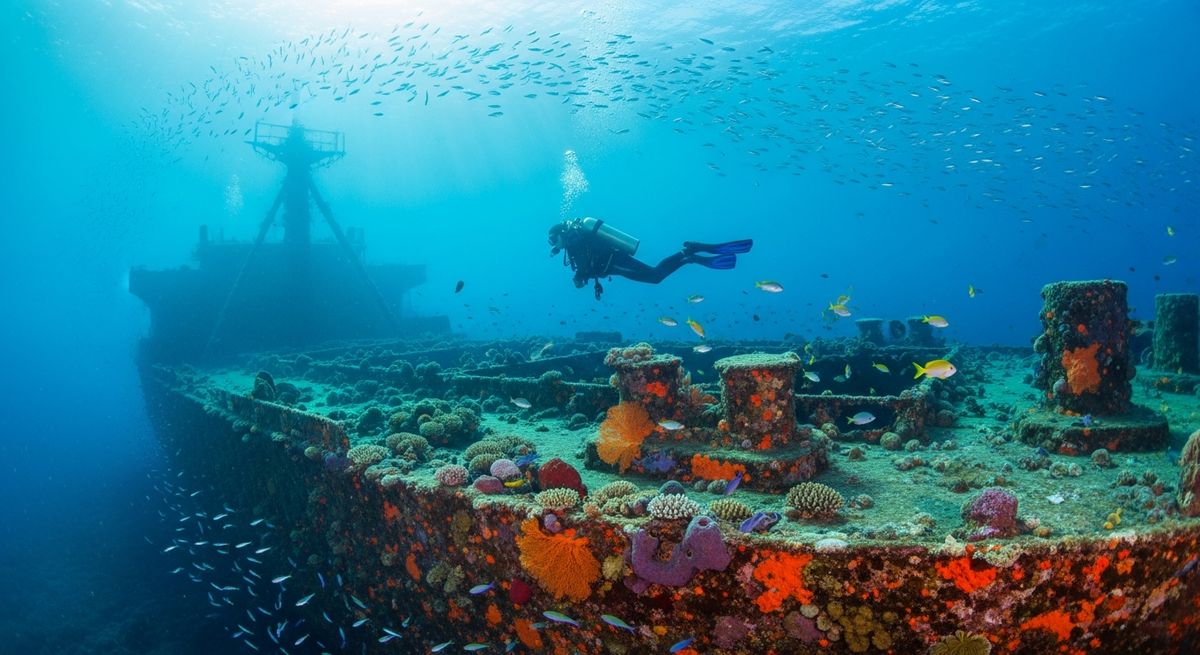
Abessinia. The name itself hints at something grander, doesn't it? This isn't a dive you do for depth or coral, that’s for sure. We’re talking two metres, max, on the Knavestone Rock. But what it lacks in plunge, it makes up for in sheer, historical drama. She went down in 1921, a sizable steamship, and now her bones are scattered, tangled in kelp, just beneath the surface. It's a proper intertidal exploration, more like snorkelling or a very shallow, long dive. We love this site for its accessibility and the way the light filters through the kelp forest, illuminating chunks of rusted metal. You’ll weave through plates and beams, imagining the sheer size of her at 137 metres. It’s not about finding intact sections, but rather the atmosphere of a wreck reclaimed by the sea in such a shallow, exposed environment. Our favourite time to go is on a calm, sunny day with minimal swell. That’s when you really get to appreciate the details and the surprising amount of small fish darting amongst the wreckage. It's a fantastic spot for photographers looking for something a bit different, and for anyone who loves their history close to the surface. Just be mindful of the currents around the Farnes; pick your slack water carefully.
Typical ABESSINIA Dive Profile
Illustrative profile based on site depth and type. Actual dive profiles vary - always follow your dive computer and training.
Safety Notes
Wreck site - avoid penetration without wreck diving certification. Watch for sharp metal and entanglement hazards.
ABESSINIA Wreck History
Year Sunk
1921
Vessel Type
cargo ship
Cause
grounding
The SS Abessinia was a German steamship built in England in 1900 for the Hamburg America Line. In her early years, she was a true globetrotter, running routes from Hamburg to China, Australia, and the United States. She later specialized in trade along the West Coast of the Americas. The Abessinia proved to be a resilient vessel, famously surviving a severe North Atlantic storm in 1913 that destroyed her rudder and disabled her engines. She spent the duration of the First World War interned in Chile before returning to service.
Her final voyage came to an abrupt end on September 3, 1921. While navigating the treacherous waters of the Farne Islands off the coast of Northumberland, she ran aground on the notorious Knave Stone Rock. The impact was catastrophic, and the ship was lost to the sea, eventually breaking apart under the relentless force of the waves.
Today, the remains of the Abessinia are a popular and fascinating dive site. Lying in a maximum depth of just 2 meters, the wreck is heavily broken up and scattered across the seabed, a testament to over a century of North Sea storms. This shallow depth makes it an excellent site for novice wreck divers and photographers who can take advantage of the abundant natural light. Divers can explore the ship's massive boilers, sections of the hull, and twisted steel plates, all of which now provide a rich habitat for the Farnes' famous seals, crustaceans, and colorful anemones.
Nearest Dive Centres to ABESSINIA
Dive shops near ABESSINIA
View all dive centres in Scottish East Coast & BordersReviews for ABESSINIA
Conditions
Ocean conditions, forecast and tides for ABESSINIA
Plan & book
Ways to dive Scottish East Coast & Borders, from day trips to liveaboards.
Day trips & courses
via GetYourGuideGuided dives, courses and snorkel trips with instant booking.
Find dive trips in Scottish East Coast & BordersPlaces to stay
via Booking.comHotels and dive resorts near Scottish East Coast & Borders.
Search stays in Scottish East Coast & BordersDive insurance
Most travel insurance excludes or limits scuba. Check what you need before you go.
Dive insurance explainedPartner links: we may earn a commission if you book, at no extra cost to you. How we make money
Where to Stay near ABESSINIA
Prices from Booking.com. We may earn a commission at no extra cost to you.