AMSTERDAM
Protected Area
Coquet Island
Why dive here
With 112+ marine species recorded in the area - including dolphins, dwarf minke whales, humpback whales, ocean sunfish (mola mola) and orcas - AMSTERDAM offers some of Scottish East Coast & Borders's richest wreck diving.
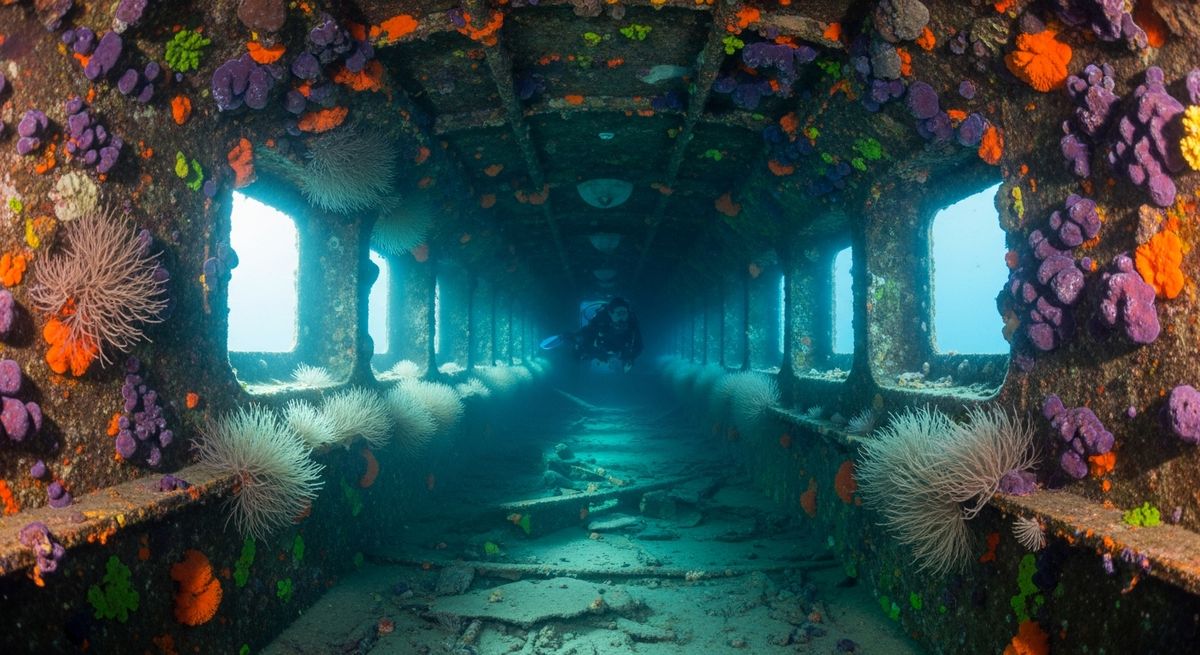
The *Amsterdam* is a dive that truly reminds you why Scottish wreck diving is so special. Down at 38 metres, she’s a proper expedition, certainly not one for a quick splash-and-dash. We love the way she’s mostly intact, lying on her port side, giving you a real sense of her scale as you descend through the often green but atmospheric water. Built in 1877, this old steamer met her end in 1918, a general cargo and coal carrier en route to Rotterdam. The wreck herself is absolutely festooned with life. We’re talking massive plumose anemones, their white tentacles waving in the slight current, and a surprising number of wrasse darting between the plates. You can still make out the compound engine, a testament to her industrial heritage. Our favourite part is often the bow, where the structure is still very discernible, offering some swim-throughs if you’re careful and experienced. You need good buoyancy control here, and ideally, pick a day with minimal surge. It’s a dive for those who appreciate history and don't mind a bit of a depth challenge, rewarding you with an authentic piece of maritime past, now a vibrant artificial reef.
Typical AMSTERDAM Dive Profile
Illustrative profile based on site depth and type. Actual dive profiles vary - always follow your dive computer and training.
Safety Notes
Deep dive (38m) - monitor air consumption closely. Advanced certification recommended.
Wreck site - avoid penetration without wreck diving certification. Watch for sharp metal and entanglement hazards.
Always perform a 3-minute safety stop at 5m before surfacing.
AMSTERDAM Wreck History
Year Sunk
1918
Vessel Type
cargo ship
Cause
torpedo
The SS Amsterdam was a steamship built in 1877 by Cunliffe & Dunlop in Port Glasgow, a product of the Clyde's renowned shipbuilding industry. For over four decades, she plied the seas, a workhorse of her era. At the time of her loss, she was owned by James Rankin & Son and was on a routine voyage from Leith to Rotterdam, carrying a general cargo.
Her final journey took place during the height of the First World War. On February 24th, 1918, while navigating the North Sea, she became another victim of Germany's unrestricted submarine warfare. The Amsterdam was torpedoed and sunk by the German U-boat UB-80, a grim end shared by many merchant vessels during the conflict.
Today, the wreck of the Amsterdam lies at a depth of 38 meters off the Scottish coast. It is a dive for more experienced divers, offering a tangible connection to WWI history. The vessel is significantly broken up after more than a century underwater, but divers can still identify key features like her compound engine and boiler. The wreckage has become an artificial reef, attracting marine life and providing a hauntingly beautiful backdrop for a dive into the past.
Nearest Dive Centres to AMSTERDAM
Dive shops near AMSTERDAM
Northumbria Scuba Divers
Aquanorth
Scuba-Life
Newcastle University Sub Aqua Society
Aqua Purists
The Diving Centre Ltd
Reviews for AMSTERDAM
Conditions
Ocean conditions, forecast and tides for AMSTERDAM
Plan & book
Ways to dive Scottish East Coast & Borders, from day trips to liveaboards.
Day trips & courses
via GetYourGuideGuided dives, courses and snorkel trips with instant booking.
Find dive trips in Scottish East Coast & BordersPlaces to stay
via Booking.comHotels and dive resorts near Scottish East Coast & Borders.
Search stays in Scottish East Coast & BordersDive insurance
Most travel insurance excludes or limits scuba. Check what you need before you go.
Dive insurance explainedPartner links: we may earn a commission if you book, at no extra cost to you. How we make money
Where to Stay near AMSTERDAM
Prices from Booking.com. We may earn a commission at no extra cost to you.