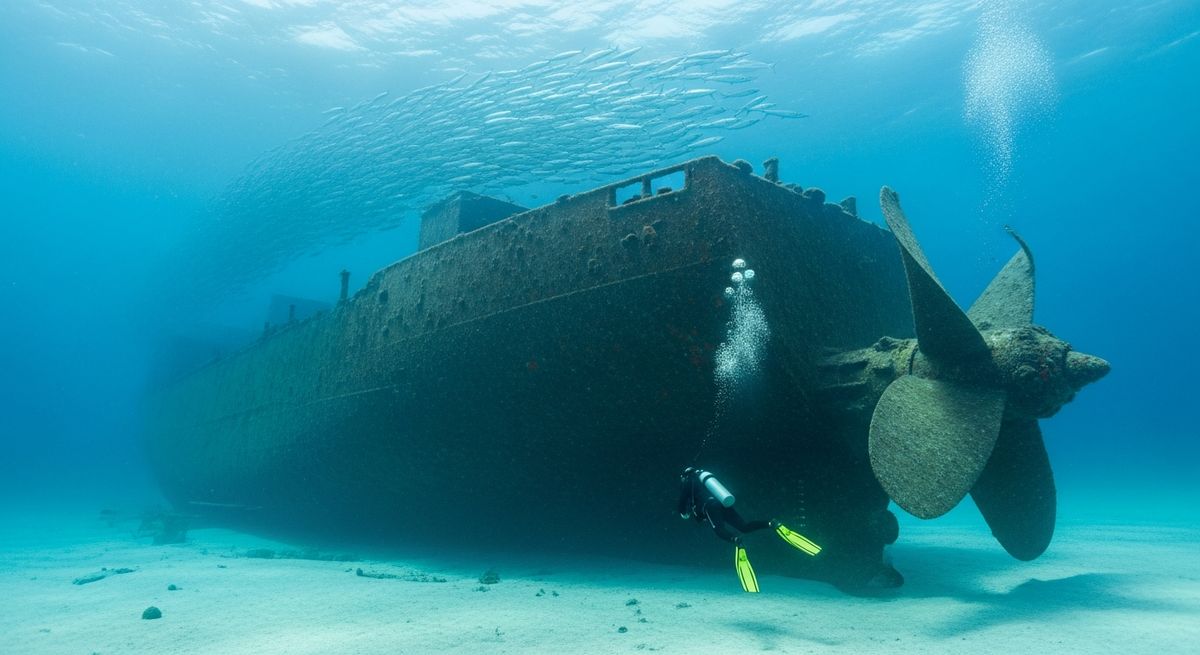
ANGELA
Protected Area
Tynemouth to Seaton Sluice
Why dive here
With 112+ marine species recorded in the area - including dolphins, dwarf minke whales, humpback whales, ocean sunfish (mola mola) and orcas - ANGELA offers some of Scottish East Coast & Borders's richest wreck diving.
The Angela, off the Scottish East Coast, is one of our favourite wreck dives when the weather plays ball. This isn't a dive for exploring intricate holds or cabins, mind you. She’s a sailing vessel, sunk by a mine in 1917, and the years have done their work. What you get now is a low, spread-out debris field, with ribs and plates scattered across the seabed at 18 metres. It feels less like a ship and more like a metal reef. We love poking through the smaller sections, finding plates lifted just enough to create hiding spots for edible crabs. Look closely, and you’ll often spot a wolfish peering out from under a larger piece of wreckage. The current can be a factor here, as you'd expect on this coast, so planning your dive for slack water is key. When the visibility is good, around 5-8 metres, the sense of history is palpable, despite the wreck's broken state. It's a dive that rewards slow, methodical exploration, perfect for divers who appreciate the subtle beauty of a wreck reclaimed by the sea.
Typical ANGELA Dive Profile
Illustrative profile based on site depth and type. Actual dive profiles vary - always follow your dive computer and training.
Safety Notes
Wreck site - avoid penetration without wreck diving certification. Watch for sharp metal and entanglement hazards.
Always perform a 3-minute safety stop at 5m before surfacing.
ANGELA Wreck History
Year Sunk
1917
Vessel Type
sailing vessel
Cause
mined
Tonnage
141 GRT
The Angela was a three-masted British schooner that served as a coastal trading vessel during the height of the First World War. Like many ships of her era, she played a vital role in transporting goods around the UK, a task fraught with danger due to the constant threat of German naval mines and U-boats patrolling the shipping lanes.
On May 5th, 1917, while on a passage from London to the River Tyne, the Angela's luck ran out. She struck a mine laid by the German submarine UC-41 and sank quickly. This was a common and tragic fate for many merchant vessels in the North Sea, which had been turned into a deadly maritime battlefield.
Today, the remains of the Angela lie at a depth of 18 meters. As a wooden sailing vessel over a century old, the wreck is heavily broken and scattered across the seabed. Divers can identify sections of timber, metal fittings, and perhaps an anchor, all now heavily colonized by marine life. It's an atmospheric dive, offering a tangible connection to the perils faced by civilian sailors during WWI and a great site for spotting the crustaceans and fish that now call these historic remains home.
Nearest Dive Centres to ANGELA
Dive shops near ANGELA
The Diving Centre Ltd
Aquanorth
Sunderland Scuba Centre
Scuba-Life
Aqua Purists
Northumbria Scuba Divers
Reviews for ANGELA
Conditions
Ocean conditions, forecast and tides for ANGELA
Plan & book
Ways to dive Scottish East Coast & Borders, from day trips to liveaboards.
Day trips & courses
via GetYourGuideGuided dives, courses and snorkel trips with instant booking.
Find dive trips in Scottish East Coast & BordersPlaces to stay
via Booking.comHotels and dive resorts near Scottish East Coast & Borders.
Search stays in Scottish East Coast & BordersDive insurance
Most travel insurance excludes or limits scuba. Check what you need before you go.
Dive insurance explainedPartner links: we may earn a commission if you book, at no extra cost to you. How we make money
Where to Stay near ANGELA
Prices from Booking.com. We may earn a commission at no extra cost to you.