ATLAS (POSSIBLY)
Protected Area
Teesmouth and Cleveland Coast
Why dive here
With 112+ marine species recorded in the area - including dolphins, dwarf minke whales, humpback whales, ocean sunfish (mola mola) and orcas - ATLAS (POSSIBLY) offers some of Scottish East Coast & Borders's richest wreck diving.
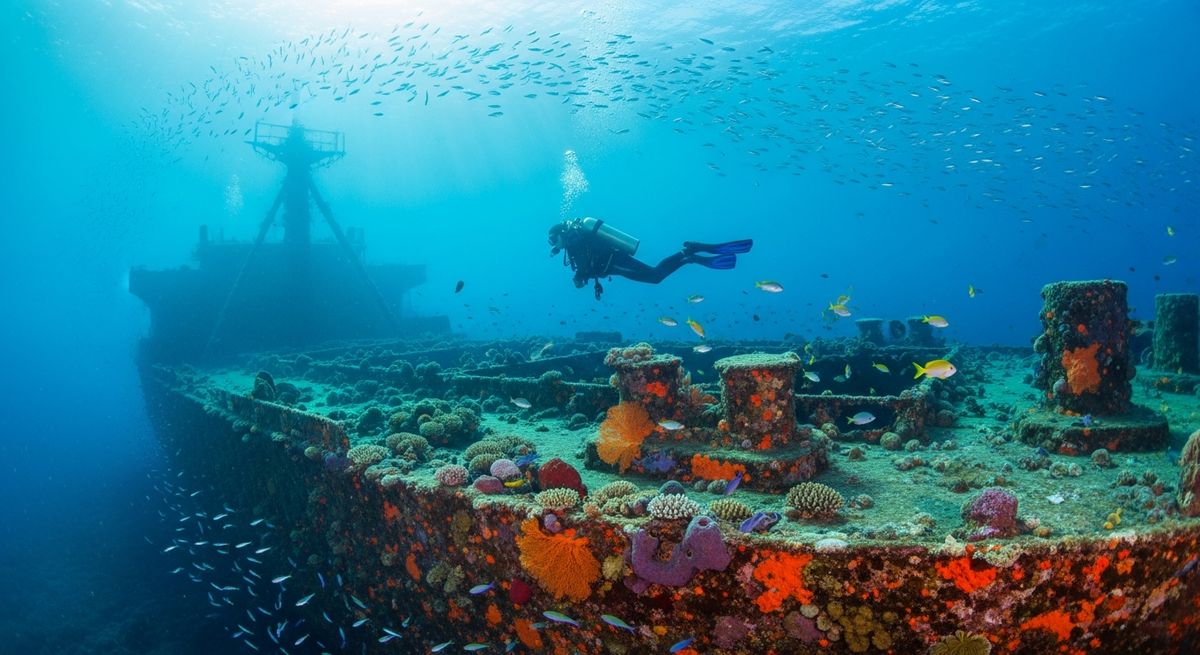
The Atlas, sitting upright at 59m, is a proper Scottish wreck dive, and we absolutely love it. Dropping onto her bow, the sheer scale hits you immediately. She's a big old steamship, built in 1897, and you can still make out the superstructure stretching away into the gloom. We’ve found the stern holds are often open, offering a dark, silty peek inside, just enough space to feel the history. The twin boilers are still prominent amidships, looking like a forgotten industrial heart, now home to clouds of tiny cod and curious ling. It’s a deep dive, no doubt, but for experienced cold water wreck enthusiasts, she delivers. Visibility can swing wildly; we've had days where you can see half the length of her, and others where it's a 5-meter tunnel vision adventure. Go for the latter; it adds to the mystery.
Typical ATLAS (POSSIBLY) Dive Profile
Illustrative profile based on site depth and type. Actual dive profiles vary - always follow your dive computer and training.
Safety Notes
Maximum depth 59m exceeds recreational limits (40m). Technical diving certification and equipment required.
Wreck site - avoid penetration without wreck diving certification. Watch for sharp metal and entanglement hazards.
Always perform a 3-minute safety stop at 5m before surfacing.
ATLAS (POSSIBLY) Wreck History
Year Sunk
1918
Vessel Type
cargo ship
Cause
torpedo
Tonnage
3,090 GRT
The steamship Atlas, built in 1897, was a typical late-Victorian cargo carrier from the shipyards of West Hartlepool. For two decades she plied her trade, but the outbreak of the First World War changed her fate forever. On Valentine's Day 1918, while steaming off the Scottish East Coast, she was spotted by the German submarine UB-63. A single torpedo strike sealed her doom, sending the 3,090-ton vessel and her cargo to the seabed.
Lying at a challenging depth of 59 metres, the Atlas is a wreck reserved for experienced technical divers. The site is often subject to strong currents and low visibility, but the reward is a largely intact WWI-era steamship. Divers can explore the vessel's structure, including her two large boilers and triple-expansion engine, which stand as proud, silent monuments to a bygone age of steam and a world at war.
Nearest Dive Centres to ATLAS (POSSIBLY)
Dive shops near ATLAS (POSSIBLY)
Sunderland Scuba Centre
The Diving Centre Ltd
Aquanorth
Scuba-Life
Aqua Purists
Newcastle University Sub Aqua Society
Reviews for ATLAS (POSSIBLY)
Conditions
Ocean conditions, forecast and tides for ATLAS (POSSIBLY)
Plan & book
Ways to dive Scottish East Coast & Borders, from day trips to liveaboards.
Day trips & courses
via GetYourGuideGuided dives, courses and snorkel trips with instant booking.
Find dive trips in Scottish East Coast & BordersPlaces to stay
via Booking.comHotels and dive resorts near Scottish East Coast & Borders.
Search stays in Scottish East Coast & BordersDive insurance
Most travel insurance excludes or limits scuba. Check what you need before you go.
Dive insurance explainedPartner links: we may earn a commission if you book, at no extra cost to you. How we make money
Where to Stay near ATLAS (POSSIBLY)
Prices from Booking.com. We may earn a commission at no extra cost to you.