BALLOCHBUIE (POSSIBLY)
Protected Area
Isle of May
Why dive here
With 112+ marine species recorded in the area - including dolphins, dwarf minke whales, humpback whales, ocean sunfish (mola mola) and orcas - BALLOCHBUIE (POSSIBLY) offers some of Scottish East Coast & Borders's richest wreck diving.
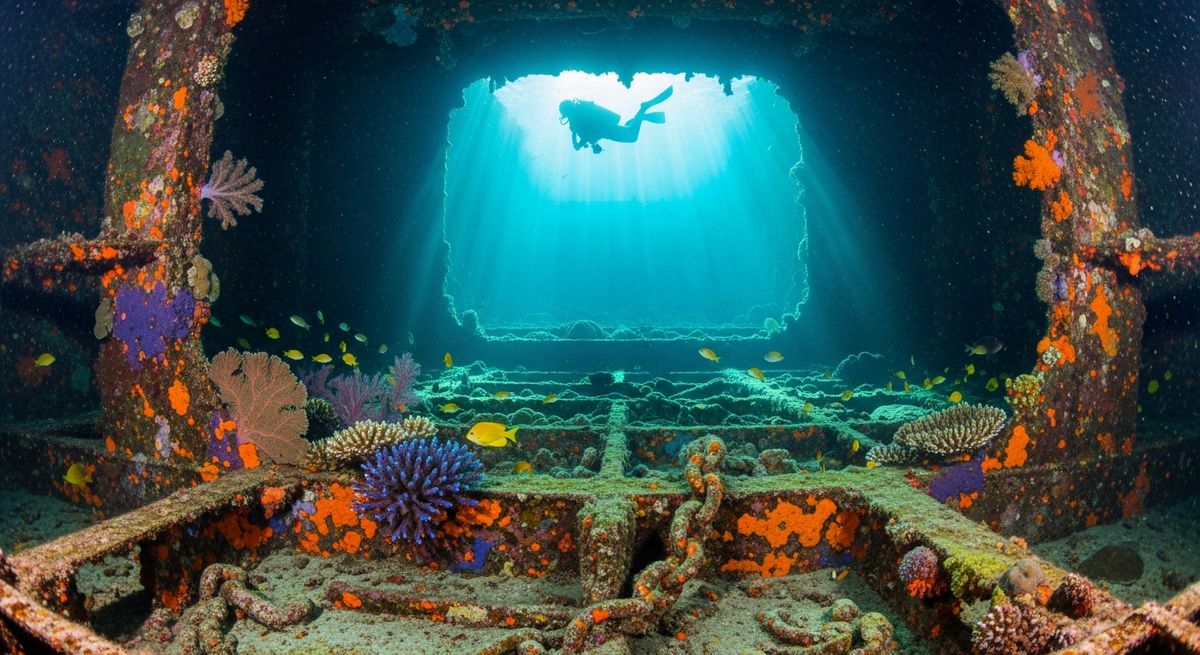
The Ballochbuie, or what we believe to be her, is a proper Scottish wreck dive, deep and moody, exactly what we look for when we’re up the East Coast. Dropping onto her at 51 metres, the visibility can be challenging, but that just adds to the atmosphere. She’s a decent size at 61 metres long, and we love the way her structure offers plenty to explore, even if the currents can be quite frisky here. You’ll find the triple-expansion engine a real highlight, a stark reminder of her working life before U-boat UC-76 found her in 1917. We’ve seen conger eels poking out of nooks and crannies, and dead man’s fingers coral growing in thick white clumps on her decks. It’s a site for experienced wreck divers comfortable with deep diving and potential low visibility, but the rewards are there. Don’t rush the dive, let your eyes adjust, and you’ll start to pick out more and more of her secrets.
Typical BALLOCHBUIE (POSSIBLY) Dive Profile
Illustrative profile based on site depth and type. Actual dive profiles vary - always follow your dive computer and training.
Safety Notes
Maximum depth 51m exceeds recreational limits (40m). Technical diving certification and equipment required.
Wreck site - avoid penetration without wreck diving certification. Watch for sharp metal and entanglement hazards.
Always perform a 3-minute safety stop at 5m before surfacing.
BALLOCHBUIE (POSSIBLY) Wreck History
Year Sunk
1917
Vessel Type
cargo ship
Cause
torpedo
Tonnage
921 GRT
This deep wreck, located off the Scottish East Coast, is believed to be the remains of the SS Ballochbuie, a 921 GRT cargo steamer sunk during World War I. The original Ballochbuie was built in Aberdeen in 1905 and served the Aberdeen Lime Co. Her story ended abruptly on April 20, 1917, when she was torpedoed and sunk by the German U-boat U-70, a common fate for merchant ships during the intense submarine campaigns of the war.
While the location and general characteristics of this wreck match the historical records for the Ballochbuie, its identity has not been definitively confirmed, hence the '(Possibly)' designation. This air of mystery adds a layer of intrigue to the dive. For the technical divers who venture down to 51 metres, the site offers more than just a wreck; it's an opportunity for exploration and potential discovery. Divers can explore the ship's remains, looking for identifying features like a ship's bell or maker's plate that could finally solve the puzzle of its name, all while observing the deep-water ecosystem that has claimed the wreck as its own.
Nearest Dive Centres to BALLOCHBUIE (POSSIBLY)
Dive shops near BALLOCHBUIE (POSSIBLY)
View all dive centres in Scottish East Coast & BordersReviews for BALLOCHBUIE (POSSIBLY)
Conditions
Ocean conditions, forecast and tides for BALLOCHBUIE (POSSIBLY)
Plan & book
Ways to dive Scottish East Coast & Borders, from day trips to liveaboards.
Day trips & courses
via GetYourGuideGuided dives, courses and snorkel trips with instant booking.
Find dive trips in Scottish East Coast & BordersPlaces to stay
via Booking.comHotels and dive resorts near Scottish East Coast & Borders.
Search stays in Scottish East Coast & BordersDive insurance
Most travel insurance excludes or limits scuba. Check what you need before you go.
Dive insurance explainedPartner links: we may earn a commission if you book, at no extra cost to you. How we make money
Where to Stay near BALLOCHBUIE (POSSIBLY)
Prices from Booking.com. We may earn a commission at no extra cost to you.