BAY FISHER
Protected Area
Whiting Ness - Ethie Haven
Why dive here
With 112+ marine species recorded in the area - including dolphins, dwarf minke whales, humpback whales, ocean sunfish (mola mola) and orcas - BAY FISHER offers some of Scottish East Coast & Borders's richest wreck diving.
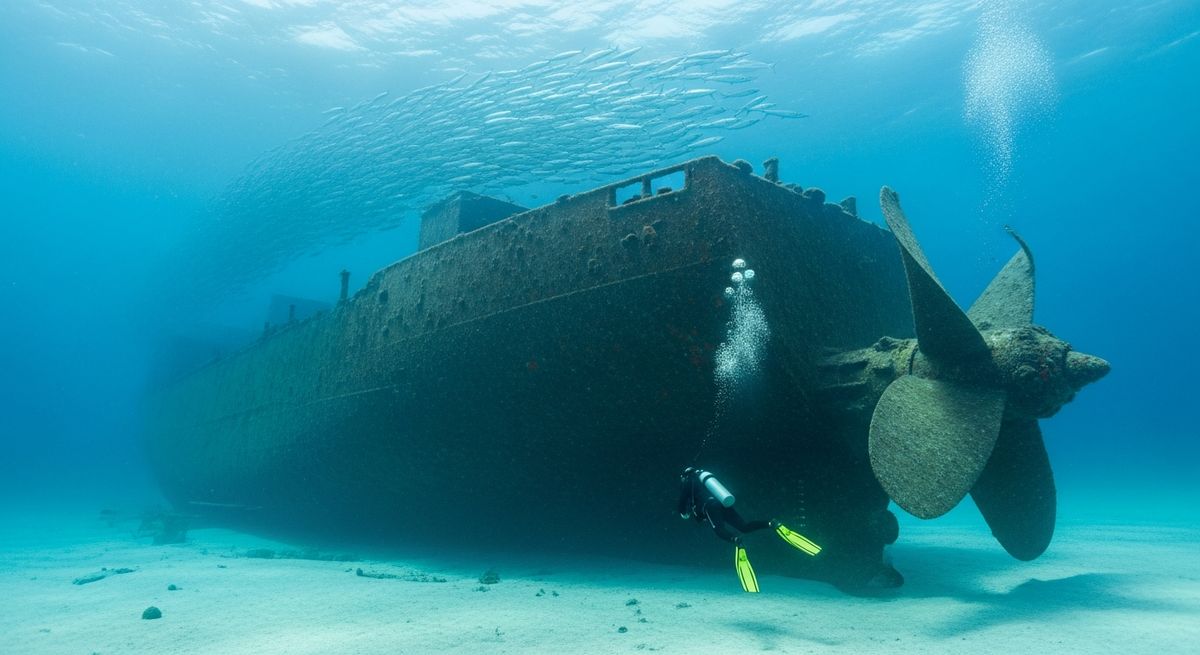
The *Bay Fisher* is one of those wrecks that really gets under your skin. Lying at 48 metres, it’s a site we always recommend for divers comfortable with depth and a bit of current, because the payoff is immense. She went down fast in 1941, bombed by a German aircraft, and now sits largely intact, upright on the seabed. You can see the triple expansion engine, still a powerful looking piece of machinery, and the single boiler is a huge presence in the midships. We love heading into the hold, where schools of cod often hang in the gloom, seemingly unafraid, before they ghost away into the deeper parts of the wreck. Look for the wolf fish, too; they’re often tucked into crevices, their broad heads and impressive teeth making them a real find. Visibility can be a bit of a lottery, as it often is in these parts, but on a good day, when the light penetrates the green water, the *Bay Fisher* feels like a proper journey back in time. It’s a dive that rewards careful exploration, making it our pick for those who appreciate the history as much as the marine life that now calls it home.
Typical BAY FISHER Dive Profile
Illustrative profile based on site depth and type. Actual dive profiles vary - always follow your dive computer and training.
Safety Notes
Maximum depth 48m exceeds recreational limits (40m). Technical diving certification and equipment required.
Wreck site - avoid penetration without wreck diving certification. Watch for sharp metal and entanglement hazards.
Always perform a 3-minute safety stop at 5m before surfacing.
BAY FISHER Wreck History
Year Sunk
1941
Vessel Type
cargo ship
Cause
aircraft
Tonnage
674 GRT
Built in Aberdeen in 1919, the SS Bay Fisher served as a commercial steamship for over two decades before being requisitioned by the British Admiralty for service during the Second World War. As a naval stores carrier, her role was to transport essential supplies between the key naval bases of the United Kingdom, a vital but perilous task during the height of the Battle of the Atlantic and the German air campaigns against British shipping.
On February 7th, 1941, her service came to a tragic end. While on passage from the main fleet anchorage at Scapa Flow to the naval dockyard at Rosyth, she was attacked by a German aircraft off St Abbs Head. The attack was devastating, and the Bay Fisher sank quickly, taking her entire crew of 21 men with her. She came to rest on the seabed, a silent casualty of the war at sea.
Today, the Bay Fisher lies upright at a depth of 48 meters. This is a dive reserved for experienced, certified technical divers due to the depth and conditions. The wreck is remarkably intact for her age, with the superstructure, holds, and machinery still recognizable. Divers can explore the ghostly remains of her deck structures and peer into the cargo areas, a poignant reminder of her final voyage. The depth ensures that bottom time is limited, making every moment on this historic wreck a precious one.
Reviews for BAY FISHER
Conditions
Ocean conditions, forecast and tides for BAY FISHER
Plan & book
Ways to dive Scottish East Coast & Borders, from day trips to liveaboards.
Day trips & courses
via GetYourGuideGuided dives, courses and snorkel trips with instant booking.
Find dive trips in Scottish East Coast & BordersPlaces to stay
via Booking.comHotels and dive resorts near Scottish East Coast & Borders.
Search stays in Scottish East Coast & BordersDive insurance
Most travel insurance excludes or limits scuba. Check what you need before you go.
Dive insurance explainedPartner links: we may earn a commission if you book, at no extra cost to you. How we make money
Where to Stay near BAY FISHER
Prices from Booking.com. We may earn a commission at no extra cost to you.