BLESSING OF BURNTISLAND
Protected Area
Firth of Forth
Why dive here
With 112+ marine species recorded in the area - including dolphins, dwarf minke whales, humpback whales, ocean sunfish (mola mola) and orcas - BLESSING OF BURNTISLAND offers some of Scottish East Coast & Borders's richest wreck diving.
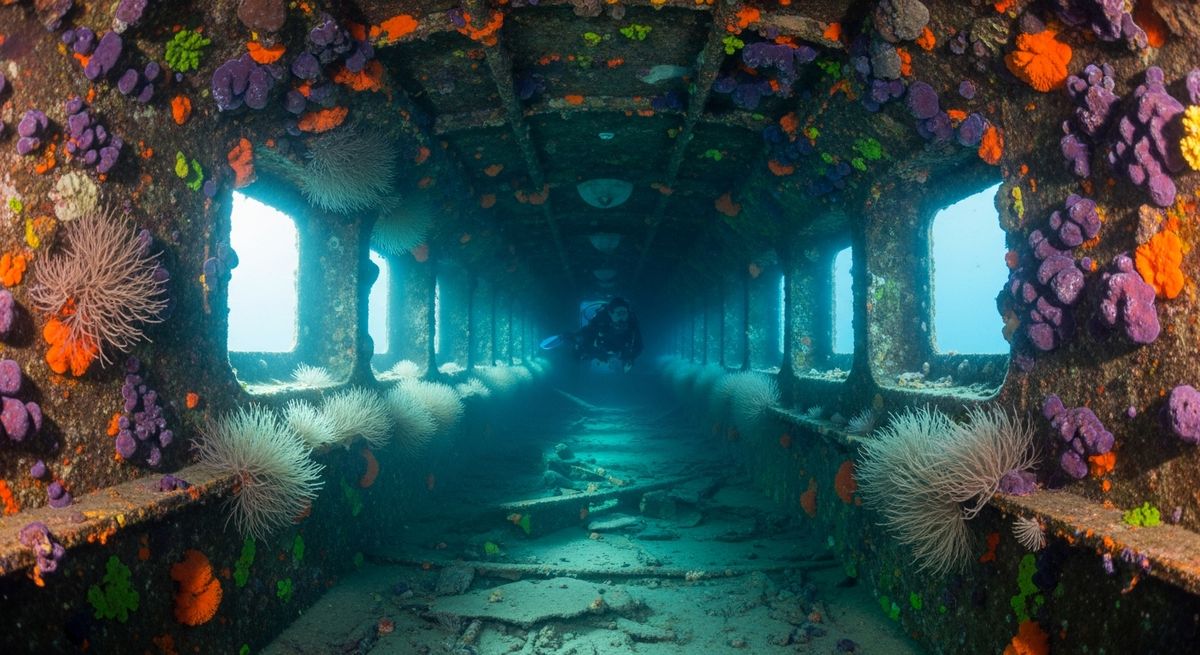
The Blessing of Burntisland, what a moody dive. We always get a shiver thinking about its history, sunk in 1633, carrying King Charles I’s personal effects after his Scottish coronation. You’re not just diving a wreck; you’re diving into a piece of turbulent British history. Down at 21 metres, it’s a site that suits experienced divers, those who appreciate the subtle beauty of a very old, broken-up wooden vessel. We've often found visibility can be a bit challenging here, typical for the Firth of Forth, so pick your day carefully, ideally on a slack tide with good light. The wreck itself is quite dispersed, low to the seabed, but you can still make out timbers and what would have been the hull. It’s absolutely covered in dead man’s fingers, making it look almost fuzzy white in the torch beam, and we’ve spotted some impressively large edible crabs scuttling between the wreckage. Our favourite part is imagining the drama of that squall, over 300 years ago, and knowing you’re touching a piece of that story.
Typical BLESSING OF BURNTISLAND Dive Profile
Illustrative profile based on site depth and type. Actual dive profiles vary - always follow your dive computer and training.
Safety Notes
Depth of 21m - Advanced Open Water certification recommended.
Wreck site - avoid penetration without wreck diving certification. Watch for sharp metal and entanglement hazards.
Always perform a 3-minute safety stop at 5m before surfacing.
BLESSING OF BURNTISLAND Wreck History
Year Sunk
1633
Vessel Type
ferry
Cause
storm
The story of the 'Blessing of Burntisland' is one of Scotland's most enduring maritime legends. In 1633, King Charles I was in Scotland for his coronation. After the lavish ceremonies, he prepared to return to London, sending his vast collection of royal treasure and personal effects ahead of him aboard a humble ferry, the Blessing of Burntisland. The treasure was said to be immense, including priceless silver, jewels, and royal regalia. As the ship crossed the Firth of Forth, it was caught in a sudden, violent squall and sank without a trace, taking its priceless cargo to the seabed.
For nearly 400 years, the exact location of the Blessing and its royal treasure has remained a mystery, tantalizing historians and treasure hunters alike. While the wreck has never been officially found and identified, this dive site is believed to be in the vicinity of the sinking. A dive here is a descent into that historical puzzle. While you may not find a king's ransom in silver, you are exploring a seabed that holds one of Scotland's greatest secrets. The dive itself is a chance to connect with a dramatic piece of royal history, wondering if the scattered timbers below could be the final resting place of the legendary lost treasure of King Charles I.
Nearest Dive Centres to BLESSING OF BURNTISLAND
Dive shops near BLESSING OF BURNTISLAND
Deep Sea World Aquarium
Deep Blue Scuba
Libertas Scuba Stirling
Reviews for BLESSING OF BURNTISLAND
Conditions
Ocean conditions, forecast and tides for BLESSING OF BURNTISLAND
Plan & book
Ways to dive Scottish East Coast & Borders, from day trips to liveaboards.
Day trips & courses
via GetYourGuideGuided dives, courses and snorkel trips with instant booking.
Find dive trips in Scottish East Coast & BordersPlaces to stay
via Booking.comHotels and dive resorts near Scottish East Coast & Borders.
Search stays in Scottish East Coast & BordersDive insurance
Most travel insurance excludes or limits scuba. Check what you need before you go.
Dive insurance explainedPartner links: we may earn a commission if you book, at no extra cost to you. How we make money
Where to Stay near BLESSING OF BURNTISLAND
Prices from Booking.com. We may earn a commission at no extra cost to you.