BRETON
Protected Area
St Mary's Island
Why dive here
With 112+ marine species recorded in the area - including dolphins, dwarf minke whales, humpback whales, ocean sunfish (mola mola) and orcas - BRETON offers some of Scottish East Coast & Borders's richest wreck diving.
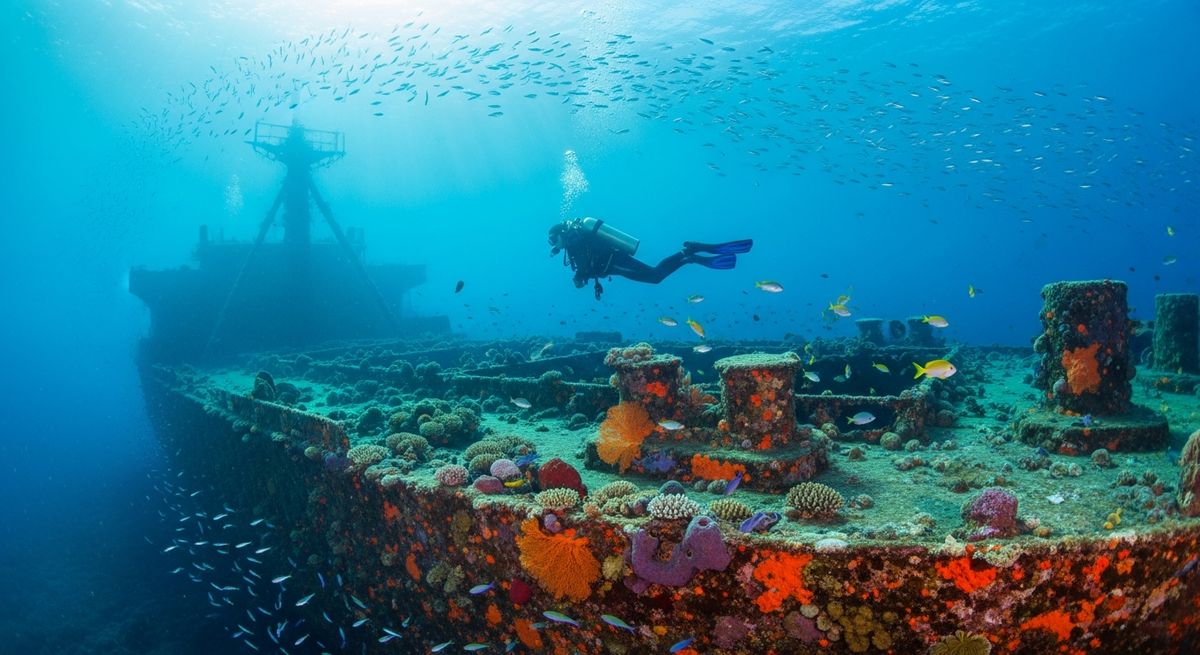
The *Breton* is a properly historical dive, a steamship that went down in 1899, and for us, that age is a huge part of its appeal. You’re not just looking at metal; you're touching a piece of maritime history, a ghost from the Victorian era. We love how the hull has completely collapsed, leaving a fascinating jumble of plates, beams, and machinery spread across the seabed. It’s like an archaeological dig down there, with schools of coalfish darting through the rusted remains, their scales catching the light. You’ll spend most of your time exploring the engine room, which is still remarkably intact. The sheer scale of the engine block is impressive, covered in anemones and dead man’s fingers, glowing under the torchlight. We often find conger eels tucked into the darker crevices, their heads poking out with a wary glance. Visibility can be hit or miss, typical for the East Coast, but on a good day, the light filtering down through the kelp-covered stern section is just beautiful. It’s a dive for those who appreciate wrecks with a story, and aren’t afraid of a bit of rummaging to uncover its secrets.
Safety Notes
Wreck site - avoid penetration without wreck diving certification. Watch for sharp metal and entanglement hazards.
BRETON Wreck History
Year Sunk
1899
Vessel Type
cargo ship
Cause
grounding
Tonnage
1,326 GRT
The SS Breton was a sturdy British steamship built in 1878. Her end came not in war, but at the hands of the North Sea's formidable weather. On November 1, 1899, while on a voyage from Leith to London with a general cargo, the Breton was caught in a severe gale. Battered by ferocious winds and mountainous waves, the crew lost their battle against the elements, and the ship was driven ashore near the dramatic cliffs of St Abbs Head.
Fortunately, this disaster did not result in loss of life. In a heroic effort, the local lifeboat crew launched into the storm and successfully rescued the entire crew from the stricken vessel. The Breton, however, could not be saved. Pounded relentlessly by the surf against the rocky coastline, the ship quickly broke apart and was completely wrecked. Her remains were scattered in the shallows, a testament to the power of the sea.
With a listed depth of 0 meters, the Breton is not a dive site in the traditional sense. Her wreckage is spread across the intertidal zone, heavily salvaged and broken down by over a century of wave action. At very low tides, it's sometimes possible to spot twisted plates and sections of machinery amongst the rocks, a ghostly reminder of the night the storm claimed a ship but spared her crew.
Nearest Dive Centres to BRETON
Dive shops near BRETON
Northumbria Scuba Divers
Aquanorth
Scuba-Life
Aqua Purists
Newcastle University Sub Aqua Society
The Diving Centre Ltd
Reviews for BRETON
Conditions
Ocean conditions, forecast and tides for BRETON
Plan & book
Ways to dive Scottish East Coast & Borders, from day trips to liveaboards.
Day trips & courses
via GetYourGuideGuided dives, courses and snorkel trips with instant booking.
Find dive trips in Scottish East Coast & BordersPlaces to stay
via Booking.comHotels and dive resorts near Scottish East Coast & Borders.
Search stays in Scottish East Coast & BordersDive insurance
Most travel insurance excludes or limits scuba. Check what you need before you go.
Dive insurance explainedPartner links: we may earn a commission if you book, at no extra cost to you. How we make money
Where to Stay near BRETON
Prices from Booking.com. We may earn a commission at no extra cost to you.