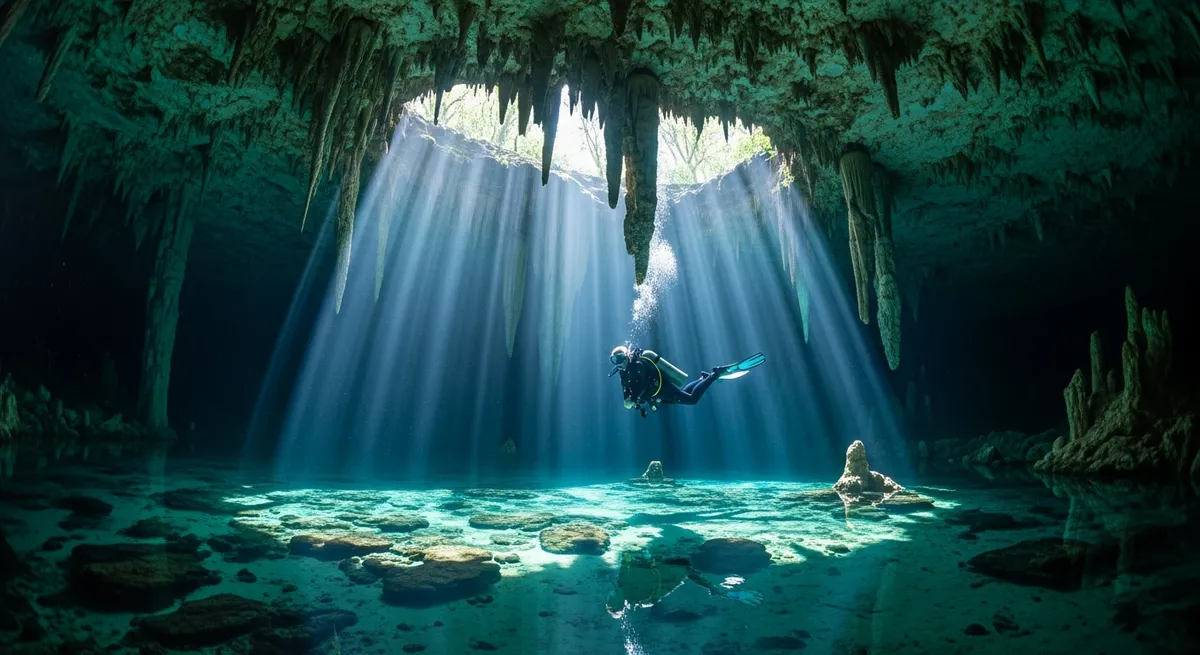
Diving in Yucatán Cenotes
Why dive here
Yucatán Cenotes offers some of Mexico's richest diving, with 417+ marine species recorded in the area - including barracuda, bull sharks, dolphins, eagle rays and hammerhead sharks.
Forget what you think you know about diving. The Yucatán Cenotes are a different beast entirely, and we absolutely love them for it. This isn't about reef fish or pelagics - though an occasional Lancer Stargazer or even a rare hammerhead might surprise you near an entrance. This is about light, shadow, and geological wonder. Descending into a cenote is like entering another world: shafts of sunlight pierce the jungle canopy, cutting through the absurdly clear freshwater like laser beams. You’ll weave between stalactites and stalagmites, following a guide line through passages that feel ancient and untouched. We’ve found that the best time to experience the famed light rays is generally late morning, usually between 11 AM and 1 PM, especially in popular spots like Dos Ojos or El Pit. It's truly magical watching the dust motes dance in those beams. Some of the deeper cenotes, like Angelita, offer an eerie hydrogen sulfide cloud that looks like an underwater river - a bizarre, unforgettable experience. Currents are non-existent, obviously, but buoyancy control is paramount. You don't want to kick up centuries of silt in these fragile systems. Our top tip? Hire a guide who knows the systems intimately; they’ll show you the subtle details you’d otherwise miss, like a tiny Pallid Goby darting between rocks. It's challenging, incredibly rewarding diving, and utterly unlike anything else on the planet.
Yucatán Cenotes Dive Site Map
Dive sites and dive centres in Yucatán Cenotes
Yucatán Cenotes Dive Sites
53 dive sites in Yucatán Cenotes
Acuario
Acuario gets its name for a reason, and it’s one we really enjoy for a relaxed morning or afternoon. While it's a shallow dive, topping out around 13 metres, it’s not just a sandy bottom. You’ll find some genuinely nice coral patches, particularly the robust Elkhorn coral, which is always a treat to see thriving. We’ve seen everything from schooling French grunts that shimmer in the sun, to the more elusive Chain Moray tucked into crevices. Keep an eye out for Sammy Johnson, the Puffer, and those surprisingly colourful Barber fish darting around. The real draw here, for us, is the sheer variety of smaller life. It's a fantastic spot for macro photography if you're into that, with plenty of opportunities to spot things like Spiny Brittle Stars or the curiously named Cook and Cluck fish. While the occasional Leatherback or Green Turtle might cruise by, Acuario consistently delivers on its promise of a vibrant, fish-filled experience without needing to go deep. It’s perfect for new divers building confidence or for experienced eyes wanting to slow down and truly observe. Visibility usually hangs around 19 metres, offering clear views of the busy reef.
Acuario
Acuario gets its name for a reason, and it’s one we really enjoy for a relaxed morning or afternoon. While it's a shallow dive, topping out around 13 metres, it’s not just a sandy bottom. You’ll find some genuinely nice coral patches, particularly the robust Elkhorn coral, which is always a treat to see thriving. We’ve seen everything from schooling French grunts that shimmer in the sun, to the more elusive Chain Moray tucked into crevices. Keep an eye out for Sammy Johnson, the Puffer, and those surprisingly colourful Barber fish darting around. The real draw here, for us, is the sheer variety of smaller life. It's a fantastic spot for macro photography if you're into that, with plenty of opportunities to spot things like Spiny Brittle Stars or the curiously named Cook and Cluck fish. While the occasional Leatherback or Green Turtle might cruise by, Acuario consistently delivers on its promise of a vibrant, fish-filled experience without needing to go deep. It’s perfect for new divers building confidence or for experienced eyes wanting to slow down and truly observe. Visibility usually hangs around 19 metres, offering clear views of the busy reef.
Akumal Reef
Akumal Reef, just a stone's throw from the Akumal Bay crowds, often gets overlooked for the cenotes. That’s a mistake, we think. This isn't a deep dive, peaking at about 17 metres, but what it lacks in depth it makes up for in sheer visibility and that classic Caribbean vibe. We love the feeling of drifting over the sandy patches, knowing a green sea turtle or a hawksbill is probably just around the corner, munching on seagrass. The reef itself is a pretty healthy example of the Mesoamerican system. You’ll find some respectable brain corals and those big, plate-like starlet corals. Keep an eye out for the smaller stuff too; we've spotted some brilliant Roughhead Triplefins tucked into crevices and the occasional Shy Brotula peeking out. Current here is usually mild, making it a very relaxed dive. It’s perfect for divers who want easy entry, predictable conditions, and a strong chance of hanging out with some very chill turtles.
Akumal Reef
Akumal Reef, just a stone's throw from the Akumal Bay crowds, often gets overlooked for the cenotes. That’s a mistake, we think. This isn't a deep dive, peaking at about 17 metres, but what it lacks in depth it makes up for in sheer visibility and that classic Caribbean vibe. We love the feeling of drifting over the sandy patches, knowing a green sea turtle or a hawksbill is probably just around the corner, munching on seagrass. The reef itself is a pretty healthy example of the Mesoamerican system. You’ll find some respectable brain corals and those big, plate-like starlet corals. Keep an eye out for the smaller stuff too; we've spotted some brilliant Roughhead Triplefins tucked into crevices and the occasional Shy Brotula peeking out. Current here is usually mild, making it a very relaxed dive. It’s perfect for divers who want easy entry, predictable conditions, and a strong chance of hanging out with some very chill turtles.
Angelita Cenote
Angelita Cenote is a striking dive, a deep sinkhole that takes you down through a layer of hydrogen sulfide. Below that spooky cloud, you'll find a submerged forest, trunks and branches reaching up from the bottom, creating an otherworldly scene. It's a dive that requires good buoyancy control and comfort with deeper, darker conditions. We'd suggest it for experienced divers looking for something truly unique.
Bahia Príncipe
Sometimes you just want an easy dive. No crazy currents, no deep deco, just a gentle cruise over a pretty reef, and that’s exactly what Bahia Príncipe delivers. We often hit it when we're shaking off travel or introducing someone to Caribbean diving because it’s so straightforward. You walk right in from the shore, fin out maybe fifty metres, and there’s the reef, topping out around 10 metres. The corals here are a mix of brain coral and starlet coral, punctuated by big barrel sponges. Not the most dramatic architecture you'll ever see, but healthy and full of life. We've spent ages watching French grunts schooling in the shade of coral heads, and the parrotfish here are always busy, especially the dark green ones. Keep an eye out for the shy brotula tucked into crevices; they’re a treat if you spot one. Visibility is usually around 20 metres, so you get a good long view of everything. It’s perfect for long, relaxed bottom times, just drifting and observing.
Bahia Príncipe
Sometimes you just want an easy dive. No crazy currents, no deep deco, just a gentle cruise over a pretty reef, and that’s exactly what Bahia Príncipe delivers. We often hit it when we're shaking off travel or introducing someone to Caribbean diving because it’s so straightforward. You walk right in from the shore, fin out maybe fifty metres, and there’s the reef, topping out around 10 metres. The corals here are a mix of brain coral and starlet coral, punctuated by big barrel sponges. Not the most dramatic architecture you'll ever see, but healthy and full of life. We've spent ages watching French grunts schooling in the shade of coral heads, and the parrotfish here are always busy, especially the dark green ones. Keep an eye out for the shy brotula tucked into crevices; they’re a treat if you spot one. Visibility is usually around 20 metres, so you get a good long view of everything. It’s perfect for long, relaxed bottom times, just drifting and observing.
Blue Ha Reef
Blue Ha Reef is a coral reef site in the Yucatán, offering a classic Caribbean dive. We've found the coral formations here are quite developed, providing plenty of nooks for smaller reef fish. It’s a straightforward dive, well-suited for those looking for an easy, relaxing drift over the reef, perhaps as a second dive. Expect typical Caribbean reef encounters.
Casa Cenote
Casa Cenote is a solid pick for a relaxed dive, especially if you’re new to cenote diving or just want an easy afternoon out. It’s essentially an open-air river, winding through a thick mangrove tunnel near Tulum. The water is a lovely emerald, and sunlight streams through the trees, making for some cool light play on the shallow bottom. Maxing out around 7 meters, it’s not about deep exploration but more about a gentle drift through the roots and rock formations. You’ll spot small fish like blennies and maybe a shy moray eel tucked into crevices, but the real draw is the unique environment itself. It’s perfect for snorkelers too, and we often take beginners here to get comfortable before moving onto deeper cenotes.
Cenote Angelita
Angelita is all about the halocline, a truly wild experience. You descend through clear fresh water, watching the light rays pierce the surface. Around 30 metres, you hit a thick, milky cloud of hydrogen sulphide, which looks exactly like an underwater river, complete with what appear to be fallen trees reaching up from the murky depths. Dropping below that cloud into the saltwater is like entering another world altogether, dark and eerie. It’s a dive that plays with your senses, perfect for those who appreciate the unusual over typical reef life. We’d suggest strong buoyancy control, as bumping the halocline ruins the effect for everyone.
Cenote Angelita
Angelita is all about the halocline, a truly wild experience. You descend through clear fresh water, watching the light rays pierce the surface. Around 30 metres, you hit a thick, milky cloud of hydrogen sulphide, which looks exactly like an underwater river, complete with what appear to be fallen trees reaching up from the murky depths. Dropping below that cloud into the saltwater is like entering another world altogether, dark and eerie. It’s a dive that plays with your senses, perfect for those who appreciate the unusual over typical reef life. We’d suggest strong buoyancy control, as bumping the halocline ruins the effect for everyone.
Cenote Angelita
Cenote Angelita, about a 20-minute drive south of Tulum, offers something genuinely different. You descend into a freshwater cavern, then hit a spooky hydrogen sulfide cloud around 30 meters down. It looks like an underwater river, complete with what appears to be trees poking out of its banks – really just fallen branches on the cloud itself. We’ve seen a few small freshwater fish darting around, but the real draw here is the geological oddity. It’s a compelling dive for advanced divers comfortable with deep, dark environments; definitely one to log if you’re looking for a unique photo opportunity.
Show all 53 dive sites in Yucatán Cenotes
- Cenote Azul
- Cenote Calavera
- Cenote Carwash
- Cenote Car Wash (Aktun Ha)
- Cenote Chan Hol
- Cenote Dos Ojos
- Cenote Dos Ojos
- Cenote Dos Palmas
- Cenote Dream Gate
- Cenote El Pit
- Cenote Nicte Ha
- Cenote Nohoch Nah Chich
- Cenote Taak Bi Ha
- Cenote Tajma Ha
- Cenote Tak Be Lum
- Cenote Yax-Chen
- Cuevitas
- DON EMILIO B
- Dreams Reef
- Escalones
- Faro Nuevo
- Ginger Scout
- Gran Cenote
- Jardin
- Kai Ha
- Kankirixche Cenote
- La Chiminea
- La China Nómada
- Laguna Kaan Luum
- La Poza, Xcalak
- Mahahual Reef
- Punta Gonzalez
- Punta Isabel
- Rio Bermejo
- Scorpion Reef
- Sieto Cocos
- Simio Bipolar
- SS Far Star
- Tankah II
- Tarpon Hole
- Xcalak
Yucatán Cenotes Dive Centres
2 dive shops and operators in Yucatán Cenotes
Ocean Wildlife in Yucatán Cenotes
417 species recorded in Yucatán Cenotes
Yucatán Cenotes Daylight & Sunrise/Sunset
Sunrise and sunset times for Yucatán Cenotes, calculated from coordinates
Today - Sunday 11 October
Sunrise
05:44
Sunset
17:32
Daylight
11h 48m
Golden Hour
17:03
First light (dawn) at 05:22 · Last light (dusk) at 17:54
Monthly Averages
| Month | Sunrise | Sunset | Daylight |
|---|---|---|---|
| Jan | 06:28 | 17:32 | 11h 4m |
| Feb | 06:21 | 17:50 | 11h 30m |
| Mar | 06:01 | 18:00 | 12h 0m |
| Apr | 05:34 | 18:08 | 12h 34m |
| May | 05:16 | 18:19 | 13h 3m |
| JunLongest | 05:12 | 18:31 | 13h 18m |
| Jul | 05:20 | 18:33 | 13h 13m |
| Aug | 05:31 | 18:21 | 12h 49m |
| Sep | 05:39 | 17:55 | 12h 17m |
| OctNow | 05:45 | 17:29 | 11h 44m |
| Nov | 05:59 | 17:12 | 11h 13m |
| DecShortest | 06:17 | 17:15 | 10h 57m |
Times are approximate local times based on longitude. Actual times may vary slightly depending on the exact timezone observed in Yucatán Cenotes.
Where to Stay near Yucatán Cenotes
Prices from Booking.com. We may earn a commission at no extra cost to you.
Marine Protected Areas near Yucatán Cenotes
20 protected areas near Yucatán Cenotes - please respect local regulations when diving
Caribe Mexicano
Sian Ka'an
Sian Ka'an
Sian Ka'an
Sian Ka'an
Banco Chinchorro
Reserva de la Biosfera Banco Chinchorro
Banco Chinchorro
Santuario del Manatí, Bahía de Chetumal
Arrecifes de Sian Ka'an
La porción norte y la franja costera oriental, terrestres y marinas de la Isla de Cozumel
Manglares y Humedales del Norte de Isla Cozumel
Showing 12 largest of 20
Getting to Yucatán Cenotes
Tulum
Cozumel
Cancún
Plan & book
Ways to dive Yucatán Cenotes, from day trips to liveaboards.
Day trips & courses
via GetYourGuideGuided dives, courses and snorkel trips with instant booking.
Find dive trips in Yucatán CenotesPlaces to stay
via Booking.comHotels and dive resorts near Yucatán Cenotes.
Search stays in Yucatán CenotesDive insurance
Most travel insurance excludes or limits scuba. Check what you need before you go.
Dive insurance explainedPartner links: we may earn a commission if you book, at no extra cost to you. How we make money