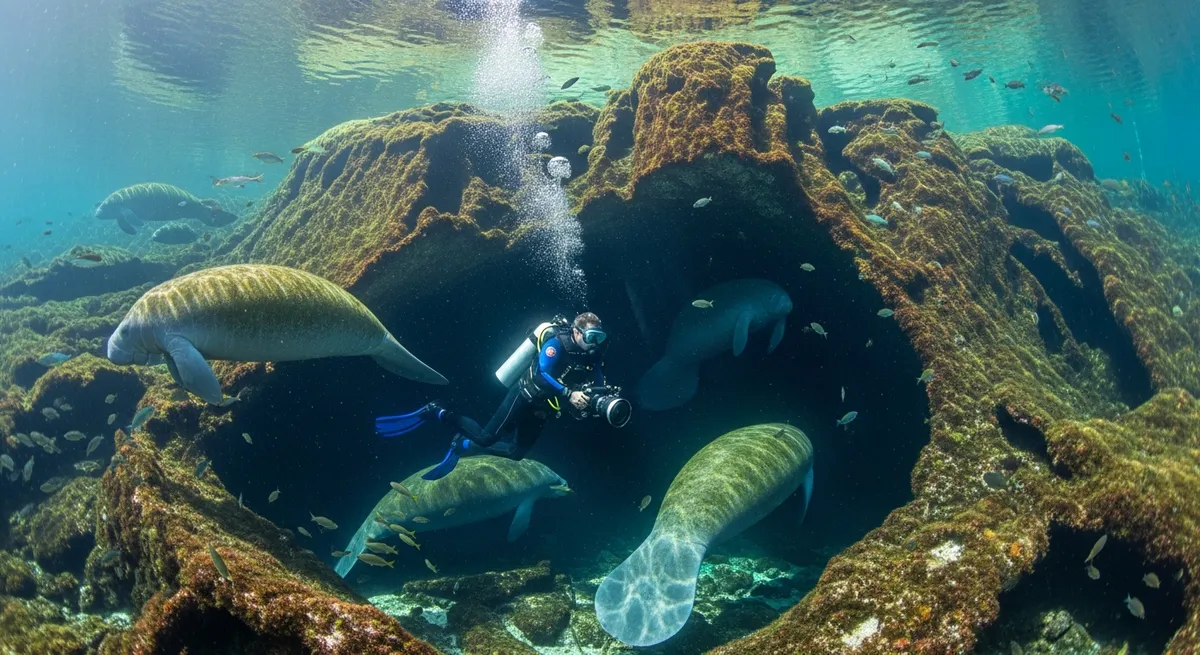
Diving in Florida Springs
Why dive here
Florida Springs offers some of United States's richest diving, with 142+ marine species recorded in the area - including dolphins, octopuses, seahorses, sea turtles and mantis shrimp. Water ranges 16-31°C, warmest June, July, August.
The Florida Springs are a different kind of dive, and we absolutely love them for it. Forget the ocean, here it’s all about the astonishing clarity of freshwater at a constant 22°C. Drifting through Ginnie Springs, the light rays pierce the water like spotlights, illuminating schools of tiny Inland Silversides, and if you’re lucky, you might spot a lazy Tarpon hanging in the current. Our top pick has to be Devil's Den - it’s a bit of a surreal experience, diving into what feels like a prehistoric cave with steam rising off the water in cooler months. We’d suggest going early to avoid the crowds, especially at Blue Spring when the manatees congregate in winter. The geology alone is worth the trip; those ancient limestone formations and the sheer power of the spring boils are genuinely captivating. It's a remarkably easy dive too, perfect for a relaxed afternoon exploring the silent, sun-dappled caverns and spotting little Killifish darting amongst the aquatic plants.
Florida Springs Dive Site Map
Dive sites and dive centres in Florida Springs
Florida Springs Dive Sites
120 dive sites in Florida Springs
Artificial Reef CCA - Deck Barge 2
The Artificial Reef CCA - Deck Barge 2 offers a straightforward dive on a sunken barge. It’s a decent spot for newer divers looking to get some wreck experience without strong currents or deep profiles. Expect to see smaller reef fish making homes in the structure, maybe some juvenile snapper or grouper. We think it's a good place for a relaxed afternoon bottom time.
Betsy Ross Reef - 175 Ship YO-224
The Betsy Ross Reef, centered around the YO-224 wreck, offers a solid dive for those exploring Florida's artificial reefs. We find schools of snapper often circling the superstructure, with barracuda patrolling the deeper sections. It’s a good spot for intermediate divers looking for a straightforward wreck dive in reasonable conditions. Visibility can vary, but we often get 15 meters here.
Betsy Ross Reef - 430 Liberty Ship
The Betsy Ross Reef, a Liberty Ship wreck, makes for a straightforward dive. Expect to see the typical encrusting corals and sponges that colonise these steel structures in Florida. It’s a good choice for divers looking to explore a piece of history without overly challenging conditions, suitable for those with some wreck experience.
Betsy Ross Reef - Bridge 1
Bridge 1, part of the Betsy Ross Reef system, offers a gentle introduction to coral diving in the Florida Keys. The reef here is fairly shallow and generally protected, making it a good spot for newer divers or those looking for a relaxed multi-level profile. You'll find a decent scattering of hard and soft corals, with the usual reef fish patrolling. It's not a site that will blow your mind, but it’s a solid, easy dive.
Cape Romain Reef
Cape Romain Reef offers a gentle introduction to Florida's spring diving. We’ve found the coral formations here are modest, but they do provide shelter for various smaller reef fish. It’s a good spot for newer divers or those looking for a relaxed dive without strong currents. Expect a tranquil experience rather than big pelagics.
Capers Reef
Capers Reef in Florida offers a straightforward coral dive. You’ll find a good spread of corals and reef fish, making it a decent spot for a relaxed exploration. It’s a solid choice if you're looking for a low-key dive without too much fuss, suitable for most experience levels.
Capers Reef - Caisson
Capers Reef, specifically the Caisson, offers a straightforward dive experience among Florida's spring systems. You'll find a notable caisson structure to explore, a clear indicator of human intervention in this freshwater environment. It's an interesting spot for divers looking to experience something a bit different from typical ocean reefs, well-suited for those keen on structural exploration over diverse marine species.
Capers Reef - Coast Guard Buoy R8
Capers Reef, marked by Coast Guard Buoy R8, is a drift dive along a low-relief coral reef. We’ve found decent hard coral formations here, with plenty of smaller reef fish darting between the crevices. It’s a good spot for a relaxed drift, particularly when the current is mild, suiting divers who enjoy a slow cruise over the reef rather than a high-octane pelagic encounter.
Capers Reef - Concrete Reef Balls 1
Capers Reef’s Concrete Reef Balls 1 site is a neat little artificial reef project. You’ll find purpose-sunk concrete structures that are slowly becoming home to various fish species, a good spot for observing the early stages of reef growth. It's a relatively easy dive, probably best for those keen on macro photography or divers looking for a relaxed exploration of a developing artificial habitat.
Capers Reef - Landing Craft 1
Capers Reef is known for its Landing Craft 1, sitting upright on the sandy bottom at around 20 meters. It’s a manageable dive, with visibility often decent, letting you explore the wreck's structure. You’ll typically find a good number of reef fish taking shelter, plus the occasional turtle passing by. It's a solid choice for those looking for a straightforward wreck dive without major currents or depths.
Capers Reef - Tug Boat
The Tug Boat at Capers Reef offers a solid dive for those exploring Florida's coast. You'll find the wreck sitting upright, mostly intact, between 15 and 30 metres. It’s a good spot for spotting some of the common reef fish and occasionally a passing turtle, a relatively easy dive, best suited for advanced open water divers comfortable with depths.
Capers Reef - Unknown Barge
Capers Reef, out from Jupiter, gives you a bit of everything. The "Unknown Barge" is a mystery, a decent-sized wreck sitting around 20-25m, often covered in gorgonians and sponges. We've seen turtles cruising by and plenty of schooling fish taking refuge. It’s a solid dive for those comfortable with deeper recreational limits and some current.
Show all 120 dive sites in Florida Springs
- Charleston Nearshore Reef
- Charleston Sixty Reef - 240 Barge
- Charleston Sixty Reef - Army APCs 1
- Charleston Sixty Reef - Concrete Reef Balls
- Charleston Sixty Reef - Missiles Equip Sects
- Charleston Sixty Reef - Missile Sleeve
- Charleston Sixty Reef - Steel Pup Tents 1
- Cherokee Sink
- City Service Tanker
- C J Davidson Jr Reef
- Comanche Reef - 165 CG Cutter
- Cooper River - Moncks Corner
- Crew Boat Mary Lou
- Crystal River - Hunter Spring
- Crystal River - King s Spring
- Crystal River - Three Sisters Springs
- DeLeon Sprongs
- Devil's Den
- Devil s Hole
- Eagles Nest Reef
- Eagles Nest Reef - Landing Craft 2
- Edisto Forty Reef
- Edisto Offshore Reef - Deckhouse
- Edisto Sixty Reef
- El Capitana
- Forty Fathom Grotto
- Frederick W. Day Wreck, Offshore Charleston, SC
- Fripp Island Drydock Wreck
- Fripp Island Reef
- Gaskins Bank Wreck
- General Gordon Wreck
- Ginnie Springs
- Greenville Reef
- Hector Reef
- Hilton Head Reef
- Hilton Head Reef - 50 Barge
- Hudson Grotto
- Hunting Island Reef
- Kiawah Reef - 100 Deck Barge
- Kiawah Reef - 100 Pusher Tug
- Kiawah Reef - 300 Hopper Barge
- Kiawah Reef - 90 Tug Coppedge
- Kiawah Reef - Automobiles
- Kiawah Reef - North Buoy
- Kiawah Reef - South Buoy
- King s Park Lake
- Lake Hollywood
- Lake Scooba
- Little River
- Lowcountry Anglers Reef
- Manatee Springs
- North Edisto Nearshore
- Paradise Springs
- Parris Island Reef
- Rainbow River
- Rainbow Spring
- Rainbow Spring North
- Reef CCA - Deck Barge
- Reef CCA - SMS Warehouse Barge
- Reef CCA - Tug Matt Turecamo
- Reef C - Esparta Wreck
- Reef C - M-60 Battle Tanks
- Reef DRH - John Bird Wreck
- Reef DRH - RV Zapala
- Reef DRH - Tug Rio Caroni
- Reef DW - Dump Scow
- Reef F - Landing Craft 1
- Reef G - Liberty Ship Nettleton
- Reef G - M-60 Battle Tanks
- Reef G - Tug Mac Tide 21
- Reef G - Tug Recife
- Reef G - Tug Tampa
- Reef G - Work Boat Striker
- Reef J - Buoy Tender Sagebrush
- Reef J - Ferry Boat Janet
- Reef J - Liberty Ship Daniels
- Reef J - M-60 Battle Tanks
- Reef J - Tug Elmira
- Reef J - Tug Rio Apon
- Reef KC - Deck Barge
- Reef KC - Dump Scow
- Reef KC - Honey Barge
- Reef KC - Motherlode Barge
- Reef KC - Olympics Barge
- Reef KC - Sailboat Jupiter
- Reef KTK - Barge Modena
- Reef L - Dredge Henry Bacon
- Reef L - Latex Barge
- Reef L - M-60 Battle Tanks
- Reef L - Tug Delta Diamond
- Reef L - Tug Senasqua
- Reef SFC - Landing Craft Optimist
- Reef SFC - M-60 Battle Tanks
- Reef WW - Hopper Barge
- Reef WW - Tug Semarca 40
- Sally Ward Spring
- Sheridan
- Spanish Rocks
- Steel-hulled drydock section
- The Breckenshire
- The Jewel
- The Living Seas
- Whitewater Reef
- Wreck of H. L. Hunley
- Y-73 Reef
- Y-73 Reef - 90 Tug Kimberly
- Y-73 Reef - 90 Tug Tanda 9
- Y-73 Reef - Steel Pup Tents
Florida Springs Dive Centres
8 dive shops and operators in Florida Springs
Ocean Wildlife in Florida Springs
142 species recorded in Florida Springs
Florida Springs Daylight & Sunrise/Sunset
Sunrise and sunset times for Florida Springs, calculated from coordinates
Today - Sunday 11 October
Sunrise
06:23
Sunset
17:58
Daylight
11h 35m
Golden Hour
17:26
First light (dawn) at 05:59 · Last light (dusk) at 18:22
Monthly Averages
| Month | Sunrise | Sunset | Daylight |
|---|---|---|---|
| Jan | 07:23 | 17:42 | 10h 19m |
| Feb | 07:06 | 18:10 | 11h 3m |
| Mar | 06:35 | 18:31 | 11h 56m |
| Apr | 05:56 | 18:51 | 12h 55m |
| May | 05:28 | 19:12 | 13h 44m |
| JunLongest | 05:19 | 19:29 | 14h 11m |
| Jul | 05:29 | 19:30 | 14h 1m |
| Aug | 05:48 | 19:08 | 13h 20m |
| Sep | 06:07 | 18:32 | 12h 24m |
| OctNow | 06:26 | 17:53 | 11h 28m |
| Nov | 06:50 | 17:26 | 10h 36m |
| DecShortest | 07:15 | 17:22 | 10h 7m |
Times are approximate local times based on longitude. Actual times may vary slightly depending on the exact timezone observed in Florida Springs.
Where to Stay near Florida Springs
Prices from Booking.com. We may earn a commission at no extra cost to you.
Marine Protected Areas near Florida Springs
37 protected areas near Florida Springs - please respect local regulations when diving
Ashepoo-Combahee-Edisto (ACE) Basin National Estuarine Research Reserve
Guana Tolomato Matanzas National Estuarine Research Reserve
Guana Tolomato Matanzas
Nassau River - St. Johns River Marshes Aquatic Preserve
Guana River Marsh Aquatic Preserve
Gray's Reef National Marine Sanctuary
Timucuan Ecological & Historic Preserve
Cumberland Island National Seashore
Fort Clinch State Park Aquati State Park
Timucuan Ecological and Historic
Fort Pulaski National Monument
Daws Island
Showing 12 largest of 37
Getting to Florida Springs
St Simons Island
Savannah
Jacksonville
Plan & book
Ways to dive Florida Springs, from day trips to liveaboards.
Day trips & courses
via GetYourGuideGuided dives, courses and snorkel trips with instant booking.
Find dive trips in Florida SpringsPlaces to stay
via Booking.comHotels and dive resorts near Florida Springs.
Search stays in Florida SpringsDive insurance
Most travel insurance excludes or limits scuba. Check what you need before you go.
Dive insurance explainedPartner links: we may earn a commission if you book, at no extra cost to you. How we make money