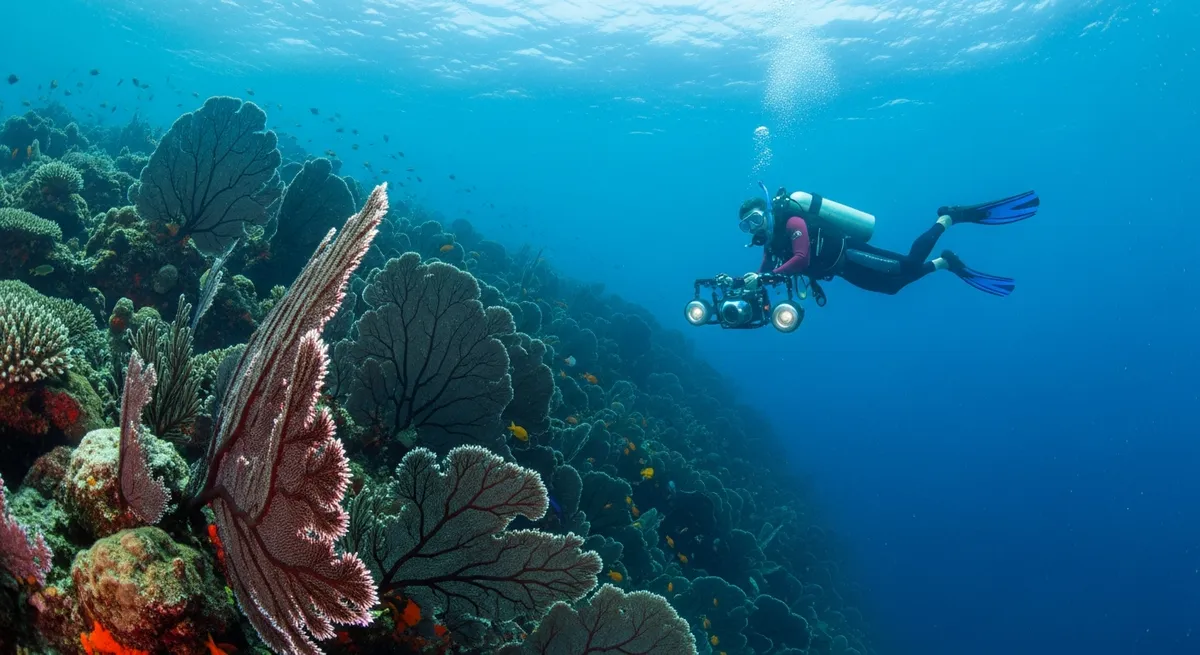
Diving in María la Gorda
Why dive here
María la Gorda offers some of Cuba's richest diving, with 109+ marine species recorded in the area - including blue sharks, oceanic whitetip sharks, sea turtles, sperm whales and manatees. Water ranges 27-31°C, warmest July, August, September.
María la Gorda really sticks out from the usual Caribbean spots. We love that it’s such a trek to get there, because it means the reefs stay quiet. You’re diving walls draped in black coral, some of the most extensive formations we've seen, and the water feels incredibly clean. The sheer size of the mustard hill coral colonies here is impressive, they just seem to go on forever, forming these complex, multi-layered structures that are a real treat to explore. Our favourite dive is often on the deeper sections, maybe 20-30m, where we’ve regularly encountered schools of mutton snapper so thick they momentarily dim the light. Keep an eye out for the barracudina, sleek and silver, they glide past with an almost effortless grace. We’ve had some truly memorable moments just hanging out, watching key worm eels poking their heads from the sand. The best time to visit is probably outside hurricane season, roughly November through May, when the visibility is consistently excellent, often pushing 30 metres, and the currents are generally mild, making it very comfortable for newer divers. Even though it's remote, the dive operations here are well-run and friendly, a welcome relief after the long drive.
María la Gorda Dive Site Map
Dive sites and dive centres in María la Gorda
María la Gorda Dive Sites
38 dive sites in María la Gorda
Acuario
Acuario, just off María la Gorda, feels like swimming through a massive fishbowl, hence the name. We usually see schools of snapper and grunt here, sometimes so many that the light gets dim. It's a relaxed dive, good for photographers or anyone wanting to just observe fish behaviour without strong currents. Expect healthy gorgonians and a few resident morays.
Balena Moby Dick
Balena Moby Dick isn't your usual Caribbean dive site, and that's precisely why we love it. Instead of a pristine reef, you're descending onto a sunken whale processing vessel, deliberately scuttled back in the 70s. It’s sitting upright on a sandy bottom at around 20 metres, and its sheer size gives it a slightly eerie, almost ghostly presence. We always feel a real sense of history here, poking around the open holds where the ship's work once happened. Inside, the light filters through gaps in the hull, illuminating schools of snapper and grunts that hang motionless. Look closely, and you’ll spot moray eels tucked into crevices, their heads peeking out, and we’ve often seen big barrel sponges growing off the metal. The structure itself is a fantastic canvas for macro life; nudibranchs and small crabs are everywhere if you take your time. This spot is brilliant for photographers who appreciate the drama of a wreck and the way marine life adapts to a new habitat. It's a relaxed dive, usually with minimal current, making it accessible for most experience levels, and a welcome change from endless coral heads.
Cabeza de Marcel
Cabeza de Marcel offers a relaxed dive, good for shaking off the travel rust or enjoying a calmer afternoon. The main attraction here is a healthy wall dropping to around 20 meters, with several swim-throughs carved into the coral. We often spot barracudas hanging in the blue and big schools of grunts tucked into the overhangs. It’s a solid choice for macro enthusiasts and photographers looking for a less current-swept spot.
CAYMAN TRANSPORT
The Cayman Transport at María la Gorda isn’t about depth, it’s about history and how the sea reclaims things. This carrier vessel ran aground in 1972 and was abandoned, its skeleton now sprawled in just four metres of water. We love a wreck with a story, and this one, so close to the surface, feels incredibly intimate. You can fin right over its deck plates, peering down into the open holds where light shafts cut through the water, illuminating schools of tiny silversides that flicker like scattered glitter. Our favourite part is the bow, which really shows its age. Rusting metal drapes and peels, creating nooks and crannies that have become home to small parrotfish and damselfish. You’ll feel the gentle surge pushing you just a little, a reminder of the forces that put it here. It's a fantastic spot for a long, relaxed dive, perfect for photographers wanting to capture the contrast of decaying steel and vibrant new life. We’d suggest going early in the morning, before the sun gets too high, for the best light on the wreck.
Cruz Corsario
Cruz Corsario offers a classic Caribbean wall dive just off María la Gorda. You'll drop onto a plateau before the reef slopes down, often with schooling jacks and snapper cruising by. It’s a solid pick for divers looking for easy access to decent reef health and a chance to spot some larger pelagics in the blue. The site generally suits all experience levels, assuming calm conditions.
Cueva Azul
Cueva Azul, or Blue Cave, is a favourite for a reason near María la Gorda. You'll drop into a large cavern, the entrance wide open to the Caribbean sun, filtering down into the blue light that gives the cave its name. We've seen reef sharks patrolling the deeper sections and often find schools of jacks circling just outside the mouth. It’s a straightforward cave dive, good for those looking for their first overhead experience.
Cueva del Ensueno
Cueva del Ensueno, or "Cave of Dreams," is a good option if you’re looking to explore some overhead environments in María la Gorda. This cave system has several chambers to poke around in, with plenty of resident reef fish darting in and out of the shadows. It’s a rewarding dive for those comfortable with cavern diving, offering a different kind of Caribbean experience.
DOLLART
Dollart isn't your typical deep wreck dive. We're talking two metres, tops, barely enough to dunk your snorkel. But don't let the shallowness fool you; this is one of our favourite spots in María la Gorda for pure, unadulterated chill. The motor vessel Dollart ran aground back in 1972, and since then, the Caribbean has slowly but surely taken it over. You fin out just a short distance from shore, and there it is: the bow, barnacle-encrusted, breaking the surface. Duck your head under, and you're immediately in the heart of it. Schools of tiny silversides shimmer around the decaying superstructure, darting in and out of what used to be crew quarters. It's a proper playground for macro life, and we love just hovering, watching the gobies and blennies peek out from every crevice. You can practically swim the length of the deck, poking around rusted winches and collapsed bulkheads. The light here is incredible, filtering through the surface and making the whole scene glow. It’s a perfect second or third dive, or even a snorkel, for when you want something easy, beautiful, and a little bit eerie. If you're into photography, especially wide-angle ambient light shots, this spot is golden.
El Almirante
El Almirante, off María la Gorda, offers some interesting dives, particularly for those who appreciate healthy gorgonian fields. We've seen plenty of nurse sharks here, often just resting under ledges. It's a relaxed dive, typically with mild current, making it a good choice for newer divers or anyone looking for a less demanding afternoon. You'll find it’s a reliable spot for a calm exploration.
El Ancla de Francois
El Ancla de Francois, out of María la Gorda, is a straightforward boat dive. We’ve found a pleasant reef here, nothing too dramatic, but consistently home to schools of snapper and grunt. The main draw is a large old anchor, partially encrusted and providing a good photo opportunity. It’s a solid choice for an easy second dive or for divers who appreciate relaxed underwater exploration without strong currents.
El Cabezo de las Isabelitas
Dropping onto the reef at El Cabezo de las Isabelitas, we usually find a good density of sponges and gorgonians covering the hard coral substrate. Keep an eye out for schooling snapper and grunts moving through the deeper sections. It's a straightforward dive, generally calm, making it a solid choice for newer divers looking for a relaxed Caribbean experience. We think it's a pleasant dive, not overly dramatic, but reliably good for a couple of hours underwater.
El Cangilon
El Cangilon, in María la Gorda, is a consistent favourite for its healthy reef. You’ll find walls dropping steeply, covered in sponges and gorgonians, with plenty of small reef fish like grunts and snappers. It’s a solid dive for those who appreciate healthy coral formations and a relaxed pace. We’d suggest it for divers looking for a straightforward, pretty Caribbean reef experience.
Show all 38 dive sites in María la Gorda
- El Encanto
- El Escondite del Buzo
- El Jardin de la Gorgonia
- El Jardin de la Reina
- El Pasaje Escondido
- El Patio de Vanessa
- El Pequeno Reino
- El Salon de Maria
- La Cadena Misteriosa
- La Peguena Pared
- Las Cuevas de Bebo
- MARIA DE LOS ANGELES
- Maria La Gorda
- María la Gorda: Centro International Buceo
- Off Limit
- ORIENTAL CHALLENGER
- Paraiso de Muke
- Paraiso Perdido
- Pecios Cayo los Indios
- PORTO PENA
- Reino Magico
- Salon Maravilloso
- SANTO DOMINGO
- TANIA
- Tunel del Amor
- Yemaya
María la Gorda Dive Centres
9 dive shops and operators in María la Gorda
Blue centro de buceo
Blue Scuba Dive Club
Centro de buceo Caballeros de Mar
Centro de Buceo Cuba Ocean Diving
Centro de Buceo Cuba Ocean Diving - La Habana
Club de Buceo
Club de Buceo
Club de Buceo MarAbierto
Show all 9 dive centres in María la Gorda
Ocean Wildlife in María la Gorda
109 species recorded in María la Gorda
María la Gorda Daylight & Sunrise/Sunset
Sunrise and sunset times for María la Gorda, calculated from coordinates
Today - Sunday 11 October
Sunrise
05:30
Sunset
17:16
Daylight
11h 46m
Golden Hour
16:46
First light (dawn) at 05:08 · Last light (dusk) at 17:38
Monthly Averages
| Month | Sunrise | Sunset | Daylight |
|---|---|---|---|
| Jan | 06:17 | 17:13 | 10h 56m |
| Feb | 06:08 | 17:33 | 11h 25m |
| Mar | 05:46 | 17:45 | 11h 59m |
| Apr | 05:18 | 17:55 | 12h 38m |
| May | 04:58 | 18:08 | 13h 10m |
| JunLongest | 04:53 | 18:20 | 13h 27m |
| Jul | 05:02 | 18:23 | 13h 21m |
| Aug | 05:14 | 18:08 | 12h 54m |
| Sep | 05:23 | 17:41 | 12h 18m |
| OctNow | 05:32 | 17:13 | 11h 41m |
| Nov | 05:47 | 16:54 | 11h 7m |
| DecShortest | 06:07 | 16:56 | 10h 49m |
Times are approximate local times based on longitude. Actual times may vary slightly depending on the exact timezone observed in María la Gorda.
Where to Stay near María la Gorda
Prices from Booking.com. We may earn a commission at no extra cost to you.
Marine Protected Areas near María la Gorda
20 protected areas near María la Gorda - please respect local regulations when diving
Cayo Campos - Cayo Rosario
Golfo de Batabanó
Sur de la Isla de la Juventud
Peninsula de Guanahacabibes
Peninsula de Guanahacabibes
Este del Archipiélago de los Colorados
Ciénaga de Lanier y Sur de la Isla de la Juventud
Cayería de las Cayamas - Los Guzmanes
Los Pretiles
Punta del Este
Cayos de San Felipe
Cayo Levisa- Corona de San Carlos
Showing 12 largest of 20
Getting to María la Gorda
Sandino
Havana
Matanzas
Plan & book
Ways to dive María la Gorda, from day trips to liveaboards.
Day trips & courses
via GetYourGuideGuided dives, courses and snorkel trips with instant booking.
Find dive trips in María la GordaPlaces to stay
via Booking.comHotels and dive resorts near María la Gorda.
Search stays in María la GordaDive insurance
Most travel insurance excludes or limits scuba. Check what you need before you go.
Dive insurance explainedPartner links: we may earn a commission if you book, at no extra cost to you. How we make money