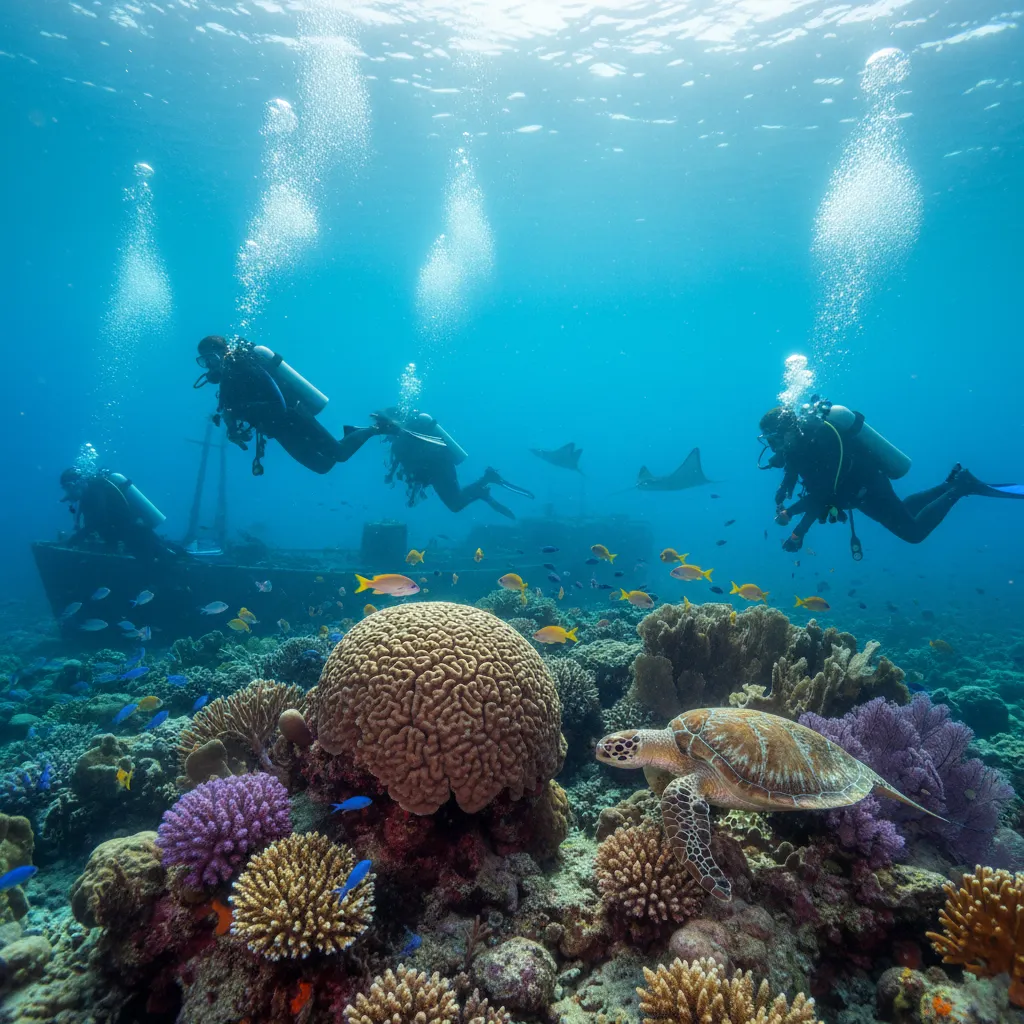
Diving in Sosua & Puerto Plata
Why dive here
Sosua & Puerto Plata offers some of Dominican Republic's richest diving, with 232+ marine species recorded in the area - including barracuda, humpback whales, orcas, sea turtles and sperm whales. Water ranges 27-30°C, warmest September, October, November.
Sosua and Puerto Plata offer a different flavour of Caribbean diving. This isn't your placid, mirror-flat stuff; the north coast faces the Atlantic, bringing with it a more dynamic energy. We love the wall dives here, especially sites like Airport Wall, where the reef really drops away into the blue. You’ll spot plenty of jacks cruising past, and the Finger Coral formations are particularly striking. Our favourite time to dive is in the calmer summer months when visibility averages 20 metres. Winter can bring stronger swells, but it’s still perfectly diveable, just a bit more of a workout. Keep an eye out for the Christmas Tree Hydroid Nudibranchs, they’re tiny but truly mesmerising if you slow down and look closely. There’s a nice mix of reef and wreck here too, with some accessible caverns adding a touch of adventure. We'd suggest asking your dive centre about the current conditions before heading out, as they can shift. This area is honest, solid Caribbean diving, a bit rugged but always rewarding.
Sosua & Puerto Plata Dive Site Map
Dive sites and dive centres in Sosua & Puerto Plata
Sosua & Puerto Plata Dive Sites
24 dive sites in Sosua & Puerto Plata
3 Rocks
3 Rocks is a straightforward dive off Sosua, ideal for an easy afternoon in the water. We often spot schools of wenchman and slender parrotfish darting around the rocky formations. It’s a good spot for newer divers, or anyone looking for a relaxed outing without strong currents. Keep an eye out for the occasional mushroom scorpionfish camouflaged on the bottom.
Airport Wall
Airport Wall lives up to its name, a gentle coral slope dropping from 8m down to 25m. We’ve had good luck spotting seahorses tucked into the corals, and sometimes frogfish if you’re really looking closely. It’s a solid pick for newer divers or those who enjoy a slower pace, giving you plenty of time to hunt for macro life.
ALSATIA
We’re going to be blunt: Alsatia isn't a typical Caribbean wreck dive. Forget deep, intact ships with massive swim-throughs. This is a shallow, scattered debris field, but don't let that put you off. What we love about Alsatia is its history, and how the ocean has slowly reclaimed it. You’re diving on the remains of a German freighter, torpedoed by a U-boat in 1942. The wreck lies in just five meters of water, totally broken up, so you’ll see scattered metal plates, twisted beams, and bits of superstructure spread across the sandy bottom. This extreme shallowness means incredible light penetration, painting everything in bright blues and greens. Look for parrotfish nibbling algae off the rusted metal, and small groups of snapper darting between the debris. We’ve often found a nurse shark or two napping under a larger piece of hull. It’s a gentle, easy dive, perfect for photographers wanting to capture light and texture, or for newer divers to experience a wreck without the depth. Our favourite time to dive it is mid-morning, when the sun is high, really illuminating the sand and attracting the smaller schooling fish. It’s a site that rewards patience and a keen eye for detail.
Canyon
The Canyon is a good drift dive, best suited for intermediate divers. We often see nurse sharks resting in the sandy bottom, and the overhangs provide shelter for smaller reef fish like slender parrotfish and barberfish. Currents can be strong, pushing you along the wall, so keep an eye on your dive buddy. It’s a solid option for a second dive in Sosúa if you’re looking for something with a bit of movement.
Canyon
The Canyon, off Sosua, offers an interesting geological dive. You'll descend into a series of narrow swim-throughs and small caverns, cutting through the reef. It’s not about big fish here, but rather the unique topography and the play of light filtering through the openings. We’d suggest this site for divers who appreciate interesting reef structures over pelagic encounters.
Canyons - Dominican Republic
This site is full of coral reefs, canyons, swims-through, and arches. Depth is in between 7 and 14 meters. This site is great for a refresher dive to work on buoyancy, or for more advanced divers to explore around. Maximum depth: 15m. Average visibility: 15m. Very high possibility to spot big crabs (centollo). Occasional nurse sharks sleeping in the tunnels. Tropical species. Occasional lionfish.
Cinco Metros, Las Ballenas
Close from the Ballenas Islands, “Cinco Metro“ is a dive site beginning at 2m deep and slowly going down until 6m. Perfect place for snorkeling and first-time dives! Maximum depth: 12m. Average visibility: 13m. A lot of fan coral and brain coral. Also some schools of snappers, surgeonfishes, and parrot fish. Some chances to find octopus, sea cicada, lobster, and giant crabs
Coral Gardens - Dominican Republic
Coral Gardens is a pleasant little wall dive near Sosua. We usually hit a max depth of 16 meters, where the mini wall itself bottoms out. The reef is actually in pretty good shape around here, with plenty of colorful corals and sponges clinging to the wall and spilling onto the sandy bottom. You’ll spot a good number of cushion sea stars, queen angelfish are common, and we’ve seen lobsters tucking into crevices. Keep an eye out for spotted sand snake eels in the sand and yellow stingrays gliding past. It's a relaxed dive, good for getting back into the swing of things.
Five Rocks
Five Rocks is a good stop for spotting some of the smaller, shyer reef inhabitants in Sosua. We’ve often found fringed filefish hovering near the rocky outcrops and spotted mushroom scorpionfish blending into the seabed. It’s a shallower site, making it a relaxed dive for newer divers or those who enjoy taking their time to seek out camouflaged creatures. Expect to see plenty of slender parrotfish grazing the algae.
Jackson Sunken Island
Jackson Sunken Island is less an island, more a scatter of history. Local legend tells of a small isle that just… disappeared, and what’s left is a truly fantastic, shallow dive. We love this site for its unique character. You’re essentially exploring the remnants of an old concrete structure, now completely taken over by the sea. Think big, chunky blocks and twisted rebar, all encrusted with corals, acting as a magnet for fish. The maximum depth of 11 metres makes this a really relaxed dive, perfect for a long bottom time. We’ve spent whole dives just poking around the nooks and crannies. Keep an eye out for the resident moray eels peeking from crevices; they seem particularly fond of the old concrete. The sandy patches surrounding the main structure are prime ray territory, so don’t forget to scan the bottom. We’ve often seen southern stingrays gliding away as we approach, and the turtlegrass beds are home to some surprisingly well-camouflaged slender filefish. Visibility averages about 9 metres, which feels ample when you're focusing on the structure and its residents. It's a peaceful site, full of small discoveries, making it ideal for photographers or anyone who enjoys a leisurely exploration.
Jet Ski
2 jet skis sunken on purpose at 60ft at the bottom of a coral pinnacle. Great for pictures and also for navigation, to go from one coral head to another one Maximum depth: 16m. Average visibility: 13m. Jet ski. Possible turtle and ray. Lion fish, Plenty of small tropical species brightly colored. Nice coral mounts.
La Piedra Prieta
La Piedra Prieta is a decent spot if you're diving out of Sosua, offering a pretty typical Caribbean reef experience. You'll find a nice spread of coral here, with plenty of nooks to poke around in. We often spot hawksbill turtles cruising by, and if you take it slow, you might catch a glimpse of an opossum pipefish tucked away. It's a relaxed dive, good for stretching out your bottom time, especially if you're hoping to tick off a few smaller species like the Mimic Triplefin or Frecklefin Goby. We'd say it’s a good option for a second dive of the day, or if you're after something less demanding.
Show all 24 dive sites in Sosua & Puerto Plata
Sosua & Puerto Plata Dive Centres
1 dive shop and operator in Sosua & Puerto Plata
Ocean Wildlife in Sosua & Puerto Plata
232 species recorded in Sosua & Puerto Plata
Sosua & Puerto Plata Daylight & Sunrise/Sunset
Sunrise and sunset times for Sosua & Puerto Plata, calculated from coordinates
Today - Sunday 11 October
Sunrise
05:36
Sunset
17:24
Daylight
11h 48m
Golden Hour
16:54
First light (dawn) at 05:14 · Last light (dusk) at 17:46
Monthly Averages
| Month | Sunrise | Sunset | Daylight |
|---|---|---|---|
| Jan | 06:20 | 17:24 | 11h 4m |
| Feb | 06:12 | 17:42 | 11h 30m |
| Mar | 05:52 | 17:52 | 12h 0m |
| Apr | 05:26 | 18:00 | 12h 34m |
| May | 05:08 | 18:10 | 13h 2m |
| JunLongest | 05:04 | 18:22 | 13h 18m |
| Jul | 05:12 | 18:25 | 13h 13m |
| Aug | 05:23 | 18:12 | 12h 49m |
| Sep | 05:30 | 17:47 | 12h 17m |
| OctNow | 05:37 | 17:21 | 11h 44m |
| Nov | 05:50 | 17:04 | 11h 14m |
| DecShortest | 06:09 | 17:06 | 10h 58m |
Times are approximate local times based on longitude. Actual times may vary slightly depending on the exact timezone observed in Sosua & Puerto Plata.
Where to Stay near Sosua & Puerto Plata
Prices from Booking.com. We may earn a commission at no extra cost to you.
Marine Protected Areas near Sosua & Puerto Plata
20 protected areas near Sosua & Puerto Plata - please respect local regulations when diving
Bancos de La Plata y La Navidad
Los Humedales de Montecristi y la Línea Noroeste
Francisco Alberto Caamaño Deñó
Monte Cristi
Santuario Marino del Norte
Gran Estero
Cayos Siete Hermanos
Manglar de la Jina
La Hispaniola
Humedales del Bajo Yaque del Sur
Laguna Gri-Grí
Estero Hondo
Showing 12 largest of 20
Getting to Sosua & Puerto Plata
Santiago
Santo Domingo
Cap Haitien
Plan & book
Ways to dive Sosua & Puerto Plata, from day trips to liveaboards.
Day trips & courses
via GetYourGuideGuided dives, courses and snorkel trips with instant booking.
Find dive trips in Sosua & Puerto PlataPlaces to stay
via Booking.comHotels and dive resorts near Sosua & Puerto Plata.
Search stays in Sosua & Puerto PlataDive insurance
Most travel insurance excludes or limits scuba. Check what you need before you go.
Dive insurance explainedPartner links: we may earn a commission if you book, at no extra cost to you. How we make money