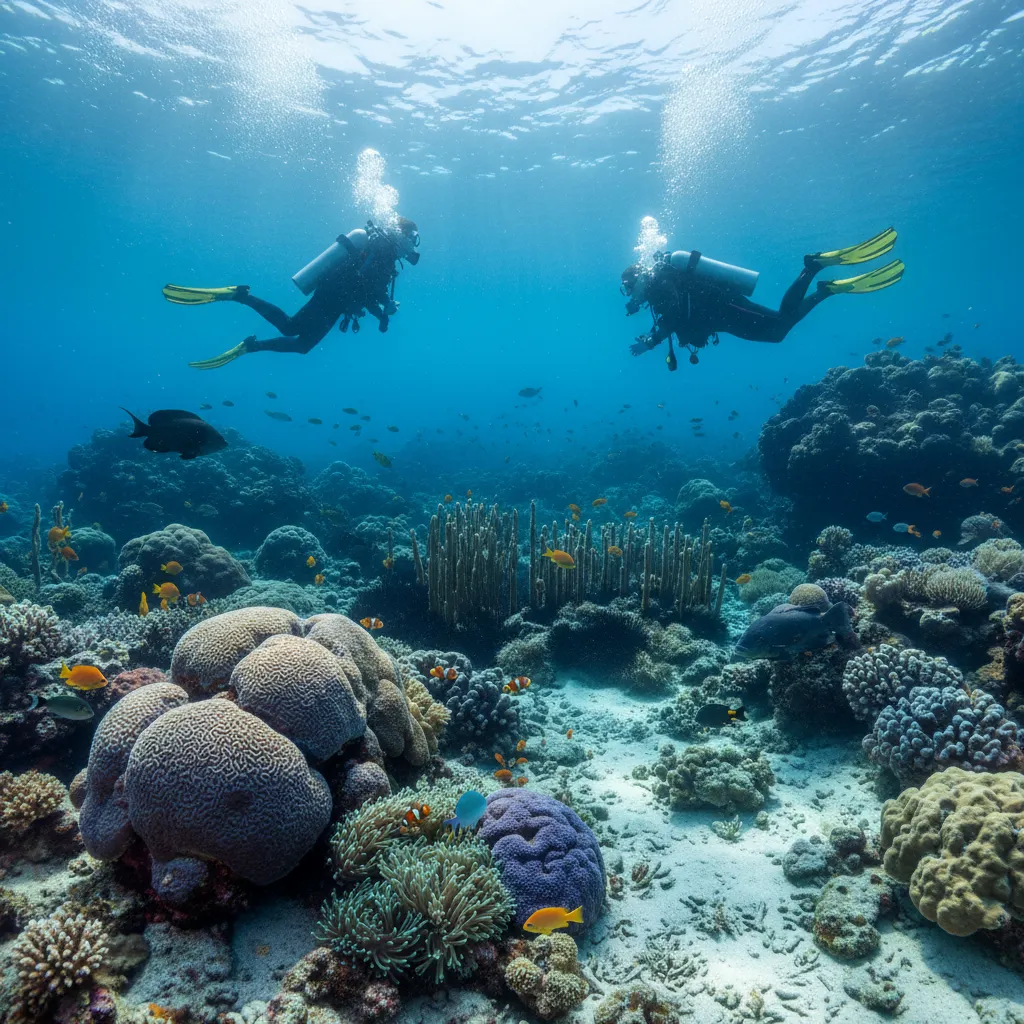
Diving in Jeju Island
Why dive here
Jeju Island offers some of South Korea's richest diving, with 113+ marine species recorded in the area - including great white sharks, hammerhead sharks, mobula rays (devil rays), octopuses and sea turtles.
Jeju Island is where we head when we want something a little different, a stark contrast to the tropical dive sites we often frequent. It’s got a raw, volcanic beauty, with dramatic basalt formations that create incredible swim-throughs and overhangs. The soft coral forests here are just phenomenal, carpets of yellows, oranges, and purples clinging to the rocks. We often spot Mimka bobtail squid jetting around the crevices or a Japanese stargazer half-buried in the sand, just its eyes peeking out. Our favourite time to dive Jeju is in autumn. The water is still warm, around 20-22°C, and the visibility can stretch to 20 metres or more. We always make a point to visit Munseom Island, particularly the ‘Seopseom Corner’ site. That’s where you’ll find the densest soft coral, along with schools of scad swirling like silver tornadoes. The currents can pick up a bit, so we’d suggest going with a local guide who knows the tides. Keep an eye out for the famed haenyeo, Jeju’s women free-divers; seeing them work is a powerful reminder of the ocean's enduring culture here. It’s not about big pelagics, it’s about the intricate details, the unique species, and the sheer, rugged beauty of the underwater landscape.
Jeju Island Dive Site Map
Dive sites and dive centres in Jeju Island
Jeju Island Dive Sites
19 dive sites in Jeju Island
범섬
Bumseom off Jeju offers a relaxed dive to 19m, making it a good spot for newer divers. You'll find a series of rock formations and a collection of temperate water species – we’ve seen everything from small nudibranchs to occasional schooling fish. It’s a solid, easy dive, particularly good if you're looking for a comfortable entry into Jeju's diving scene.
BANGJOO NO.12
Bangjoo No. 12 isn't one of those wrecks that's instantly photogenic from every angle, but we’ve always found it a compelling dive. The old fishing vessel went down after a collision in 1991, and now rests upright at 26 metres, a proper steel skeleton. What we love about it is how the local marine life has completely taken over. Drop down and you're immediately into this ghostly, industrial landscape, softened by years of growth. Nudibranchs crawl all over the encrusted hull, vibrant against the dark metal. We’ve spotted big schools of juvenile snapper darting through the superstructure, a silvery, shimmering cloud, and the occasional grumpy-looking scorpionfish tucked away in a shadowy corner. Inside, if you're comfortable with a bit of penetration, the wheelhouse offers a tight squeeze, but it’s worth it to imagine the ship's final moments. It’s a dive for those who appreciate history and how nature reclaims its own, rather than a showstopper reef.
BO WOO NO.7
We've always had a soft spot for wrecks that tell a story, and Bo Woo No.7 is a classic example. Sunk in a storm back in '82, this old cargo ship now sits upright, mostly intact, about 30 metres down off Jeju's coast. When you drop down, the sheer size of it is immediately impressive. The wheelhouse is still there, eerily complete, and you can duck your head into the cargo holds, imagining the last journey. What we really love about this site, though, is how the ocean has completely reclaimed it. The deck railings are fuzzy with hydroids, and anemones burst from every crevice. Look closely and you’ll find nudibranchs inching across the metal, and we've often seen schools of yellowtail fusiliers swirling around the mast, so thick they almost block out the sun. It's a proper wreck dive, perfect for those who enjoy exploring the nooks and crannies of a submerged piece of history, rather than just admiring a coral garden. Just be prepared for potential currents; they can pick up, especially if you're planning a deeper penetration.
CITY OF PEKIN (POSSIBLY)
The *City of Pekin* is less a dive site and more a deep-water expedition. We're talking 45 metres here, so this one's for the technically minded, the wreck enthusiasts who appreciate history resting on the seabed. This isn't a casual dip; it’s a commitment. Dropping down, the sheer scale of this 135-metre steamship slowly materialises. She sank in 1930, hitting a rock near Brook Island, and now lies upright, remarkably intact for a wreck of her age and depth. We love tracing the superstructure, imagining the decks, and the life that once moved across them. The ship’s huge boilers are a particular highlight, often covered in dense clusters of jewel anemones, shimmering like stained glass in your torch beam. Look closely for the resident scorpionfish camouflaged against the rust, or a curious octopus peeking from a porthole. It’s a very different vibe from Jeju’s coral gardens, offering a stark, beautiful contrast. Due to the depth, bottom time is limited, so dive planning is key. We always suggest two dives, if conditions allow, to properly appreciate her.
Gageo Reef
Gageo Reef, off Jeju Island, offers a solid rock reef dive, a pleasant change from some of the volcanic landscapes found elsewhere in the region. We've seen a good variety of temperate corals here, clinging to the rocky structures. It's a site that suits experienced divers looking for something a bit different in the Yellow Sea, especially if you appreciate the subtler beauty of a colder water environment. Expect a robust dive rather than a tropical spectacle.
HMS BEDFORD
The HMS Bedford, sitting at a comfortable 20 metres, isn't your typical coral-encrusted tropical wreck. We love it for its sheer scale and the eerie, industrial beauty of a warship left to the sea. You’ll descend onto a massive hull, largely intact, stretching almost 140 metres along the seabed. We often find ourselves just floating above, trying to take in the sheer length of it before dropping closer to examine the details. What makes the Bedford special is the way the metal has become a living structure. Schools of jackfish often swirl around the broken sections of the superstructure, and the stern, where the triple-expansion engines once hummed, is now home to surprisingly robust anemones and the occasional octopus tucked into a crevice. The visibility can be a bit variable here; on a good day, you get that classic wreck silhouette against the blue, but even when it's murkier, the sense of discovery is strong as features emerge from the gloom. Our favourite moments involve exploring the huge propeller shafts and imagining the power they once wielded. This site suits divers who appreciate history and the unique ecosystems that form around sunken steel.
HWAYOUNG-HO 55
The Hwayoung-ho 55 is a wreck dive that genuinely surprises in Jeju. We're talking about a fishing vessel, sunk back in '90 after a collision, and it’s now lying upright at 30 metres. What really sets it apart for us is the intact feel of the structure – you can still make out the wheelhouse, the hold, even some of the fishing gear, all draped in a thick carpet of soft corals. Dropping down, the first thing you notice is the way the light filters through the superstructure, creating these shafts that dance with the movement of the water. Inside, the nooks and crannies are packed with life; we've seen everything from schooling cardinalfish to various nudibranchs tucked into crevices. Keep an eye out for larger pelagics cruising past too, especially when there's a gentle current pushing through. It's a dive that rewards slow exploration. Our tip? Go early if you can. You'll have the wreck largely to yourself, and the visibility tends to be at its best. This site is fantastic for experienced wreck divers who appreciate a good story and a healthy dose of marine colonisation.
JANG YUNG NO.2
The Jang Yung No.2 holds a special place for us on Jeju, a real standout despite the island's often challenging conditions. This 48-meter motor vessel, wrecked on rocks back in '86, lies at 46 meters, making it a dive for experienced deep wreck enthusiasts. Drop down, and the stern rises first, often shrouded in a green haze of plankton, giving it a ghost-like presence. We love the way the ship has settled, split open in places, inviting you to peek inside the cargo holds where light filters down, illuminating schools of tiny sweepers. The deckhouse, surprisingly intact, offers swim-throughs that are just wide enough, and you can still see hints of its working life – a ladder here, a section of railing there, all encrusted now with thick layers of sponges and hydroids. Keep an eye out for resident scorpionfish camouflaged on the hull, and we’ve often spotted moray eels peeking from the darker crevices. The currents can be fierce, especially on incoming tides, so plan your dive around slack water for the best chance to properly explore. It's a deep dive, yes, but the payoff is a wreck with real character, a true piece of Jeju's maritime history.
Jungmun Beach
Jungmun Beach often gets overlooked for Jeju’s flashier volcanic sites, but we think that's a mistake. This is an excellent shore dive, the kind where you can take your time, poke around, and discover something new every time. Entry is straightforward from the beach, just wade in and let the gentle swell guide you. What we love here are the rocky shallows. They're full of little ledges and crevices, perfect hideouts for Variable Blennies and those comical Jenny Linds. Keep an eye out for Japanese electric rays buried in the sand – they’re masters of camouflage. We’ve had some fantastic encounters with giant octopus here too, often peeking out from under a rock. Visibility can vary, but on a good day, it's a calm, sun-dappled exploration. This site really shines for macro enthusiasts and anyone who enjoys a relaxed, unhurried dive, especially when the crowds are elsewhere. It’s a great spot to practice buoyancy and really observe the smaller residents.
LADY WOLMER
Jeju’s a bit of a wildcard in the dive world, and the Lady Wolmer wreck perfectly embodies that spirit. This isn't your typical rust bucket; it’s a ferro-concrete merchant ship, sunk in 1953 after an unfortunate encounter with a rock. Sitting at a shallow 8 metres, it’s a site we absolutely love for its accessibility and peculiar charm. What you'll find here is less about dramatic intact structures and more about an organic, rock-like formation that’s completely integrated with the reef. Imagine diving on a historical, concrete boulder, sculpted by the sea. We’ve spent many a dive poking around its broken sections, spotting grumpy scorpionfish blending perfectly into the ship’s surface. The real draw for us, though, is the sheer density of small, colourful nudibranchs that cling to every crevice. You’ll also see small schools of damselfish flitting through the gaps and, if you’re lucky, a curious moray eel peeking from beneath a collapsed beam. It’s a fantastic spot for macro photography, especially on a sunny day when the light penetrates directly. We’d suggest going at high tide to maximise visibility and avoid any tricky entry over the shore rocks. It’s ideal for newer wreck divers or anyone who appreciates the quiet beauty of a wreck that has truly become part of its environment.
Munseom Island
Munseom Island, for us, is where Jeju really shines. Sure, it’s not the tropics, but the sheer density of life here is genuinely surprising. We love dropping into the ‘Small Munseom’ side, especially around the rocky wall that slopes down to 20 metres or so. That’s where you’ll find the Giant Long-finned Eels, usually tucked into crevices, their heads poking out with those distinctive fins. It’s cooler water diving, so thick wetsuits or drysuits are the norm, but the visibility often pushes past 15 metres, particularly in the autumn months. Keep an eye out for the smaller stuff too. The Opossum Pipefish are masters of disguise amongst the hydroids, and those Bicolor Nudibranchs add splashes of colour against the volcanic rock. We’ve had incredible luck spotting giant octopus here, sometimes just chilling on a rock ledge, sometimes jetting past us. Currents can pick up, especially further out, so it’s best for confident divers comfortable with a bit of a drift. Overall, Munseom offers a truly unique East Asian diving experience, rewarding those who appreciate vibrant temperate water ecosystems.
Parangcho
Parangcho is a solid reef dive off Jeju. We've found the coral formations here provide good shelter for smaller reef fish. It’s a site that suits divers looking for a relaxed exploration, often with gentle currents. Visibility can vary, but on a good day, it offers a pleasant dive into Jeju's subtler underwater landscape.
Show all 19 dive sites in Jeju Island
Jeju Island Dive Centres
24 dive shops and operators in Jeju Island
Ocean Wildlife in Jeju Island
113 species recorded in Jeju Island
Jeju Island Daylight & Sunrise/Sunset
Sunrise and sunset times for Jeju Island, calculated from coordinates
Today - Sunday 11 October
Sunrise
05:36
Sunset
17:07
Daylight
11h 31m
Golden Hour
16:34
First light (dawn) at 05:11 · Last light (dusk) at 17:32
Monthly Averages
| Month | Sunrise | Sunset | Daylight |
|---|---|---|---|
| Jan | 06:39 | 16:48 | 10h 9m |
| Feb | 06:20 | 17:18 | 10h 58m |
| Mar | 05:46 | 17:42 | 11h 56m |
| Apr | 05:05 | 18:05 | 13h 0m |
| May | 04:35 | 18:28 | 13h 53m |
| JunLongest | 04:24 | 18:47 | 14h 22m |
| Jul | 04:35 | 18:46 | 14h 11m |
| Aug | 04:57 | 18:23 | 13h 26m |
| Sep | 05:18 | 17:43 | 12h 25m |
| OctNow | 05:39 | 17:02 | 11h 23m |
| Nov | 06:06 | 16:33 | 10h 27m |
| DecShortest | 06:32 | 16:28 | 9h 56m |
Times are approximate local times based on longitude. Actual times may vary slightly depending on the exact timezone observed in Jeju Island.
Where to Stay near Jeju Island
Prices from Booking.com. We may earn a commission at no extra cost to you.
Marine Protected Areas near Jeju Island
182 protected areas near Jeju Island - please respect local regulations when diving
신안다도해
다도해해상
Getbol, Korean Tidal Flats
신안 갯벌 습지보호지역
완도도암만
완도-도암만
여자만
득량만
득량만
가막만
가막만
남해-통영 I
Showing 12 largest of 182
Getting to Jeju Island
Jeju City
Muan (Piseo-ri)
Busan
Plan & book
Ways to dive Jeju Island, from day trips to liveaboards.
Day trips & courses
via GetYourGuideGuided dives, courses and snorkel trips with instant booking.
Find dive trips in Jeju IslandPlaces to stay
via Booking.comHotels and dive resorts near Jeju Island.
Search stays in Jeju IslandDive insurance
Most travel insurance excludes or limits scuba. Check what you need before you go.
Dive insurance explainedPartner links: we may earn a commission if you book, at no extra cost to you. How we make money