CAPE MATAPAN
Protected Area
Robben island Marine Protected Area
Why dive here
With 269+ marine species recorded in the area - including blue sharks, blue whales, dolphins, dwarf minke whales and great white sharks - CAPE MATAPAN offers some of Cape Town & Western Cape's richest wreck diving. Water ranges 14-16°C, warmest February, March, April.
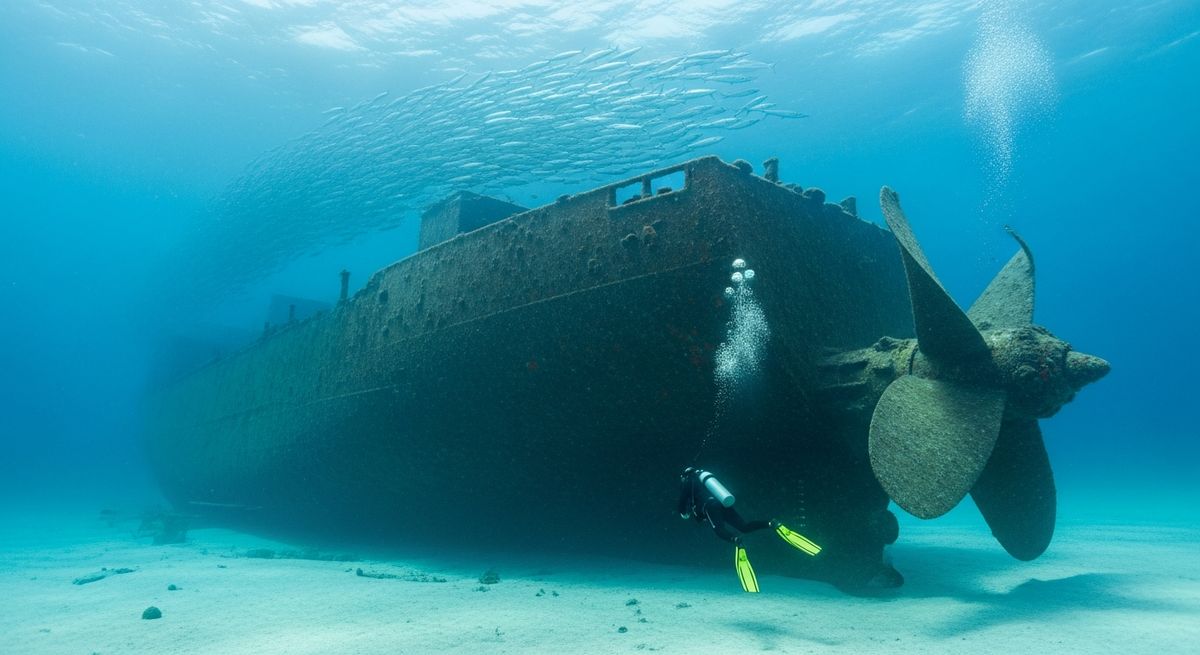
The Cape Matapan wreck is pure Cape Town charm, a proper trawler sitting upright on the seabed at 23 metres. We’ve always been drawn to how intact it is; the bow still points purposefully, and you can swim right into the wheelhouse if you’re comfortable with a bit of overhead. Inside, you’ll likely brush past some pretty bold hottentot fish, and the occasional Roman will eye you from a shadowy corner. The Matapan sunk in 1960, and over sixty years, it’s become a fantastic artificial reef. Look closely at the deck plating, and you’ll find nudibranchs in all sorts of colours, little flashes of orange and purple against the rust. Our favourite part has to be the stern, though. The prop is still there, usually covered in anemones, and the area around it is often buzzing with koelvoet and strepies. We’d suggest diving this one on a calm day, particularly after a few days of southeast wind; that’s when the visibility really opens up, giving you the best chance to appreciate the full outline of the vessel. It’s a classic Cape Town wreck dive, suitable for anyone comfortable with the depth and a bit of a current, which can sometimes sweep through.
Typical CAPE MATAPAN Dive Profile
Illustrative profile based on site depth and type. Actual dive profiles vary - always follow your dive computer and training.
Safety Notes
Depth of 23m - Advanced Open Water certification recommended.
Wreck site - avoid penetration without wreck diving certification. Watch for sharp metal and entanglement hazards.
Cold water this month (avg 15°C). Drysuit or thick wetsuit (7mm+) recommended.
Always perform a 3-minute safety stop at 5m before surfacing.
CAPE MATAPAN Wreck History
Year Sunk
1976
Vessel Type
warship
Cause
scuttled
Tonnage
750 tons
Originally serving in the Royal Navy as a WWII-era Isles-class anti-submarine trawler, the SAS Cape Matapan had a long and storied career. After the war, she was transferred to the South African Navy, where she continued her service. By the 1970s, the aging vessel was decommissioned. Instead of being sent to the scrapyard, a new mission was planned: she would become a cornerstone of a new artificial reef designed to attract both marine life and scuba divers.
In 1976, the Cape Matapan was stripped of contaminants and carefully prepared for her final descent. She was scuttled in Smitswinkel Bay, near Cape Town, where she settled upright on the sandy seabed. She is one of five wrecks sunk in the bay, creating a world-class 'wreck alley' for advanced divers. The Cape Matapan sits at a depth of around 23 meters and remains remarkably intact. Divers can explore her decks, peer into the holds, and admire the bridge area, all of which are now festooned with a spectacular array of vibrant soft corals, sponges, and sea fans. The wreck is a bustling metropolis for fish, making it a truly breathtaking and photogenic dive.
Nearest Dive Centres to CAPE MATAPAN
Dive shops near CAPE MATAPAN
Two Oceans Aquarium
Into the Blue Scuba
Dive Action
Coral Wetsuits
University of Cape Town Underwater Club
UCT Underwater Club
Reviews for CAPE MATAPAN
Conditions
Ocean conditions, forecast and tides for CAPE MATAPAN
CAPE MATAPAN Ocean Conditions
Monthly averages for CAPE MATAPAN, sourced from Open-Meteo marine data - nearest station: Open-Meteo marine grid (-33.92, 18.46) (8km away)
October Averages
Sea Temperature
15°C
59°F · Range: 12.4–17.2°C
Air Temperature
17°C
62°F
Wind Speed
7.33 m/s
14.2 knots
Atmospheric Pressure
1018.1 hPa
Based on 4 years of monitoring data · Data sources: Open-Meteo marine data
Plan & book
Ways to dive Cape Town & Western Cape, from day trips to liveaboards.
Day trips & courses
via GetYourGuideGuided dives, courses and snorkel trips with instant booking.
Find dive trips in Cape Town & Western CapePlaces to stay
via Booking.comHotels and dive resorts near Cape Town & Western Cape.
Search stays in Cape Town & Western CapeDive insurance
Most travel insurance excludes or limits scuba. Check what you need before you go.
Dive insurance explainedPartner links: we may earn a commission if you book, at no extra cost to you. How we make money
Where to Stay near CAPE MATAPAN
Prices from Booking.com. We may earn a commission at no extra cost to you.