BRITISH STEEL
Protected Area
Espacio marino de La Bocayna
Why dive here
With 76+ marine species recorded in the area - including dolphins, octopuses, sea turtles, sperm whales and cuttlefish - BRITISH STEEL offers some of Canary Islands's richest wreck diving. Water ranges 20-24°C, warmest August, September, October.
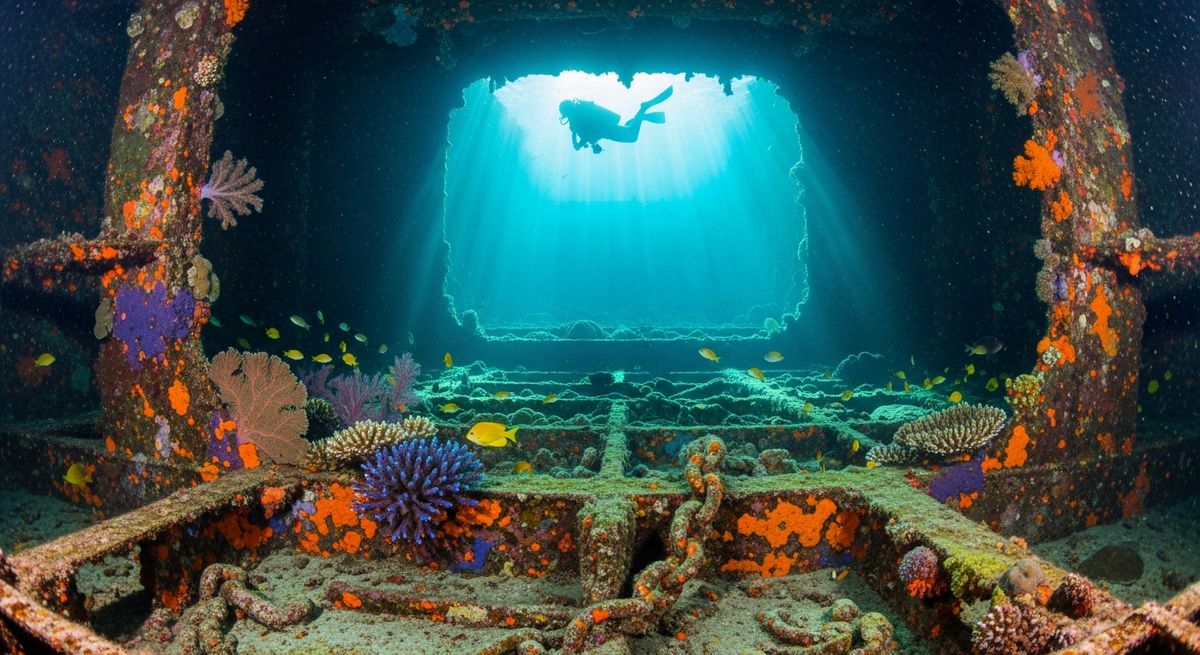
The British Steel wreck isn't about depth; it's about the sheer volume of history and life crammed into seven metres. We’re talking about a beast of a yacht, beached back in '76, that’s now thoroughly entwined with the Fuerteventura coastline. It's a surprisingly accessible adventure, perfect for an extended rummage. You'll spend your dive weaving through crumpled steel plates and the skeletal remains of what was once a graceful vessel. Schools of damselfish shimmer in the shafts of light penetrating the shallows, darting amongst the rusted girders. Look closely, and you’ll spot moray eels peering from crevices, their heads swaying gently, and an octopus or two tucked into shadowy corners. We love how the shallow depth gives you ample bottom time to really explore the nooks and crannies, letting you appreciate the scale of this broken giant. Our favourite part? Finding little pockets of air trapped in the superstructure, making for a strangely intimate, echoey moment. The British Steel is fantastic for photographers or anyone who appreciates a good story with their dive, especially on a calm day when the visibility really opens up.
Typical BRITISH STEEL Dive Profile
Illustrative profile based on site depth and type. Actual dive profiles vary - always follow your dive computer and training.
Safety Notes
Wreck site - avoid penetration without wreck diving certification. Watch for sharp metal and entanglement hazards.
BRITISH STEEL Wreck History
Year Sunk
1976
Vessel Type
yacht
Cause
grounding
This is no ordinary yacht wreck; this is the final resting place of the legendary *British Steel*. This 59-foot steel ketch was skippered by Chay Blyth into the history books in 1971 when he became the first person to sail single-handed, non-stop westwards around the world-against the prevailing winds and currents. His 'wrong way' circumnavigation was a monumental feat of endurance and seamanship that captured the world's imagination.
Five years after its historic voyage, the celebrated yacht's luck ran out. On Christmas Eve 1976, while sailing between the Canary Islands, the *British Steel* ran aground and was wrecked near the El Toston lighthouse on Fuerteventura. Lying in just 7 metres of water, the remains are now scattered and well broken up by the Atlantic swell. However, for novice divers and snorkelers, it offers a unique opportunity to see the remnants of a truly iconic vessel, now encrusted with marine life and integrated into the shallow reef.
Nearest Dive Centres to BRITISH STEEL
Dive shops near BRITISH STEEL
MAGMA FREEDIVING SCHOOL FUERTEVENTURA
Punta Amanay SL
Las Toninas
Dive College Lanzarote
Pura Vida Lanzarote Diving
Windblue Lanzarote
Reviews for BRITISH STEEL
Conditions
Ocean conditions, forecast and tides for BRITISH STEEL
BRITISH STEEL Ocean Conditions
Monthly averages for BRITISH STEEL, sourced from Open-Meteo marine data + Copernicus Marine (EU) - nearest station: Open-Meteo marine grid (28.18, -15.41) (10km away)
October Averages
Sea Temperature
24°C
74°F · Range: 22.2–25.4°C
Current Speed
10 cm/s
Direction: SE (126.9°)
Chlorophyll-a
0.081 mg/m³
Very clear (oligotrophic)
Salinity
36.89 PSU
Based on 4 years of monitoring data · Data sources: Open-Meteo marine data + Copernicus Marine (EU)
Plan & book
Ways to dive Canary Islands, from day trips to liveaboards.
Day trips & courses
via GetYourGuideGuided dives, courses and snorkel trips with instant booking.
Find dive trips in Canary IslandsPlaces to stay
via Booking.comHotels and dive resorts near Canary Islands.
Search stays in Canary IslandsDive insurance
Most travel insurance excludes or limits scuba. Check what you need before you go.
Dive insurance explainedPartner links: we may earn a commission if you book, at no extra cost to you. How we make money
Where to Stay near BRITISH STEEL
Prices from Booking.com. We may earn a commission at no extra cost to you.