CALA RAS
Protected Area
Bahía del Confital
Why dive here
With 76+ marine species recorded in the area - including dolphins, octopuses, sea turtles, sperm whales and cuttlefish - CALA RAS offers some of Canary Islands's richest wreck diving. Water ranges 20-24°C, warmest August, September, October.
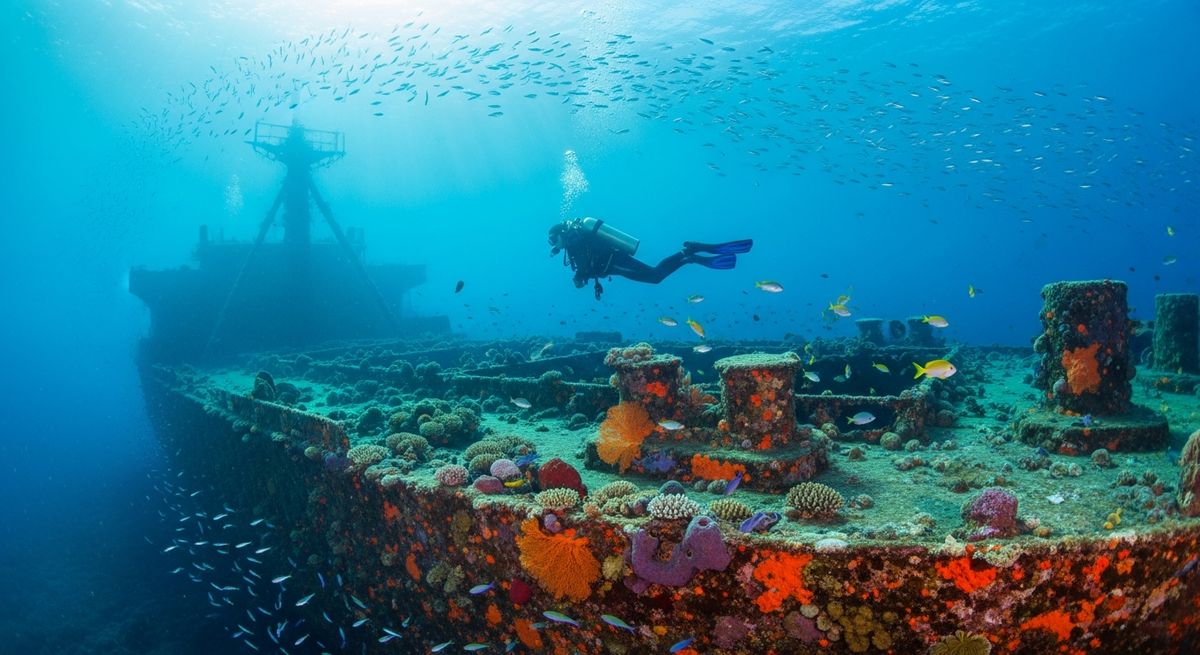
Cala Ras, near Las Palmas, is a cracking little wreck for divers who appreciate a good story and a relaxed dive. We’re talking about the remains of a 54-meter motor vessel, sunk after a collision back in ’74. It’s sitting upright in about 13 metres, so you’ve got plenty of bottom time to really nose around. What we love about this one is how nature has completely taken over. The prop is still there, draped in sponges, and the hull plates are fuzzy with tunicates. Shoals of barracuda often cruise overhead, their silver scales catching the light, and we’ve often found octopus tucked into crevices in the deeper sections. It’s a gentle exploration, perfect for photographers or anyone wanting to spend a solid hour just observing the details. There’s a quiet beauty to it, the way the light filters through the water and illuminates the rusted metal, hinting at its past life. Our tip: go mid-morning; the sun angle really brings out the colours.
Typical CALA RAS Dive Profile
Illustrative profile based on site depth and type. Actual dive profiles vary - always follow your dive computer and training.
Safety Notes
Wreck site - avoid penetration without wreck diving certification. Watch for sharp metal and entanglement hazards.
Always perform a 3-minute safety stop at 5m before surfacing.
CALA RAS Wreck History
Year Sunk
1974
Vessel Type
cargo ship
Cause
collision
The M.V. Cala Ras was a 54-meter motor vessel whose career ended abruptly in the busy port of Las Palmas. On January 9, 1974, while maneuvering within the harbour, the Cala Ras was involved in a fatal collision with the Spanish trawler 'Roque del Este'. The damage was too severe to be contained, and the ship sank within the harbour's confines.
Resting at a shallow depth of just 13 meters, the Cala Ras is an accessible and fascinating dive. Its location within a working harbour can mean variable visibility, but it also provides a unique backdrop. The wreck itself, though relatively modern, has become an established artificial reef, attracting a variety of local marine life. It is classified as a 'Dangerous Wreck', which for divers means there are potential hazards like sharp metal and snagging points, demanding careful buoyancy and awareness. This adds a layer of challenge and excitement for those exploring its structure.
Nearest Dive Centres to CALA RAS
Dive shops near CALA RAS
BUCEO CANARIAS BY MEDUSA
Mirafondos, Centro de Buceo
El Azul Gran Canaria Dive Center
Buceo La Vieja
KARAPAT DIVE
Buceo Norte
Reviews for CALA RAS
Conditions
Ocean conditions, forecast and tides for CALA RAS
CALA RAS Ocean Conditions
Monthly averages for CALA RAS, sourced from Open-Meteo marine data + Copernicus Marine (EU) - nearest station: Open-Meteo marine grid (28.18, -15.41) (10km away)
October Averages
Sea Temperature
24°C
74°F · Range: 22.2–25.4°C
Current Speed
10 cm/s
Direction: SE (126.9°)
Chlorophyll-a
0.081 mg/m³
Very clear (oligotrophic)
Salinity
36.89 PSU
Based on 4 years of monitoring data · Data sources: Open-Meteo marine data + Copernicus Marine (EU)
Plan & book
Ways to dive Canary Islands, from day trips to liveaboards.
Day trips & courses
via GetYourGuideGuided dives, courses and snorkel trips with instant booking.
Find dive trips in Canary IslandsPlaces to stay
via Booking.comHotels and dive resorts near Canary Islands.
Search stays in Canary IslandsDive insurance
Most travel insurance excludes or limits scuba. Check what you need before you go.
Dive insurance explainedPartner links: we may earn a commission if you book, at no extra cost to you. How we make money
Where to Stay near CALA RAS
Prices from Booking.com. We may earn a commission at no extra cost to you.