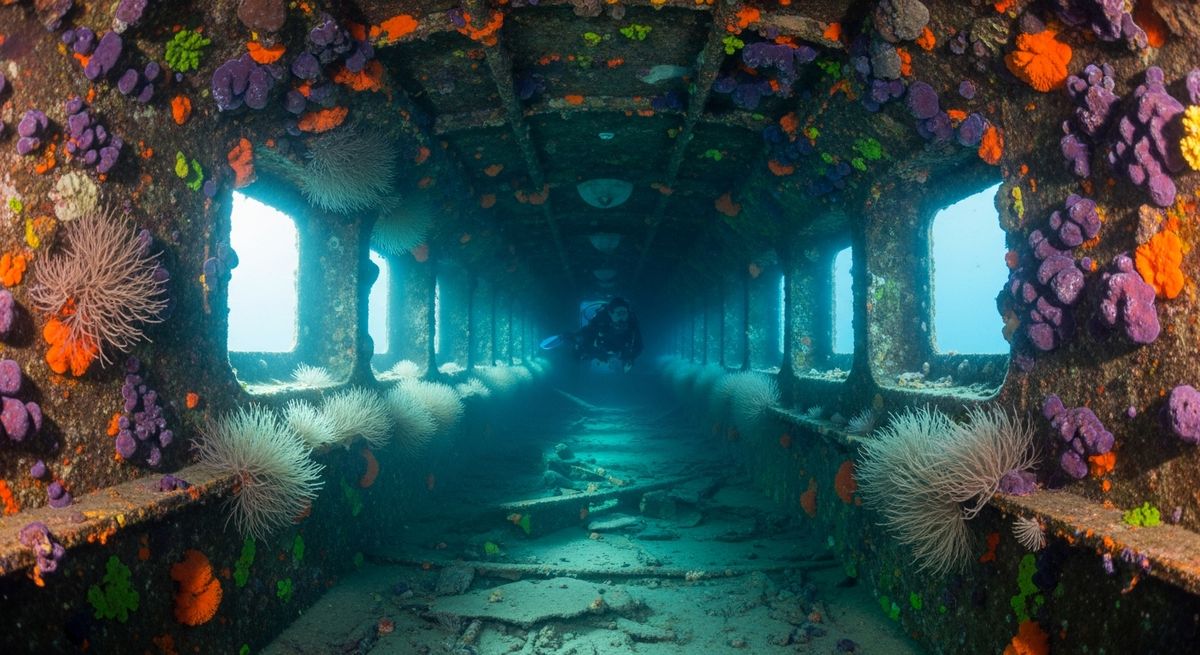
ALMERIA
Protected Area
Copinsay
Why dive here
With 140+ marine species recorded in the area - including blue whales, dolphins, dwarf minke whales, humpback whales and ocean sunfish (mola mola) - ALMERIA offers some of Scapa Flow, Orkney's richest wreck diving. Water ranges 8-14°C, warmest July, August, September.
The Almeria might only sit at 5 metres, but don’t let that fool you into thinking it's not worth a dive. This blockship, deliberately sunk in 1915 to protect the Flow, offers a surprisingly engaging dive, especially for those looking to experience Scapa’s history without the deep-water commitment. We love how accessible she is, making her a perfect second dive or a relaxed exploration when the weather keeps you out of the deeper Flow. You’ll find the Almeria broken up, her steel plates creating a fascinating jumble of twisted metal and open spaces. It’s like an underwater playground, with plenty of swim-throughs and sheltered nooks perfect for spotting the resident ballan wrasse and blennies. Look closely, and you’ll often find dogfish resting in the sand nearby. We always suggest diving her on a slack tide; the visibility really opens up then, letting you appreciate the scale of the wreckage and the way the light filters through the broken hull. It’s a gentle introduction to Scapa’s wrecks, delivering plenty of character for its shallow depth.
Typical ALMERIA Dive Profile
Illustrative profile based on site depth and type. Actual dive profiles vary - always follow your dive computer and training.
Safety Notes
Wreck site - avoid penetration without wreck diving certification. Watch for sharp metal and entanglement hazards.
Cold water this month (avg 13°C). Drysuit or thick wetsuit (7mm+) recommended.
ALMERIA Wreck History
Year Sunk
1915
Vessel Type
cargo ship
Cause
scuttled
Tonnage
4,614 GRT
The SS Almeria was a civilian steamship whose fate became entwined with the grand naval strategy of World War I. Built in 1888, the steel-hulled vessel was purchased by the British Admiralty not for combat, but for a crucial defensive role. In the early days of the war, the vast natural harbor of Scapa Flow, home to the Royal Navy's Grand Fleet, was vulnerable to raids by German U-boats. To block the smaller, more treacherous channels, the Admiralty began sinking old merchant ships, creating a network of underwater barriers.
On February 20, 1915, the Almeria became one of these 'blockships,' deliberately scuttled in Burra Sound. Today, the wreck lies in very shallow water, with parts breaking the surface at low tide. While the powerful Orkney currents have flattened and torn the hull apart over the last century, it provides a fascinating dive, particularly for those new to Scapa Flow. Divers can explore the ship's massive boilers and twisted steel plates, which are now covered in kelp and home to a variety of fish and crustaceans. It's a tangible piece of WWI history, sacrificed to protect the mighty warships that once anchored nearby.
Nearest Dive Centres to ALMERIA
Dive shops near ALMERIA
View all dive centres in Scapa Flow, OrkneyReviews for ALMERIA
Conditions
Ocean conditions, forecast and tides for ALMERIA
ALMERIA Ocean Conditions
Monthly averages for ALMERIA, sourced from Open-Meteo marine data - nearest station: Open-Meteo marine grid (58.64, -3.16) (8km away)
October Averages
Sea Temperature
13°C
55°F · Range: 11.4–13.8°C
Air Temperature
10°C
50°F
Wind Speed
9.26 m/s
18.0 knots
Atmospheric Pressure
1005.3 hPa
Based on 4 years of monitoring data · Data sources: Open-Meteo marine data
Plan & book
Ways to dive Scapa Flow, Orkney, from day trips to liveaboards.
Day trips & courses
via GetYourGuideGuided dives, courses and snorkel trips with instant booking.
Find dive trips in Scapa Flow, OrkneyPlaces to stay
via Booking.comHotels and dive resorts near Scapa Flow, Orkney.
Search stays in Scapa Flow, OrkneyDive insurance
Most travel insurance excludes or limits scuba. Check what you need before you go.
Dive insurance explainedPartner links: we may earn a commission if you book, at no extra cost to you. How we make money
Where to Stay near ALMERIA
Prices from Booking.com. We may earn a commission at no extra cost to you.