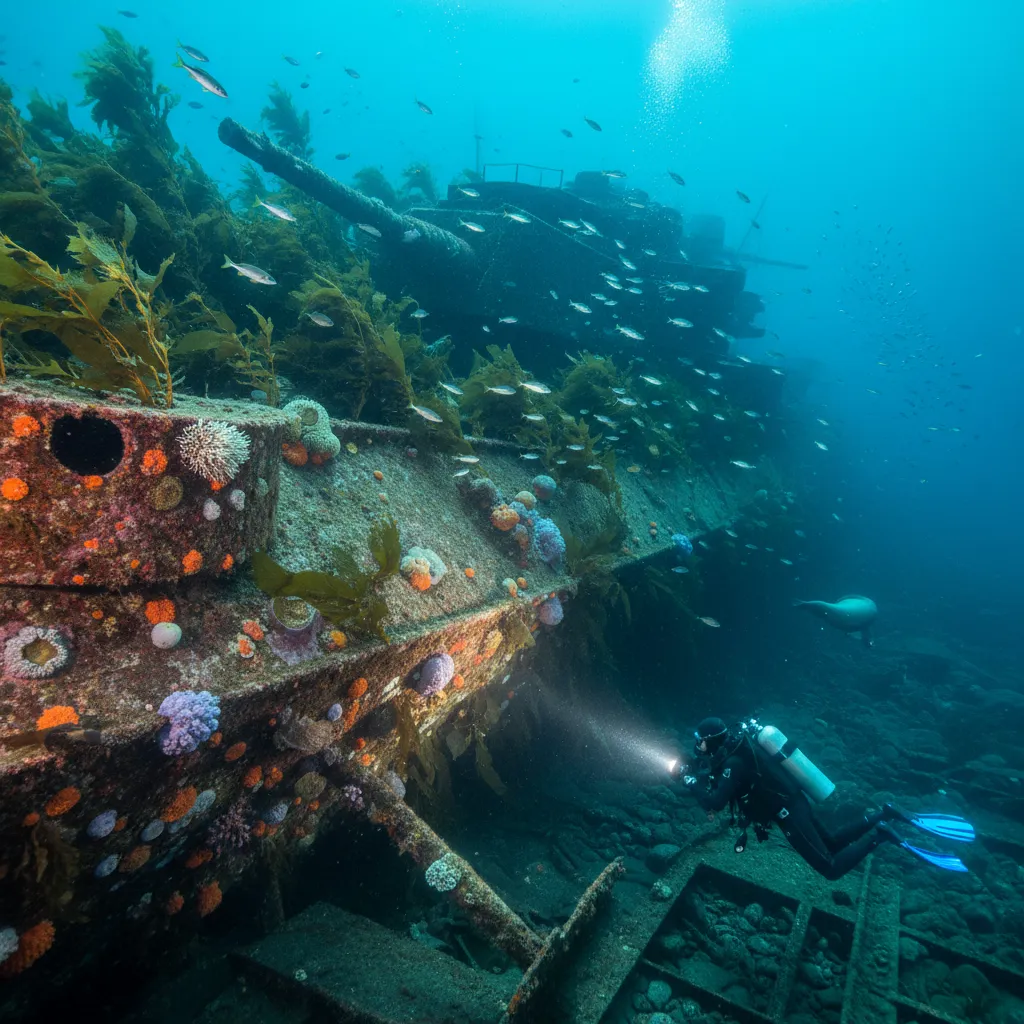
Diving in Scapa Flow, Orkney
Why dive here
Scapa Flow, Orkney offers some of United Kingdom's richest diving, with 140+ marine species recorded in the area - including blue whales, dolphins, dwarf minke whales, humpback whales and ocean sunfish (mola mola). Water sits around 8°C.
Scapa Flow isn't just diving, it’s a journey through time. We’re talking about the scuttled German High Seas Fleet from 1919 - this isn't some scattered debris, these are massive battleships and cruisers, largely intact. Dropping down onto the *SMS Brummer* or the *SMS Coln*, you feel the sheer scale of these wrecks immediately. The metal structures loom out of the green gloom, often adorned with plumose anemones, and you’ll pass through gaping shell holes or into vast, empty holds. Visibility can swing wildly, but when it's good, seeing these giants emerge is incredible. We love the feeling of the history pressing in on you. It’s a cold dive, so drysuits are non-negotiable, and a good dive guide is essential to navigate the wrecks and currents. The sheer number of sites means you could spend weeks here and still not see it all. Our favourite time to visit is late spring, when the weather starts to settle but before the summer crowds, though "crowds" is a relative term here. It's a deep, dark, and utterly compelling experience.
Scapa Flow, Orkney Dive Site Map
Dive sites and dive centres in Scapa Flow, Orkney
Scapa Flow, Orkney Dive Sites
1,031 dive sites in Scapa Flow, Orkney
090
The 090 wreck in Scapa Flow lies at 26 metres, an old workboat now classified as dangerous, but still a compelling dive. You'll find a sturdy hull, largely intact, providing plenty of nooks for exploration. Wrasse dart through the structure, and the metalwork offers a good home for various anemones. This site is best for divers who enjoy a robust wreck in a historically rich area.
AASE
The AASE sits at 60 metres, a deep dive suitable for experienced wreck enthusiasts. This steamship went down in 1928, and while she's a non-dangerous wreck, the depth and potential for currents around Brims Ness mean you need to be on your game. We've found her bow mostly intact, with a clear outline of the forecastle area, though much of the superstructure has collapsed. Look for conger eels hiding in the cargo holds and decent-sized wrasse patrolling the decks. Visibility can be a challenge, so pick your day carefully, but when it’s good, the sheer scale of the wreck at this depth is impressive.
ABERDEEN CITY
The Aberdeen City isn't about depth, it's about sheer accessibility and atmosphere. At just five metres, this trawler wreck is practically begging for a long, leisurely dive, perfect for any skill level or if you just fancy stretching a cylinder. We love how the shallow depth paints the wreck in natural light, often a murky green, giving it a wonderfully eerie feel as you descend onto the main deck. Her wheelhouse is our favourite feature, still mostly intact, inviting you to peer inside and imagine the last moments before she settled in 1963. You can swim the length of her, picking out the winch gear, feeling the cool metal under your fingertips. The superstructure is now home to a surprising amount of life, little crabs scuttling over corroded plates, and we’ve often seen inquisitive ballan wrasse darting in and out of the open holds. It’s a proper Scapa Flow wreck experience, just without the decompression obligations. A great afternoon dive after a deeper morning run, or simply an ideal spot for practicing your wreck penetration skills in well-lit, shallow conditions.
AC6
AC6, one of Scapa Flow's many blockships, offers a surprisingly compelling shallow dive. This old Metal Industries Ltd barge, intentionally scuttled, now sits just 5 metres deep, making it perfect for newer divers or those looking for a longer bottom time. The wreck itself is reasonably intact, with some interesting nooks and crannies to peer into, though penetration isn't really the point here. We’ve spotted plenty of inquisitive wrasse darting through the rusted metal, and the occasional curious seal sometimes pops by for a look. It’s a great way to experience a piece of Scapa’s history without the demands of the deeper fleet wrecks.
ACHILLES
Achilles, oh, Achilles. This isn't one of Scapa's colossal German battleships, and honestly, we love it for that. She's a fishing vessel, sunk back in 1970, and resting upright at a neat 32 metres. The story goes a rope fouled her propeller near Whiten Head, and down she went. What makes her a standout for us isn't the history lesson, but the sheer diveability. You drop onto her deck and immediately feel that cool, low-vis Scapa embrace. Forget sprawling over miles of deck; Achilles is compact, coherent. You can make a full circuit, poking into her wheelhouse, peering down into the fish hold where light filters in green and spooky. The stern, with its prominent propeller and rudder, is always our favourite part. It’s a proper wreck dive, intimate and explorable, without the deco commitment of the big boys. This wreck is absolutely coated in life. Dead man's fingers drape everywhere, anemones bloom from every surface, and if you bring a torch, you'll spot crabs scuttling in the shadows. The local wrasse population treats Achilles like their personal playground, darting between the decaying superstructure. It's a fantastic second dive, perfect for refining your wreck skills or just soaking in the atmosphere without feeling rushed. We'd suggest aiming for slack water, always a good call in Scapa, to really take your time navigating her decks.
ACTIVE
The *Active* in Scapa Flow isn't just another wreck; it's a piece of raw history, resting upright at 42 metres. We love how intact she remains, a substantial trawler, torpedoed by German aircraft in 1939. Dropping down, you start to make out the ghostly outline, gradually resolving into deck gear, winches, and the superstructure still largely in place. Exploring her feels like stepping back in time, with the vast, dark water pressing in around you. Our favourite part is the penetration into the wheelhouse, if conditions allow, where you can still feel the palpable sense of its last moments. It's a proper wreck dive, perfect for those comfortable with deeper sites and the chill of northern waters. You’ll see plenty of squat lobsters tucked into every crevice, and plumose anemones bloom from the steelwork, adding splashes of white against the rust. Keep an eye out for curious dogfish cruising the perimeter. This is a dive for history buffs and wreck enthusiasts who appreciate a sombre, atmospheric experience.
Aith Baa
Notable reef in Scapa Flow, Orkney, United Kingdom. reef in Shetland Islands, Scotland, UK.
ALABAMA
The *Alabama*, just shy of 115 metres long, is one of Scapa Flow's shallower giants, lying on her port side at a friendly 12 metres. This isn't just a jumble of twisted metal; you get a real sense of her scale here. We love exploring the stern, especially around the massive prop and rudder. The boilers are still very much in place, impressive even after all these years, and a swim-through takes you past the engine room, a tight but rewarding squeeze. What makes the *Alabama* a standout is how accessible she is, even for newer wreck divers. Visibility can be superb, letting you appreciate the sheer length of her hull, now a vibrant canvas of plumose anemones, dead man's fingers, and kelp. Look for the wolfish that often lurk in the shadowed nooks and crannies. We’d suggest diving this one on a slack tide, giving you ample time to really pick through the details without fighting a current. It’s a proper Scapa wreck, just without the deep commitments, perfect for an afternoon exploration.
ALCORA (POSSIBLY)
The Alcora, or what we believe to be the Alcora, holds a spot for us in Scapa Flow. It’s a good 40-metre dive, sitting upright and mostly intact on the seabed. Dropping down, you’ll find three massive boilers, still very much where they should be, and the triple-expansion engine. It’s a proper steamship, built in 1919, and the sheer scale of the engineering still impresses. We love the penetration opportunities here, if you’ve got the right training and experience. The holds are fairly open, revealing crates and bottles, hinting at its cargo. Visibility can be a bit variable, but on a good day, with the light filtering through the gloom, the wreck takes on a ghostly presence. Look out for the resident conger eels, they’re hefty here, and the soft corals that have started to bloom on the metalwork. It’s a dive for those who appreciate history and don’t mind a bit of a deeper challenge.
ALMERIA
The Almeria might only sit at 5 metres, but don’t let that fool you into thinking it's not worth a dive. This blockship, deliberately sunk in 1915 to protect the Flow, offers a surprisingly engaging dive, especially for those looking to experience Scapa’s history without the deep-water commitment. We love how accessible she is, making her a perfect second dive or a relaxed exploration when the weather keeps you out of the deeper Flow. You’ll find the Almeria broken up, her steel plates creating a fascinating jumble of twisted metal and open spaces. It’s like an underwater playground, with plenty of swim-throughs and sheltered nooks perfect for spotting the resident ballan wrasse and blennies. Look closely, and you’ll often find dogfish resting in the sand nearby. We always suggest diving her on a slack tide; the visibility really opens up then, letting you appreciate the scale of the wreckage and the way the light filters through the broken hull. It’s a gentle introduction to Scapa’s wrecks, delivering plenty of character for its shallow depth.
ANDALINA
The *Andalina* is a beauty, a smaller wreck, but don't let that fool you into thinking it's not worth your time. She sits shallow, just 8 metres, which means light penetrates everywhere, even on a cloudy Orkney day. This isn't a penetration dive, not really; instead, we love just swimming over her ribs, seeing the outline of her hull. We often spot wrasse darting between the metalwork and those incredibly resilient anemones that just cling to everything. What makes *Andalina* special is that she's a fantastic second dive, a relaxed way to warm down after something deeper, or a cracking start to the day if you want to ease in. The shallow depth also means you get long bottom times, perfect for photographers or just for really soaking it all in. We often find ourselves circling her a few times, noticing new details on each pass. She's approachable, friendly, and a brilliant snapshot of Scapa's history without the demands of the bigger blockships.
ANDRIAS
The Andrias isn’t one of the grand Scapa Flow battleships, but we think it’s a brilliant dive for something a bit different. This modern trawler ran aground and sank in 1981, and what’s left of her is now scattered across the seabed at 27 metres. We love how the stern section is still largely intact, sitting upright with its propeller clear and proud. You can peek into the engine room, often finding conger eels lurking in the shadows. What really makes the Andrias shine, though, is the sheer amount of life. Every surface of the fragmented hull is plastered with plumose anemones, their white tentacles swaying gently in the mild current. We’ve seen huge shoals of juvenile pollock darting through the wreckage, and plenty of wrasse picking at the growth. It’s a dive that shows how quickly a wreck becomes a vibrant reef. For divers who appreciate historical context but also want a living, breathing dive, the Andrias is a fantastic choice, especially if the big wrecks are busy.
Show all 1,031 dive sites in Scapa Flow, Orkney
- ANVERS
- AORANGI
- ARCADIA
- ARGYLL
- ARGYLL
- ARNISDALE
- ARNISH
- B109
- B 109 (PART)
- B110
- B111
- B112
- B 98
- Baa of Oxafirth
- Baas of Trevan
- BEATRIX FERNANDE
- BEL LILY
- BENACHIE
- BE READY
- BERMUDA
- BETTINA DANICA
- BJORN
- BON AMI
- BOSTON STIRLING
- BOY GRAHAM
- BOY LESLIE
- BRAER
- BRIARBANK
- BRILLIANT
- BRUMMER
- BUDRIE
- BURRAY NESS
- BUSK
- CAIRNMONA
- CALEDONIA
- CALEDONIA (BCK 375)
- CALINA
- CARISBROOK (POSSIBLY)
- CAROLINA THORNDEN
- CARRON
- CHARISMA
- CHARKOW
- CHARLES GOODANEW
- CHEINCHA
- CLAN MACDONALD
- CLARKWOOD
- CLIO
- CLIO II
- COLLINGDOC
- COLUMBINE
- COMMANDER BOYLE
- CONSORT
- CONSTANT STAR
- COPELAND
- CORINTHIA (STERN SECTION)
- COTOVIA (PROBABLY)
- CROMA
- DAGHESTAN
- DAGHESTAN (PROBABLY)
- DALEWOOD (POSSIBLY)
- DERFFLINGER
- DEVOTION
- DISPERSER
- DRESDEN
- DROMARA
- DUNA
- DURHAM CASTLE
- DYLE
- EAMONT
- EBANEZER
- EBENEZER
- EBENEZER
- EDENMORE
- EDINBOUNE
- EDWARD BONAVENTURA
- ELEGANCE
- ELLIE MAY
- ELSA
- ELTON
- EMERALD WINGS
- EMPIRE SEAMAN
- EMULOUS II
- ENERGY
- ENTERPRISE
- EPHRAM
- ESPIRANS
- EYFIRDINGUR
- F2
- F2 Barge
- FAIR DAWN
- FAIRWEATHER V (PROBABLY)
- FAITHFUL FRIEND II
- FANCY NANCY
- FARO
- FORGET ME NOT
- FORNEBO
- FRAM (BOW SECTION) (POSSIBLY)
- FRAM (STERN SECTION)
- FREESIA
- FREIDIG
- FREIDIG (POSSIBLY)
- FREYA (PART OF)(POSSIBLY)
- FREYA (POSSIBLY)
- Friendly Isle
- FULMAR
- FV LAWRET
- FYLLA
- G 38
- G 39
- G40
- G 86
- G 89
- G 91
- G92
- GERTRUD
- GIRALDA (POSSIBLY)
- GIRL ANGELA
- GIRL ISLA
- GIRL ISLA
- GIRL KATHLEEN
- GK 41/GR 41
- GLENGAIRN
- GLENRAVEL
- Gobernador
- GOBERNADOR BORIES
- GOLDEN STRAND
- GOLDEN WEST
- GONDOLIER
- GOODWILL MERCHANT
- GRATITUDE
- GRATITUDE
- GRAYFISH
- GRETAFIELD (AFTER PART)
- GRETAFIELD (FORE PART)
- GUIDING LIGHT
- GUIDING STAR
- H 145
- HAMNAVOE
- HANSI
- HASSETT
- HASTINGS COUNTY
- HEINKEL 111
- H I KROYER
- HMD CHANCE
- HMD IMBAT
- HMD Lustring
- HMS Albacore (Bow section)
- HMS Bullen
- HMS Bullen
- HMS C34 (possibly)
- HMS Daring
- HMS Daring
- HMS DEWEY EVE
- HMS ENDEAVOUR
- HMS Exmouth
- HMS Fiona
- HMS GOLDFINCH
- HMS GRIVE
- HMS Hampshire
- HMS HARMONY
- HMS IMBAT
- HMS Imogen
- HMS Imogen (possibly)
- HMS Iolaire
- HMS Iolaire
- HMS King Edward VII
- HMS King Edward VII (possibly)
- HMS Lively
- HMS LIVELY
- HMS Lynx
- HMS LYNX
- HMS Lynx (possibly)
- HMS MARSONA (N SECTION)
- HMS Marsona (possibly)
- HMS MARSONA (S SECTION)
- HMSM TANTIVY
- HMS NARBOROUGH
- HMS Natal
- HMS Natal
- HMS Nelson
- HMS Nelson
- HMS OCEANA
- HMS OCEANIC
- HMS OPAL
- HMS Ormonde (possibly)
- HMS Ormonde (possibly)
- HMS Ormonde (possibly)
- HMS Roedean
- HMS ROSE VALLEY
- HMS Royal Oak
- HMS SALVAGE KING
- HMS ST OLAVES
- HMS STRATHGARRY
- HMS Vanguard
- HMS VULTURE II
- HMS ZAREFAH
- HMT BEECH
- HMT JASPER
- HMY IOLAIRE
- HMY VERONA
- IJSSELSTROOM
- ILSENSTEIN
- INCENTIVE
- INCONNU
- INNISJURA (POSSIBLY)
- INTREPID II
- INVADER
- INVERLANE (BOW SECTION)
- IRIS
- ISLAND LASS
- IVY ROSE
- JACQUELINE
- JAMBO
- JAMES BARRIE
- JERIA
- JOHANNA THORDEN
- JOHN RANDOLPH (FORE PART)
- JUANITA
- JUNIATA (FORE PART)
- KAREN JANE
- KARLSRUHE
- KASPAROFF
- KATHE NIEDERKIRCHNER
- KEDANA
- KINGSTON TURQUOISE
- Kirk Taing
- KIRUNA
- KITTY FISHER
- KOLN
- KONIG
- KOORAH
- KORALL
- KRONPRINZ WILHELM
- LADY PRIMROSE
- LAKE NEUCHATTE
- LANGENS
- LANS
- LENA SORENSEN
- LIANA
- LINKMOOR
- LLANISHEN
- LLANISHEN (PROBABLY)
- LOCH ERISORT
- LOCH MADDY (STERN SECTION)
- LOFOTEN
- LORNE
- LOYAL FRIEND
- LYCIA
- LYNNE ANNE
- MAGICIAN
- MAGNUS
- MAJORKA
- MAKALLA (PROBABLY)
- MALIN HEAD
- MALMLAND
- MANINA
- MANXWOOD
- MARA
- MARANDRA
- MARCO POLO
- MARGO
- MARJORY
- MARKGRAF
- MARRADALE
- MARSTENEN
- MARSTENEN (POSSIBLY)
- MARTIS
- MARZOCCO
- MAVERICK
- MHAIGHDEAN HEARRACH
- Middle Muck
- Midsound Baas
- MIM
- MINSK
- MISS CECILIA
- MISTLEY
- MORAY ADVENTURER
- MORAY FIRTH (PROBABLY)
- MURIEL
- MURIEL
- MURRAYFIELD (POSSIBLY)
- NAJA (PART OF)
- NAVARRE
- NAVENA
- Neil and Jane
- NEPTUNE
- NEPTUNIA
- NOREEN MARY
- NORSEMANS BRIDE
- NORTHERN LIGHT
- NUMIDIAN
- OCEAN HERALD II
- OLIVE LEAF
- ORMAZA
- Outer Loch Roe
- PARAGON
- PARAGON (POSSIBLY)
- PENAROZ
- PENNSYLVANIA
- PERKINA
- Perth Sub Aqua Club
- PETER BERG
- PHARAON
- PHILIPPA
- Pinnace 288
- PINNACE 744
- PIONERSK
- PITSTRUAN (PROBABLY)
- PLOUGH
- Point of the Graand
- PONTOON NO 1
- PONTOS
- PORTUGAL
- PRESTONIAN
- PRUDENTIA
- QUIET WATERS
- Rackwick Bow
- RADIATION
- Rattray Briggs
- REDSTONE
- REGENT BIRD
- REGINALD
- REINFIELD
- REIN (POSSIBLY)
- REMUERA
- REMUS
- RENOWN II
- RMS Oceanic
- RMS Oceanic
- ROBINA
- RONA
- ROS BUI (?PART OF)(POSSIBLY)
- ROSEBANK (POSSIBLY)
- ROSE OF SHARON
- ROSS PUMA
- ROSS TERN
- ROTHERFIELD
- Row Taing
- RUBICON
- RUBY
- RUBY
- S131
- S 136
- S138
- S32
- S 36
- S 36 (BOW SECTION)
- S 49
- S 50
- S52
- S53
- S54
- S 55
- S56
- SAINT KENTIGERN
- SAINT MAGNUS
- SAN TIBURCIO
- SCANDINAVIC
- SCOTIA
- SEAFORTH
- SEALGAIR
- SEA REEFER
- SERVUS
- SHELBRIT 1
- SIHERITE
- SILANION
- SILVER REWARD
- SILVER SPRAY (PROBABLY)
- Sinclair Buss
- SMIT-LLOYD 47
- SMS Brummer
- SMS Cöln
- SMS Cöln, Scapa Flow (Wreck)
- SMS Dresden
- SMS Karlsruhe
- SMS Karlsruhe
- SMS Konig
- SMS König
- SMS Kronprinz Wilhelm
- SMS Kronprinz Wilhelm
- SMS Markgraf
- SMS Markgraf
- Sneuk
- SOLAN
- SORIANO
- SOVEREIGN
- SOVEREIGN
- SS Otway
- SS Otway
- STAR DIVINE
- STAR OF FAITH
- STAR OF VICTORY
- ST CLAIR
- STELLATUS
- STERNDON
- ST GERALDINE
- ST NICHOLAS
- STRATO
- ST ROGNVALD
- SUECIA
- SUE LYNN
- SUMMER ISLES
- SUNBEAM
- SUNBEAM (POSSIBLY)
- SUNLIGHT
- SUNNYVALE
- Swarf
- SWIFTSURE
- SWIFTSURE
- Tabarka (block ship)
- Tain Bar
- TAMARA
- TAMARA (POSSIBLY)
- Tangi
- TEESWOOD
- TEKLA (PART OF)
- TEKLA (PART OF)(PROBABLY)
- TENNESSEE
- TERN
- The Old Bar
- The Riv
- The Skares
- The Sneckan
- THREE BELLS
- Three Kings
- THYRA
- TOMMELINE
- TOSTO
- TRANSCEND
- TRIDENT
- TRSAT
- U 309
- U 36
- UB 116
- UNITY
- URMSTONE GRANGE
- USTETIND
- V 129
- V 45
- V70
- V 78
- V 81
- V83
- V 83 Destroyer
- VALONIA
- VESPER
- VICTORY
- VIRGINIA ROSE
- WANJA
- WATCHFUL
- West Muck
- WILLIAM H WELCH (FWD SECTION)
- WILLIAM H WELCH (STERN SECTION)
- WILSTON (PROBABLY)
- WINCHESTER
- Wreck of A4 Mooring Buoy
- Wreck of Aase (Possibly)
- Wreck of Ac6
- Wreck of A C W 11 (Possibly)
- Wreck of Adventure
- Wreck of Alabama
- Wreck of Alcora (Possibly)
- Wreck of Alexanders
- Wreck of Alex Hastings
- Wreck of Allan
- Wreck of Allan
- Wreck of Almond Blossom
- Wreck of Andalina
- Wreck of Angus
- Wreck of Angus
- Wreck of Aorangi
- Wreck of Archangel
- Wreck of Arcturus
- Wreck of Argyle
- Wreck of Arne Kjode
- Wreck of Arnish
- Wreck of Artemis
- Wreck of Atland (Possibly)
- Wreck of Baradrangur
- Wreck of Ben Aigen
- Wreck of Ben Doran
- Wreck of Ben Tarbert
- Wreck of Bjorn
- Wreck of Blake
- Wreck of Borgfelde
- Wreck of Boston Heron
- Wreck of Bourbon Dolphin
- Wreck of Bourbon Dolphin
- Wreck of Bpt No 31
- Wreck of Bromley
- Wreck of Budrie
- Wreck of Bug
- Wreck of Burray Ness
- Wreck of Busk
- Wreck of C1 Mooring Buoy
- Wreck of Cairnavon
- Wreck of Cairnmona
- Wreck of Caledonia [Possibly]
- Wreck of Camba
- Wreck of Carmania II
- Wreck of Carolina Thorden
- Wreck of Carron
- Wreck of Char
- Wreck of Cheviot
- Wreck of Cheviot
- Wreck of Christina
- Wreck of Christine
- Wreck of City Of Osaka
- Wreck of Clan Mackinlay
- Wreck of Clestrain Sound, Scapa Flow, Orkney
- Wreck of Collingdoc
- Wreck of Concordia
- Wreck of Conqueror 2
- Wreck of Cornelia
- Wreck of Cotovia
- Wreck of Croma
- Wreck of Crown
- Wreck of Crusader
- Wreck of Dagon
- Wreck of Daniel Cotton
- Wreck of Danmark
- Wreck of Disperser
- Wreck of Doyle
- Wreck of Duchess
- Wreck of Duckbridge (Possibly)
- Wreck of Eamont
- Wreck of Ebenezer
- Wreck of Ebro
- Wreck of Edenmore
- Wreck of Edward Bonaventura
- Wreck of El Gran Grifon
- Wreck of Elton
- Wreck of Emerald Wings
- Wreck of Empire Parsons
- Wreck of Endeavour
- Wreck of Energy
- Wreck of Eugene T Chamberlain
- Wreck of Eva
- Wreck of Evergreen
- Wreck of Fairweather V
- Wreck of Faro
- Wreck of Ferrol
- Wreck of Ferrol
- Wreck of Finlande
- Wreck of Fitful Head
- Wreck of Flotta
- Wreck of Fram
- Wreck of Fram (Possibly)
- Wreck of Frau Anna Katharina
- Wreck of Frederick Bartholdi
- Wreck of Frederika
- Wreck of Fruitful Bough
- Wreck of Gertrud
- Wreck of Geysir
- Wreck of Giralda (Possibly)
- Wreck of Glen Albyn
- Wreck of Glenisla
- Wreck of Glen Tanar
- Wreck of Glide
- Wreck of Glide
- Wreck of Glitra (Possibly)
- Wreck of Gohan
- Wreck of Golfer
- Wreck of Golfer
- Wreck of Gondolier
- Wreck of Gotfrede (Possibly)
- Wreck of Grace Darling
- Wreck of Gratitude
- Wreck of Gretafield (After Part)
- Wreck of Guiding Star
- Wreck of Guiding Star [Possibly]
- Wreck of Gunnaren
- Wreck of Halcyon
- Wreck of Hansi
- Wreck of Hastings County
- Wreck of Hearty
- Wreck of Heinkel
- Wreck of Highcliffe
- Wreck of Hmt Beech
- Wreck of Hmt Brora
- Wreck of Hsl 117
- Wreck of Hsl 117
- Wreck of Hylas
- Wreck of Hylas (Possibly)
- Wreck of Ilsenstein
- Wreck of Innisjura
- Wreck of Inverlane
- Wreck of Iona (Possibly)
- Wreck of Isleford
- Wreck of Italia
- Wreck of James Hall
- Wreck of Johanna Thorden
- Wreck of John Dunkin [Possibly]
- Wreck of John Randolph (Fore Part)
- Wreck of Juniata
- Wreck of Kiruna
- Wreck of Kondor
- Wreck of Langenes
- Wreck of Lapland
- Wreck of Loch Erisort
- Wreck of Loch Maddy
- Wreck of Loch Wasdale
- Wreck of Lorne
- Wreck of Maggie
- Wreck of Magician
- Wreck of Majorka
- Wreck of Manipur
- Wreck of Mara
- Wreck of Maria-W
- Wreck of Marstenen (Possibly)
- Wreck of Martin
- Wreck of Martis
- Wreck of Mary Croan
- Wreck of Mary Margaret
- Wreck of Mary Of Banff
- Wreck of Marzocco
- Wreck of May Island
- Wreck of Mercator
- Wreck of Mfv Majestic
- Wreck of Mfv Sovereign
- Wreck of Mim
- Wreck of Minieh
- Wreck of Mormond
- Wreck of MTB 712
- Wreck of Muriel (Possibly)
- Wreck of Naja
- Wreck of Navarre
- Wreck of Neptune
- Wreck of Neptunia
- Wreck of Nitedal
- Wreck of Noordpool
- Wreck of Nordhuk
- Wreck of Normannvik
- Wreck of North Queen
- Wreck of Nurzec
- Wreck of Ord Young
- Wreck of Orlock Head (Possibly)
- Wreck of Os
- Wreck of Pajala
- Wreck of Parnu
- Wreck of Pennsylvania
- Wreck of Peter Berg
- Wreck of Pontos
- Wreck of Portugal
- Wreck of Premier
- Wreck of Prince Rupert City (Probably)
- Wreck of Promotive
- Wreck of Providence
- Wreck of Prudentia
- Wreck of Questing
- Wreck of Reginald
- Wreck of Remus
- Wreck of Repart
- Wreck of Rheinfield
- Wreck of Rosewood
- Wreck of Rotherfield
- Wreck of Roulette Worker
- Wreck of Ruby [Possibly]
- Wreck of Ruby [Possibly]
- Wreck of Ruemera
- Wreck of San Tiburcio
- Wreck of Sarah Alice
- Wreck of Scandinavic
- Wreck of Scapa Flow, Orkney
- Wreck of Seriano
- Wreck of Sheila
- Wreck of shipwreck possibly the Bel Lily
- Wreck of shipwreck possibly the Cairnie
- Wreck of shipwreck possibly the Carisbrook
- Wreck of shipwreck possibly the Clan Macdonald
- Wreck of shipwreck possibly the Conqueror II
- Wreck of shipwreck possibly the Cransdale
- Wreck of shipwreck possibly the Daghestan
- Wreck of shipwreck possibly the Danae
- Wreck of shipwreck possibly the Dane N
- Wreck of shipwreck possibly the Egenaes
- Wreck of shipwreck possibly the Honoria
- Wreck of shipwreck possibly the Kildale
- Wreck of shipwreck possibly the Lady Primrose
- Wreck of shipwreck possibly the Llanishen
- Wreck of shipwreck possibly the Lloyd George
- Wreck of shipwreck possibly the Loch Loyal
- Wreck of shipwreck possibly the Mercator
- Wreck of shipwreck possibly the Moray
- Wreck of shipwreck possibly the Mudlark
- Wreck of shipwreck possibly the Pitstruan
- Wreck of shipwreck possibly the Sarah Anne
- Wreck of shipwreck possibly the Skomer
- Wreck of shipwreck possibly the St Geraldine
- Wreck of shipwreck possibly the Strathmiglo
- Wreck of shipwreck possibly the Strato
- Wreck of shipwreck possibly the Sword Dance
- Wreck of shipwreck possibly the Trsat
- Wreck of shipwreck possibly the U-965
- Wreck of shipwreck possibly the Varing
- Wreck of shipwreck possibly the Victory
- Wreck of shipwreck possibly the Young Sid
- Wreck of Short Sunderland Flying Boat
- Wreck of Silanion
- Wreck of Silver Reward
- Wreck of Silver Spray
- Wreck of Skua Flaes Beacon, The Ruff, St Margarets Hope, South Ronaldsay
- Wreck of SMS B109 (secondary location)
- Wreck of SMS Baden
- Wreck of SMS Bayern
- Wreck of SMS Bremse
- Wreck of SMS Bremse
- Wreck of SMS Cöln
- Wreck of SMS Derfflinger
- Wreck of SMS Dresden
- Wreck of SMS Friedrich der Grosse
- Wreck of SMS Friedrich der Grosse
- Wreck of SMS Grosser Kurfürst
- Wreck of SMS Hindenburg
- Wreck of SMS Hindenburg
- Wreck of SMS Kaiser
- Wreck of SMS Kaiserin
- Wreck of SMS König
- Wreck of SMS König Albert
- Wreck of SMS Kronprinz
- Wreck of SMS Moltke
- Wreck of SMS Nürnberg
- Wreck of SMS Prinzregent Luitpold
- Wreck of SMS Prinzregent Luitpold
- Wreck of SMS S131 (secondary location)
- Wreck of SMS S50 (secondary location)
- Wreck of SMS S54 (secondary location)
- Wreck of SMS Seydlitz
- Wreck of SMS Von der Tann
- Wreck of Sonderborg
- Wreck of Star Of Britain
- Wreck of Star Of Victory
- Wreck of Stassa
- Wreck of St Catherine
- Wreck of St Catherine
- Wreck of St Glen
- Wreck of St Gothard
- Wreck of St Magnus (Possibly)
- Wreck of Strathgarry
- Wreck of Strato
- Wreck of Strona
- Wreck of St Sunniva
- Wreck of Summer Isles (Possibly)
- Wreck of Sunbeam
- Wreck of Sunnyvale
- Wreck of Svarton
- Wreck of Svecia
- Wreck of Svinta
- Wreck of Swiftsure
- Wreck of Tabarka
- Wreck of Teeswood
- Wreck of Tennessee
- Wreck of Thames
- Wreck of Thomas Stratten
- Wreck of Thyra
- Wreck of Tosto
- Wreck of U-1206
- Wreck of U-18 (Probably)
- Wreck of U-27
- Wreck of U-297 (Possibly)
- Wreck of U-36
- Wreck of U-53 (Possibly)
- Wreck of Ub-116
- Wreck of Uc-55 (Possibly)
- Wreck of Unnamed Shipwreck - Canmore 101650
- Wreck of Unnamed Shipwreck - Canmore 101650
- Wreck of Unnamed Shipwreck - Canmore 101713
- Wreck of Unnamed Shipwreck - Canmore 101713
- Wreck of Unnamed Shipwreck - Canmore 101714
- Wreck of Unnamed Shipwreck - Canmore 101714
- Wreck of Unnamed Shipwreck - Canmore 101715
- Wreck of Unnamed Shipwreck - Canmore 101715
- Wreck of Unnamed Shipwreck - Canmore 101716
- Wreck of Unnamed Shipwreck - Canmore 101716
- Wreck of Unnamed Shipwreck - Canmore 101717
- Wreck of Unnamed Shipwreck - Canmore 101717
- Wreck of Unnamed Shipwreck - Canmore 101718
- Wreck of Unnamed Shipwreck - Canmore 101718
- Wreck of Unnamed Shipwreck - Canmore 101719
- Wreck of Unnamed Shipwreck - Canmore 101719
- Wreck of Unnamed Shipwreck - Canmore 101721
- Wreck of Unnamed Shipwreck - Canmore 101722
- Wreck of Unnamed Shipwreck - Canmore 101723
- Wreck of Unnamed Shipwreck - Canmore 101724
- Wreck of Unnamed Shipwreck - Canmore 101725
- Wreck of Unnamed Shipwreck - Canmore 101726
- Wreck of Unnamed Shipwreck - Canmore 101727
- Wreck of Unnamed Shipwreck - Canmore 101728
- Wreck of Unnamed Shipwreck - Canmore 101729
- Wreck of Unnamed Shipwreck - Canmore 101730
- Wreck of Unnamed Shipwreck - Canmore 101731
- Wreck of Unnamed Shipwreck - Canmore 101732
- Wreck of Unnamed Shipwreck - Canmore 101733
- Wreck of Unnamed Shipwreck - Canmore 101735
- Wreck of Unnamed Shipwreck - Canmore 101736
- Wreck of Unnamed Shipwreck - Canmore 101737
- Wreck of Unnamed Shipwreck - Canmore 101738
- Wreck of Unnamed Shipwreck - Canmore 101743
- Wreck of Unnamed Shipwreck - Canmore 101746
- Wreck of Unnamed Shipwreck - Canmore 101748
- Wreck of Unnamed Shipwreck - Canmore 101768
- Wreck of Unnamed Shipwreck - Canmore 101770
- Wreck of Unnamed Shipwreck - Canmore 101773
- Wreck of Unnamed Shipwreck - Canmore 101774
- Wreck of Unnamed Shipwreck - Canmore 101775
- Wreck of Unnamed Shipwreck - Canmore 101789
- Wreck of Unnamed Shipwreck - Canmore 101792
- Wreck of Unnamed Shipwreck - Canmore 101794
- Wreck of Unnamed Shipwreck - Canmore 101797
- Wreck of Unnamed Shipwreck - Canmore 101799
- Wreck of Unnamed Shipwreck - Canmore 101800
- Wreck of Unnamed Shipwreck - Canmore 101802
- Wreck of Unnamed Shipwreck - Canmore 101803
- Wreck of Unnamed Shipwreck - Canmore 101804
- Wreck of Unnamed Shipwreck - Canmore 101804
- Wreck of Unnamed Shipwreck - Canmore 101805
- Wreck of Unnamed Shipwreck - Canmore 101805
- Wreck of Unnamed Shipwreck - Canmore 101806
- Wreck of Unnamed Shipwreck - Canmore 101806
- Wreck of Unnamed Shipwreck - Canmore 101807
- Wreck of Unnamed Shipwreck - Canmore 101807
- Wreck of Unnamed Shipwreck - Canmore 101809
- Wreck of Unnamed Shipwreck - Canmore 101809
- Wreck of Unnamed Shipwreck - Canmore 101810
- Wreck of Unnamed Shipwreck - Canmore 101810
- Wreck of Unnamed Shipwreck - Canmore 101811
- Wreck of Unnamed Shipwreck - Canmore 101811
- Wreck of Unnamed Shipwreck - Canmore 101812
- Wreck of Unnamed Shipwreck - Canmore 101812
- Wreck of Unnamed Shipwreck - Canmore 101813
- Wreck of Unnamed Shipwreck - Canmore 101813
- Wreck of Unnamed Shipwreck - Canmore 101814
- Wreck of Unnamed Shipwreck - Canmore 101814
- Wreck of Unnamed Shipwreck - Canmore 101815
- Wreck of Unnamed Shipwreck - Canmore 101815
- Wreck of Unnamed Shipwreck - Canmore 101816
- Wreck of Unnamed Shipwreck - Canmore 101816
- Wreck of Unnamed Shipwreck - Canmore 101817
- Wreck of Unnamed Shipwreck - Canmore 101817
- Wreck of Unnamed Shipwreck - Canmore 101826
- Wreck of Unnamed Shipwreck - Canmore 101826
- Wreck of Unnamed Shipwreck - Canmore 101827
- Wreck of Unnamed Shipwreck - Canmore 101827
- Wreck of Unnamed Shipwreck - Canmore 101828
- Wreck of Unnamed Shipwreck - Canmore 101828
- Wreck of Unnamed Shipwreck - Canmore 101841
- Wreck of Unnamed Shipwreck - Canmore 101845
- Wreck of Unnamed Shipwreck - Canmore 101849
- Wreck of Unnamed Shipwreck - Canmore 101851
- Wreck of Unnamed Shipwreck - Canmore 101852
- Wreck of Unnamed Shipwreck - Canmore 101855
- Wreck of Unnamed Shipwreck - Canmore 101857
- Wreck of Unnamed Shipwreck - Canmore 101863
- Wreck of Unnamed Shipwreck - Canmore 101868
- Wreck of Unnamed Shipwreck - Canmore 101869
- Wreck of Unnamed Shipwreck - Canmore 101870
- Wreck of Unnamed Shipwreck - Canmore 101872
- Wreck of Unnamed Shipwreck - Canmore 101873
- Wreck of Unnamed Shipwreck - Canmore 101915
- Wreck of Unnamed Shipwreck - Canmore 101915
- Wreck of Unnamed Shipwreck - Canmore 101916
- Wreck of Unnamed Shipwreck - Canmore 101916
- Wreck of Unnamed Shipwreck - Canmore 101922
- Wreck of Unnamed Shipwreck - Canmore 101922
- Wreck of Unnamed Shipwreck - Canmore 101923
- Wreck of Unnamed Shipwreck - Canmore 101923
- Wreck of Unnamed Shipwreck - Canmore 101925
- Wreck of Unnamed Shipwreck - Canmore 101927
- Wreck of Unnamed Shipwreck - Canmore 101929
- Wreck of Unnamed Shipwreck - Canmore 101931
- Wreck of Unnamed Shipwreck - Canmore 101944
- Wreck of Unnamed Shipwreck - Canmore 101945
- Wreck of Unnamed Shipwreck - Canmore 101951
- Wreck of Unnamed Shipwreck - Canmore 101955
- Wreck of Unnamed Shipwreck - Canmore 101958
- Wreck of Unnamed Shipwreck - Canmore 101959
- Wreck of Unnamed Shipwreck - Canmore 102053
- Wreck of Unnamed Shipwreck - Canmore 102053
- Wreck of Unnamed Shipwreck - Canmore 102055
- Wreck of Unnamed Shipwreck - Canmore 102055
- Wreck of Unnamed Shipwreck - Canmore 102057
- Wreck of Unnamed Shipwreck - Canmore 102057
- Wreck of Unnamed Shipwreck - Canmore 102058
- Wreck of Unnamed Shipwreck - Canmore 102058
- Wreck of Unnamed Shipwreck - Canmore 102059
- Wreck of Unnamed Shipwreck - Canmore 102059
- Wreck of Unnamed Shipwreck - Canmore 102062
- Wreck of Unnamed Shipwreck - Canmore 102062
- Wreck of Unnamed Shipwreck - Canmore 102156
- Wreck of Unnamed Shipwreck - Canmore 102156
- Wreck of Unnamed Shipwreck - Canmore 102157
- Wreck of Unnamed Shipwreck - Canmore 102157
- Wreck of Unnamed Shipwreck - Canmore 102160
- Wreck of Unnamed Shipwreck - Canmore 102162
- Wreck of Unnamed Shipwreck - Canmore 102174
- Wreck of Unnamed Shipwreck - Canmore 102175
- Wreck of Unnamed Shipwreck - Canmore 102180
- Wreck of Unnamed Shipwreck - Canmore 102181
- Wreck of Unnamed Shipwreck - Canmore 102184
- Wreck of Unnamed Shipwreck - Canmore 102240
- Wreck of Unnamed Shipwreck - Canmore 102240
- Wreck of Unnamed Shipwreck - Canmore 102242
- Wreck of Unnamed Shipwreck - Canmore 102242
- Wreck of Unnamed Shipwreck - Canmore 102245
- Wreck of Unnamed Shipwreck - Canmore 102245
- Wreck of Unnamed Shipwreck - Canmore 102246
- Wreck of Unnamed Shipwreck - Canmore 102246
- Wreck of Unnamed Shipwreck - Canmore 102247
- Wreck of Unnamed Shipwreck - Canmore 102249
- Wreck of Unnamed Shipwreck - Canmore 102249
- Wreck of Unnamed Shipwreck - Canmore 102251
- Wreck of Unnamed Shipwreck - Canmore 102252
- Wreck of Unnamed Shipwreck - Canmore 102252
- Wreck of Unnamed Shipwreck - Canmore 102256
- Wreck of Unnamed Shipwreck - Canmore 102263
- Wreck of Unnamed Shipwreck - Canmore 102263
- Wreck of Unnamed Shipwreck - Canmore 102266
- Wreck of Unnamed Shipwreck - Canmore 102267
- Wreck of Unnamed Shipwreck - Canmore 102273
- Wreck of Unnamed Shipwreck - Canmore 102281
- Wreck of Unnamed Shipwreck - Canmore 102286
- Wreck of Unnamed Shipwreck - Canmore 102401
- Wreck of Unnamed Shipwreck - Canmore 102769
- Wreck of Unnamed Shipwreck - Canmore 102770
- Wreck of Unnamed Shipwreck - Canmore 102888
- Wreck of Unnamed Shipwreck - Canmore 102889
- Wreck of Unnamed Shipwreck - Canmore 102892
- Wreck of Unnamed Shipwreck - Canmore 102893
- Wreck of Unnamed Shipwreck - Canmore 102896
- Wreck of Unnamed Shipwreck - Canmore 102896
- Wreck of Unnamed Shipwreck - Canmore 102897
- Wreck of Unnamed Shipwreck - Canmore 102897
- Wreck of Unnamed Shipwreck - Canmore 102899
- Wreck of Unnamed Shipwreck - Canmore 102899
- Wreck of Unnamed Shipwreck - Canmore 102904
- Wreck of Unnamed Shipwreck - Canmore 102904
- Wreck of Unnamed Shipwreck - Canmore 102905
- Wreck of Unnamed Shipwreck - Canmore 102905
- Wreck of Unnamed Shipwreck - Canmore 102906
- Wreck of Unnamed Shipwreck - Canmore 102906
- Wreck of Unnamed Shipwreck - Canmore 102907
- Wreck of Unnamed Shipwreck - Canmore 102907
- Wreck of Unnamed Shipwreck - Canmore 102911
- Wreck of Unnamed Shipwreck - Canmore 102911
- Wreck of Unnamed Shipwreck - Canmore 102914
- Wreck of Unnamed Shipwreck - Canmore 102914
- Wreck of Unnamed Shipwreck - Canmore 102917
- Wreck of Unnamed Shipwreck - Canmore 102917
- Wreck of Unnamed Shipwreck - Canmore 102920
- Wreck of Unnamed Shipwreck - Canmore 102923
- Wreck of Unnamed Shipwreck - Canmore 102925
- Wreck of Unnamed Shipwreck - Canmore 102927
- Wreck of Unnamed Shipwreck - Canmore 102927
- Wreck of Unnamed Shipwreck - Canmore 102930
- Wreck of Unnamed Shipwreck - Canmore 102939
- Wreck of Unnamed Shipwreck - Canmore 102939
- Wreck of Unnamed Shipwreck - Canmore 102940
- Wreck of Unnamed Shipwreck - Canmore 102940
- Wreck of Unnamed Shipwreck - Canmore 102942
- Wreck of Unnamed Shipwreck - Canmore 102942
- Wreck of Unnamed Shipwreck - Canmore 102943
- Wreck of Unnamed Shipwreck - Canmore 102975
- Wreck of Unnamed Shipwreck - Canmore 102976
- Wreck of Unnamed Shipwreck - Canmore 102978
- Wreck of Unnamed Shipwreck - Canmore 102978
- Wreck of Unnamed Shipwreck - Canmore 102979
- Wreck of Unnamed Shipwreck - Canmore 102979
- Wreck of Unnamed Shipwreck - Canmore 102981
- Wreck of Unnamed Shipwreck - Canmore 102981
- Wreck of Unnamed Shipwreck - Canmore 102982
- Wreck of Unnamed Shipwreck - Canmore 102984
- Wreck of Unnamed Shipwreck - Canmore 102984
- Wreck of Unnamed Shipwreck - Canmore 102985
- Wreck of Unnamed Shipwreck - Canmore 103002
- Wreck of Unnamed Shipwreck - Canmore 103007
- Wreck of Unnamed Shipwreck - Canmore 103008
- Wreck of Unnamed Shipwreck - Canmore 103008
- Wreck of Unnamed Shipwreck - Canmore 103013
- Wreck of Unnamed Shipwreck - Canmore 103013
- Wreck of Unnamed Shipwreck - Canmore 103017
- Wreck of Unnamed Shipwreck - Canmore 103021
- Wreck of Unnamed Shipwreck - Canmore 103027
- Wreck of Unnamed Shipwreck - Canmore 103029
- Wreck of Unnamed Shipwreck - Canmore 196008
- Wreck of Unnamed Shipwreck - Canmore 196023
- Wreck of Unnamed Shipwreck - Canmore 196024
- Wreck of Unnamed Shipwreck - Canmore 196025
- Wreck of Unnamed Shipwreck - Canmore 196027
- Wreck of Unnamed Shipwreck - Canmore 196038
- Wreck of Urania
- Wreck of Urmstone Grange
- Wreck of Valentine Tank
- Wreck of Varing
- Wreck of Velocipede
- Wreck of Vestfoss
- Wreck of Vestfoss
- Wreck of Victory
- Wreck of Victory (Possibly)
- Wreck of Viola
- Wreck of Violet (Possibly)
- Wreck of Wanja
- Wreck of Welman 10
- Wreck of William Butler
- Wreck of William H Welch (Bow Portion)
- Wreck of William Richardson
- Wreck of William Richardson
- Wreck of Wilston
- Wreck of Windward Ho
- Wreck of Worsley
- Wreck of Wrestler (Possibly)
- Wreck of Wyre Corsair
- Wreck of Xenia
- Wreck of Zarefah
- Wreck of Zitella
- WYNOR
- WYRE LAW
- YC 21
- YOUNG FOX (POSSIBLY)
- ZENITH
Scapa Flow, Orkney Dive Centres
1 dive shop and operator in Scapa Flow, Orkney
Ocean Wildlife in Scapa Flow, Orkney
140 species recorded in Scapa Flow, Orkney
Scapa Flow, Orkney Daylight & Sunrise/Sunset
Sunrise and sunset times for Scapa Flow, Orkney, calculated from coordinates
Today - Sunday 11 October
Sunrise
06:37
Sunset
17:23
Daylight
10h 46m
Golden Hour
16:28
First light (dawn) at 05:57 · Last light (dusk) at 18:03
Monthly Averages
| Month | Sunrise | Sunset | Daylight |
|---|---|---|---|
| Jan | 08:52 | 15:53 | 7h 1m |
| Feb | 07:50 | 17:06 | 9h 16m |
| Mar | 06:33 | 18:12 | 11h 39m |
| Apr | 05:04 | 19:23 | 14h 18m |
| May | 03:48 | 20:31 | 16h 43m |
| JunLongest | 03:06 | 21:22 | 18h 16m |
| Jul | 03:28 | 21:10 | 17h 42m |
| Aug | 04:32 | 20:05 | 15h 33m |
| Sep | 05:40 | 18:38 | 12h 58m |
| OctNow | 06:46 | 17:12 | 10h 26m |
| Nov | 08:00 | 15:56 | 7h 56m |
| DecShortest | 08:56 | 15:20 | 6h 24m |
Times are approximate local times based on longitude. Actual times may vary slightly depending on the exact timezone observed in Scapa Flow, Orkney.
Where to Stay near Scapa Flow, Orkney
Prices from Booking.com. We may earn a commission at no extra cost to you.
Marine Protected Areas near Scapa Flow, Orkney
202 protected areas near Scapa Flow, Orkney - please respect local regulations when diving
North-west Orkney
North-west Orkney
West Shetland Shelf
West Shetland Shelf
Seas off Foula
Southern Trench
Moray Firth
Moray Firth
Moray Firth
Central Fladen
Central Fladen
North-east Lewis
Showing 12 largest of 202
Getting to Scapa Flow, Orkney
Wick
Aberdeen
Edinburgh
Plan & book
Ways to dive Scapa Flow, Orkney, from day trips to liveaboards.
Day trips & courses
via GetYourGuideGuided dives, courses and snorkel trips with instant booking.
Find dive trips in Scapa Flow, OrkneyPlaces to stay
via Booking.comHotels and dive resorts near Scapa Flow, Orkney.
Search stays in Scapa Flow, OrkneyDive insurance
Most travel insurance excludes or limits scuba. Check what you need before you go.
Dive insurance explainedPartner links: we may earn a commission if you book, at no extra cost to you. How we make money