BERMUDA
Protected Area
Scourie Coast
Why dive here
With 140+ marine species recorded in the area - including blue whales, dolphins, dwarf minke whales, humpback whales and ocean sunfish (mola mola) - BERMUDA offers some of Scapa Flow, Orkney's richest wreck diving. Water ranges 8-14°C, warmest July, August, September.
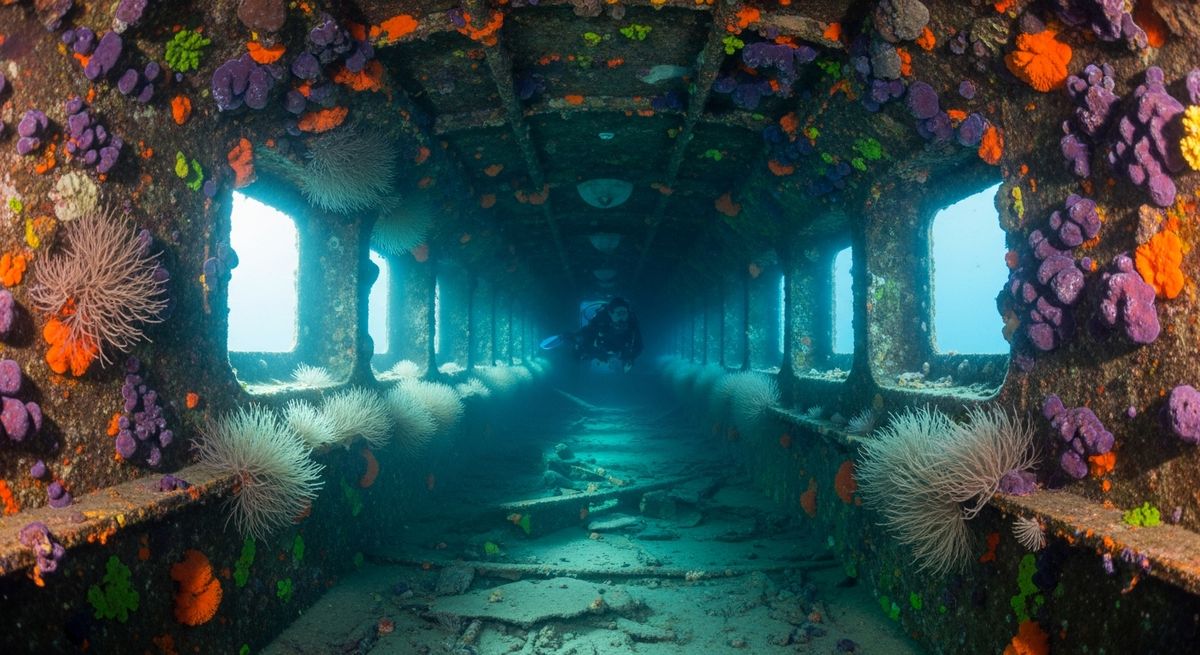
Okay, so Scapa Flow. Everyone talks about the German High Seas Fleet, and fair enough, they’re incredible. But if you’ve been a few times, or you’re looking for something a bit different, we always point people towards the *Bermuda*. She’s not deep, just 12 metres, but don’t let that fool you. This isn’t some broken-up barge; she’s a proper merchant vessel, big, built in '27 and then burnt out in Belfast before being scuttled in '33. What we love about the *Bermuda* is how intact she feels for a shallow wreck. You can still make out the superstructure, the sheer scale of her. It’s like ghosting through a drowned warehouse. We always find conger eels tucked away in the darker sections, their heads poking out from pipes, watching you with that unblinking stare. Visibility here can be really good, especially on a settled day, and then the light filtering through the Orkney green water just makes the whole place feel eerie and beautiful. Our favourite is to find a vantage point on the deck and just watch the shoals of pollock drift past, like silver rain. It’s a site that suits anyone comfortable with a bit of history and plenty of space to explore.
Typical BERMUDA Dive Profile
Illustrative profile based on site depth and type. Actual dive profiles vary - always follow your dive computer and training.
Safety Notes
Wreck site - avoid penetration without wreck diving certification. Watch for sharp metal and entanglement hazards.
Cold water this month (avg 13°C). Drysuit or thick wetsuit (7mm+) recommended.
Always perform a 3-minute safety stop at 5m before surfacing.
BERMUDA Wreck History
Year Sunk
1933
Vessel Type
passenger ship
Cause
scuttled
Tonnage
19,086 GRT
The story of the vessel known as the 'Bermuda' wreck in Scapa Flow is one of luxury and misfortune. Launched in 1927 as the magnificent passenger liner MS Bermuda, she was built to ferry wealthy clients between New York and Bermuda. Hailed as one of the most opulent ships of her time, her career was tragically short. In June 1931, a massive fire broke out while she was docked in Hamilton, Bermuda, gutting the vessel. She was towed back to Belfast for repairs, but fate struck again when a second fire erupted, sealing her doom.
Deemed a constructive total loss, the burnt-out hulk was sold for scrap. However, instead of being broken up, the vessel was acquired by the Admiralty. She was towed to the strategic naval anchorage of Scapa Flow and deliberately sunk in 1933. Her purpose in her final resting place is not entirely clear, with some suggesting she was intended for use as a blockship or for demolition experiments.
Today, the wreck of the 'Bermuda' lies upside down in just 12 meters of water in the sheltered confines of Widewall Bay. The shallow depth makes it an excellent and accessible dive for all levels of experience, including trainees. While the hull is largely flattened, divers can explore the recognizable bow and stern sections, peer into the wreckage, and observe the abundant marine life, like wrasse and crabs, that have made this once-glorious liner their home.
Reviews for BERMUDA
Conditions
Ocean conditions, forecast and tides for BERMUDA
BERMUDA Ocean Conditions
Monthly averages for BERMUDA, sourced from Open-Meteo marine data - nearest station: Open-Meteo marine grid (58.64, -3.16) (8km away)
October Averages
Sea Temperature
13°C
55°F · Range: 11.4–13.8°C
Air Temperature
10°C
50°F
Wind Speed
9.26 m/s
18.0 knots
Atmospheric Pressure
1005.3 hPa
Based on 4 years of monitoring data · Data sources: Open-Meteo marine data
Plan & book
Ways to dive Scapa Flow, Orkney, from day trips to liveaboards.
Day trips & courses
via GetYourGuideGuided dives, courses and snorkel trips with instant booking.
Find dive trips in Scapa Flow, OrkneyPlaces to stay
via Booking.comHotels and dive resorts near Scapa Flow, Orkney.
Search stays in Scapa Flow, OrkneyDive insurance
Most travel insurance excludes or limits scuba. Check what you need before you go.
Dive insurance explainedPartner links: we may earn a commission if you book, at no extra cost to you. How we make money
Where to Stay near BERMUDA
Prices from Booking.com. We may earn a commission at no extra cost to you.