BOY GRAHAM
Protected Area
Muckle and Little Green Holm
Why dive here
With 140+ marine species recorded in the area - including blue whales, dolphins, dwarf minke whales, humpback whales and ocean sunfish (mola mola) - BOY GRAHAM offers some of Scapa Flow, Orkney's richest wreck diving. Water ranges 8-14°C, warmest July, August, September.
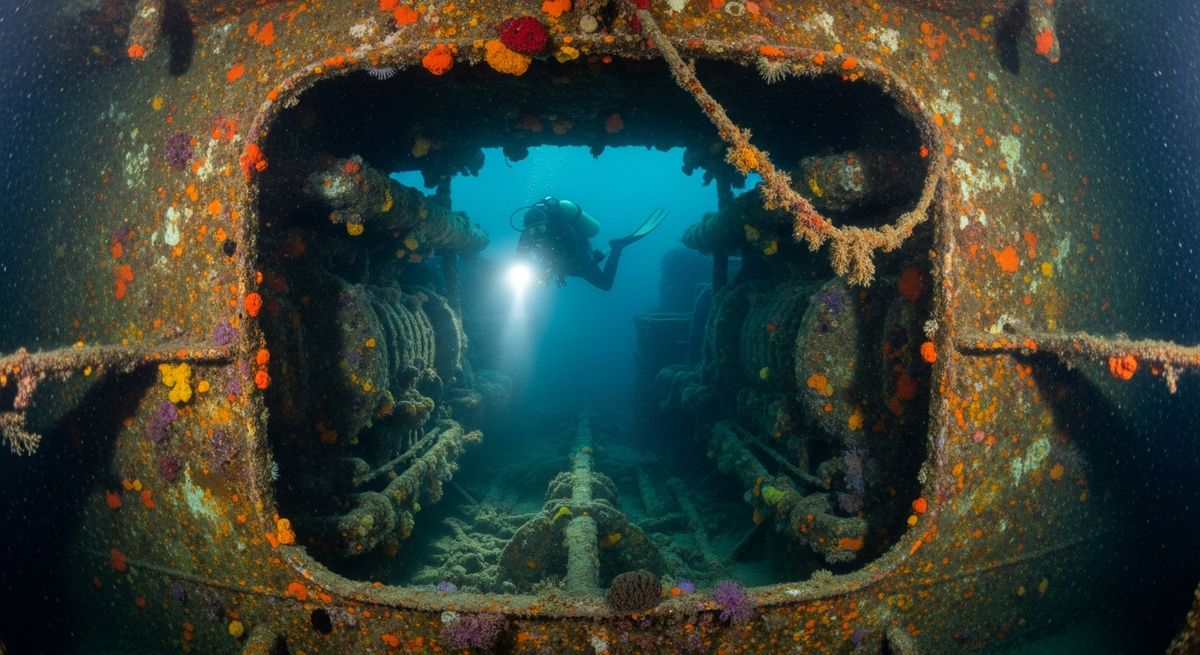
The Boy Graham sits at 31 metres, a fishing vessel that went down in 1981 after a burst pipe flooded her engine room. She’s a decent size at 21 metres, perfect for a good poke around without feeling overwhelmed. We think it’s one of Scapa Flow’s more underrated wrecks, probably because she’s not part of the scuttled German fleet. But that’s exactly what we love about her; there’s a genuine workhorse feel to the Boy Graham, the kind of boat that saw hard graft. You’ll typically drop onto her bow, which points north. The bridge superstructure has collapsed a fair bit, but the holds are still open and easy to explore. We always suggest carrying a good torch to really appreciate the details inside – the winch gear, some old fishing paraphernalia, and the general clutter of a working vessel that just... stopped. Conger eels often peek out from under plates of steel, and the entire wreck is draped in plumose anemones, their white tentacles swaying gently in the subtle flow. It’s a captivating picture against the green-grey light. This site suits divers who appreciate the quiet history of a modern wreck and enjoy the challenge of a cooler water dive.
Typical BOY GRAHAM Dive Profile
Illustrative profile based on site depth and type. Actual dive profiles vary - always follow your dive computer and training.
Safety Notes
Deep dive (31m) - monitor air consumption closely. Advanced certification recommended.
Wreck site - avoid penetration without wreck diving certification. Watch for sharp metal and entanglement hazards.
Cold water this month (avg 13°C). Drysuit or thick wetsuit (7mm+) recommended.
Always perform a 3-minute safety stop at 5m before surfacing.
BOY GRAHAM Wreck History
Year Sunk
1981
Vessel Type
fishing vessel
Cause
unknown
While Scapa Flow is world-renowned for the scuttled German High Seas Fleet of WWI, it is also home to more modern, humble tragedies like the fishing vessel Boy Graham. Built in 1957, this local Orkney vessel served the fishing community for over two decades. Its end was not a dramatic battle or storm, but a sudden mechanical failure. On October 7th, 1981, a pipe burst in the engine room, causing catastrophic and rapid flooding that sent the ship to the bottom.
Lying at 31 meters, the Boy Graham is a dive for more experienced divers. Unlike the colossal, broken battleships nearby, this 21-meter fishing vessel offers a more intact and recognizable wreck experience. Divers can explore its decks and superstructure, picturing its final moments and appreciating the contrast between this small working boat and the wartime giants that share its final resting place.
Nearest Dive Centres to BOY GRAHAM
Dive shops near BOY GRAHAM
View all dive centres in Scapa Flow, OrkneyReviews for BOY GRAHAM
Conditions
Ocean conditions, forecast and tides for BOY GRAHAM
BOY GRAHAM Ocean Conditions
Monthly averages for BOY GRAHAM, sourced from Open-Meteo marine data - nearest station: Open-Meteo marine grid (58.64, -3.16) (8km away)
October Averages
Sea Temperature
13°C
55°F · Range: 11.4–13.8°C
Air Temperature
10°C
50°F
Wind Speed
9.26 m/s
18.0 knots
Atmospheric Pressure
1005.3 hPa
Based on 4 years of monitoring data · Data sources: Open-Meteo marine data
Plan & book
Ways to dive Scapa Flow, Orkney, from day trips to liveaboards.
Day trips & courses
via GetYourGuideGuided dives, courses and snorkel trips with instant booking.
Find dive trips in Scapa Flow, OrkneyPlaces to stay
via Booking.comHotels and dive resorts near Scapa Flow, Orkney.
Search stays in Scapa Flow, OrkneyDive insurance
Most travel insurance excludes or limits scuba. Check what you need before you go.
Dive insurance explainedPartner links: we may earn a commission if you book, at no extra cost to you. How we make money
Where to Stay near BOY GRAHAM
Prices from Booking.com. We may earn a commission at no extra cost to you.