CALEDONIA (BCK 375)
Protected Area
Whiteness Head
Why dive here
With 140+ marine species recorded in the area - including blue whales, dolphins, dwarf minke whales, humpback whales and ocean sunfish (mola mola) - CALEDONIA (BCK 375) offers some of Scapa Flow, Orkney's richest wreck diving. Water ranges 8-14°C, warmest July, August, September.
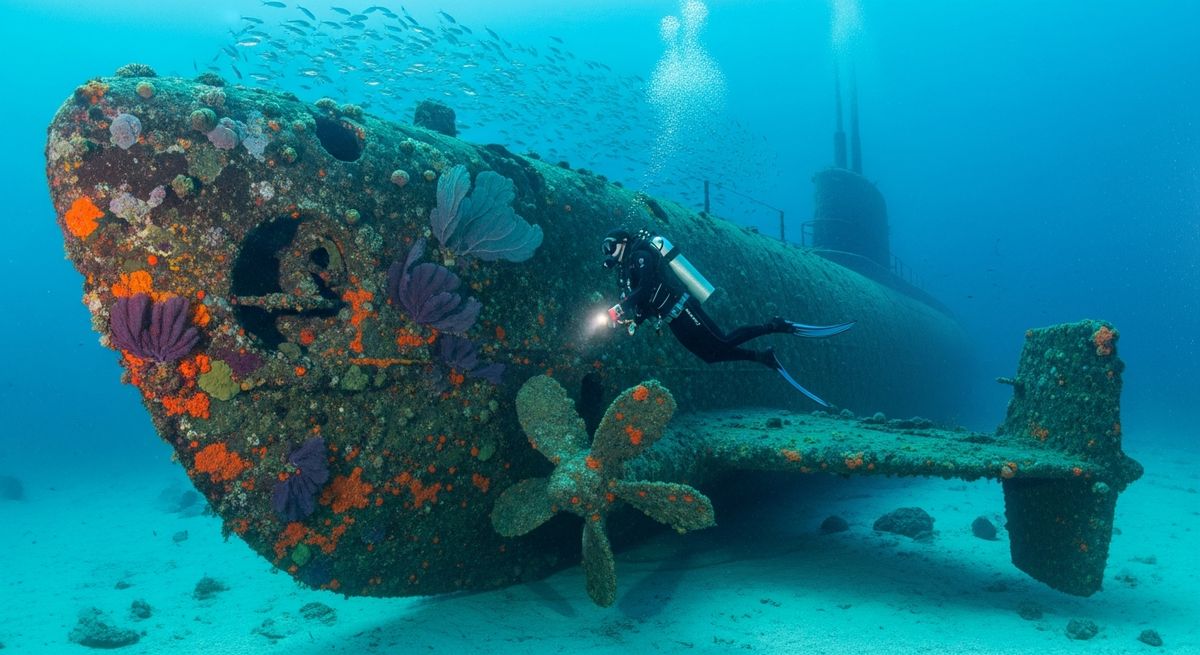
The Caledonia, a fishing trawler that burned and sank in 1923, sits upright and largely intact at 57 metres. We think it’s a brilliant dive for those comfortable with deeper wrecks in colder water. You descend onto the stern, where the propeller still offers a stark photo opportunity against the low light of Scapa Flow. The wheelhouse is gone, but the hull itself is a haven for life. We’ve often found substantial ling and conger eels tucked into the hold, alongside dense schools of saithe swirling around the mast. The visibility here can be surprisingly good on a calm day, sometimes pushing 10-15 metres, which really lets you appreciate the scale of the trawler. Exploring the deck allows you to trace the fire’s path, imagining the crew’s final moments. Keep an eye out for nudibranchs on the superstructure – we’ve seen some unusual varieties. It’s a site that rewards multiple visits; each dive reveals another detail, another resident.
Typical CALEDONIA (BCK 375) Dive Profile
Illustrative profile based on site depth and type. Actual dive profiles vary - always follow your dive computer and training.
Safety Notes
Maximum depth 57m exceeds recreational limits (40m). Technical diving certification and equipment required.
Wreck site - avoid penetration without wreck diving certification. Watch for sharp metal and entanglement hazards.
Cold water this month (avg 13°C). Drysuit or thick wetsuit (7mm+) recommended.
Always perform a 3-minute safety stop at 5m before surfacing.
CALEDONIA (BCK 375) Wreck History
Year Sunk
1923
Vessel Type
fishing vessel
Cause
fire
The Caledonia (BCK 375) was a motor fishing vessel registered in the Scottish port of Buckie. Owned by James & Alexander Smith of Portessie, she was a workhorse of the North Sea fishing fleet. On August 27, 1923-coincidentally the very same day the much larger HMS Caledonia sank nearby-disaster struck the fishing boat. A fire broke out on board, and despite the crew's efforts, it quickly raged out of control. The vessel was consumed by flames and sank, though thankfully her crew of four was recovered safely.
Resting at a depth of 57 metres, the Caledonia is a deep, challenging dive reserved for experienced technical and trimix divers. Lying in the dark, cold waters of Scapa Flow, the wreck is often subject to strong currents. Those qualified to make the descent will find the remains of a classic early 20th-century fishing boat. Depending on how she landed, divers might identify her engine, winches, and the general outline of her hull, now heavily colonized by anemones and other deep-water marine life.
Reviews for CALEDONIA (BCK 375)
Conditions
Ocean conditions, forecast and tides for CALEDONIA (BCK 375)
CALEDONIA (BCK 375) Ocean Conditions
Monthly averages for CALEDONIA (BCK 375), sourced from Open-Meteo marine data - nearest station: Open-Meteo marine grid (58.64, -3.16) (8km away)
October Averages
Sea Temperature
13°C
55°F · Range: 11.4–13.8°C
Air Temperature
10°C
50°F
Wind Speed
9.26 m/s
18.0 knots
Atmospheric Pressure
1005.3 hPa
Based on 4 years of monitoring data · Data sources: Open-Meteo marine data
Plan & book
Ways to dive Scapa Flow, Orkney, from day trips to liveaboards.
Day trips & courses
via GetYourGuideGuided dives, courses and snorkel trips with instant booking.
Find dive trips in Scapa Flow, OrkneyPlaces to stay
via Booking.comHotels and dive resorts near Scapa Flow, Orkney.
Search stays in Scapa Flow, OrkneyDive insurance
Most travel insurance excludes or limits scuba. Check what you need before you go.
Dive insurance explainedPartner links: we may earn a commission if you book, at no extra cost to you. How we make money
Where to Stay near CALEDONIA (BCK 375)
Prices from Booking.com. We may earn a commission at no extra cost to you.