CARISBROOK (POSSIBLY)
Protected Area
Long Berry Coast
Why dive here
With 140+ marine species recorded in the area - including blue whales, dolphins, dwarf minke whales, humpback whales and ocean sunfish (mola mola) - CARISBROOK (POSSIBLY) offers some of Scapa Flow, Orkney's richest wreck diving. Water ranges 8-14°C, warmest July, August, September.
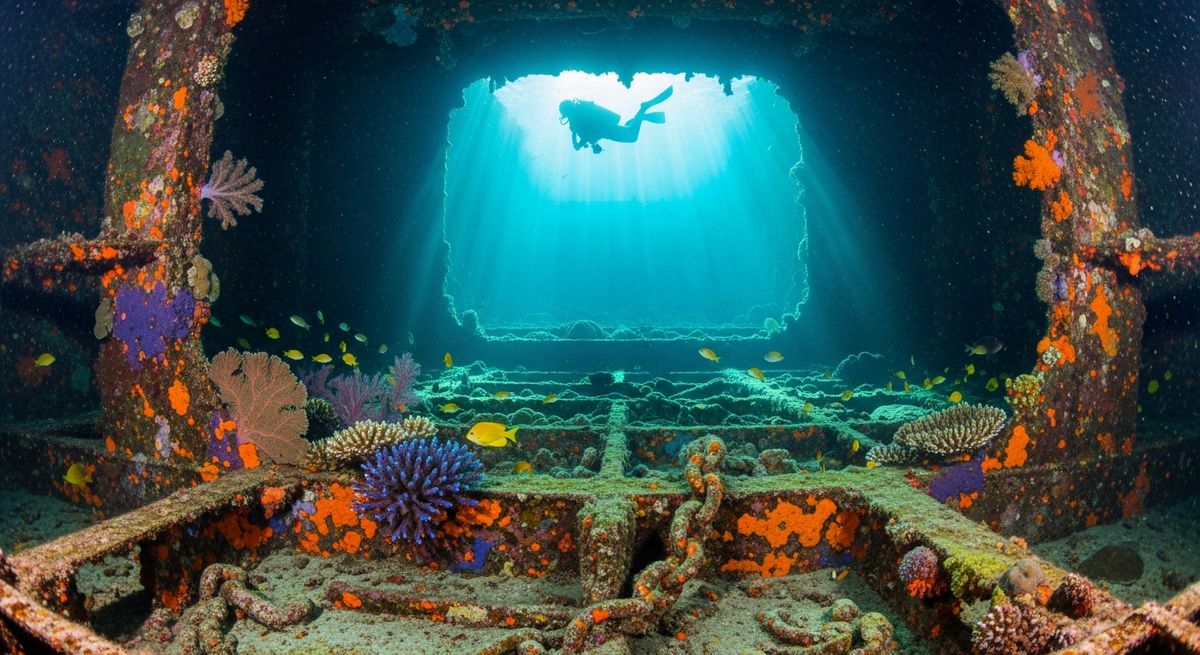
The *Carisbrook* might not be the poster child of Scapa Flow, but for those willing to venture a little deeper, it delivers a genuinely captivating dive. We’ve always found these lesser-known wrecks offer a different kind of magic. Dropping down, you're immediately struck by the sheer scale of the hull, largely intact and resting upright at 50 metres. There's a real sense of history here, the metalwork draped in anemones and dead man’s fingers, particularly vibrant under the torch beam. Our favourite part has to be exploring the stern. The twin boilers are still prominent, huge cylinders encrusted with sponges, and the triple expansion engine, though mostly collapsed, still offers fascinating nooks and crannies. Keep an eye out for conger eels peering from dark recesses and ling lurking amongst the twisted plates. Visibility can be hit or miss in Scapa, but when it's good, seeing the *Carisbrook*'s profile emerge from the green gloom is a powerful experience. We’d suggest diving this on a slack tide for the best conditions, allowing plenty of time to really soak in the atmosphere. This is a dive for experienced wreck enthusiasts, comfortable with deeper profiles and the often-chilly North Sea temperatures, who appreciate the quiet dignity of a well-preserved historical site.
Typical CARISBROOK (POSSIBLY) Dive Profile
Illustrative profile based on site depth and type. Actual dive profiles vary - always follow your dive computer and training.
Safety Notes
Maximum depth 50m exceeds recreational limits (40m). Technical diving certification and equipment required.
Wreck site - avoid penetration without wreck diving certification. Watch for sharp metal and entanglement hazards.
Cold water this month (avg 13°C). Drysuit or thick wetsuit (7mm+) recommended.
Always perform a 3-minute safety stop at 5m before surfacing.
CARISBROOK (POSSIBLY) Wreck History
Year Sunk
1915
Vessel Type
cargo ship
Cause
unknown
Resting in the deep, historic waters of Scapa Flow, the steamship identified as the Carisbrook is a challenging and rewarding dive for experienced technical divers. Built in 1907 by J. Blumer & Co. in Sunderland, this vessel was powered by a 236hp triple-expansion engine. At the time of her loss on June 21, 1915, she was owned by the Brook SS Co Ltd and was on a passage from Montreal, likely laden with cargo for the war effort.
The exact cause of the Carisbrook's sinking remains undocumented, adding a layer of mystery to the dive. Unlike the famous German High Seas Fleet scuttled here in 1919, her end is less certain, possibly the result of an accident or unrecorded enemy action during the height of World War I. The 'possibly' in her identification suggests that her true identity is still not 100% confirmed, inviting visiting divers to look for clues.
At a depth of 50 meters, the wreck is a serious undertaking, requiring decompression procedures and trimix gas. Divers who make the descent are greeted by the remains of a classic WWI-era steamship. The two large boilers and the impressive triple-expansion engine are key features, offering a fascinating glimpse into the engineering of the period. The dark, cool waters of the Flow often provide excellent visibility, making the exploration of this enigmatic wreck a truly memorable experience.
Reviews for CARISBROOK (POSSIBLY)
Conditions
Ocean conditions, forecast and tides for CARISBROOK (POSSIBLY)
CARISBROOK (POSSIBLY) Ocean Conditions
Monthly averages for CARISBROOK (POSSIBLY), sourced from Open-Meteo marine data - nearest station: Open-Meteo marine grid (58.64, -3.16) (8km away)
October Averages
Sea Temperature
13°C
55°F · Range: 11.4–13.8°C
Air Temperature
10°C
50°F
Wind Speed
9.26 m/s
18.0 knots
Atmospheric Pressure
1005.3 hPa
Based on 4 years of monitoring data · Data sources: Open-Meteo marine data
Plan & book
Ways to dive Scapa Flow, Orkney, from day trips to liveaboards.
Day trips & courses
via GetYourGuideGuided dives, courses and snorkel trips with instant booking.
Find dive trips in Scapa Flow, OrkneyPlaces to stay
via Booking.comHotels and dive resorts near Scapa Flow, Orkney.
Search stays in Scapa Flow, OrkneyDive insurance
Most travel insurance excludes or limits scuba. Check what you need before you go.
Dive insurance explainedPartner links: we may earn a commission if you book, at no extra cost to you. How we make money
Where to Stay near CARISBROOK (POSSIBLY)
Prices from Booking.com. We may earn a commission at no extra cost to you.