Diving with Nautiluses
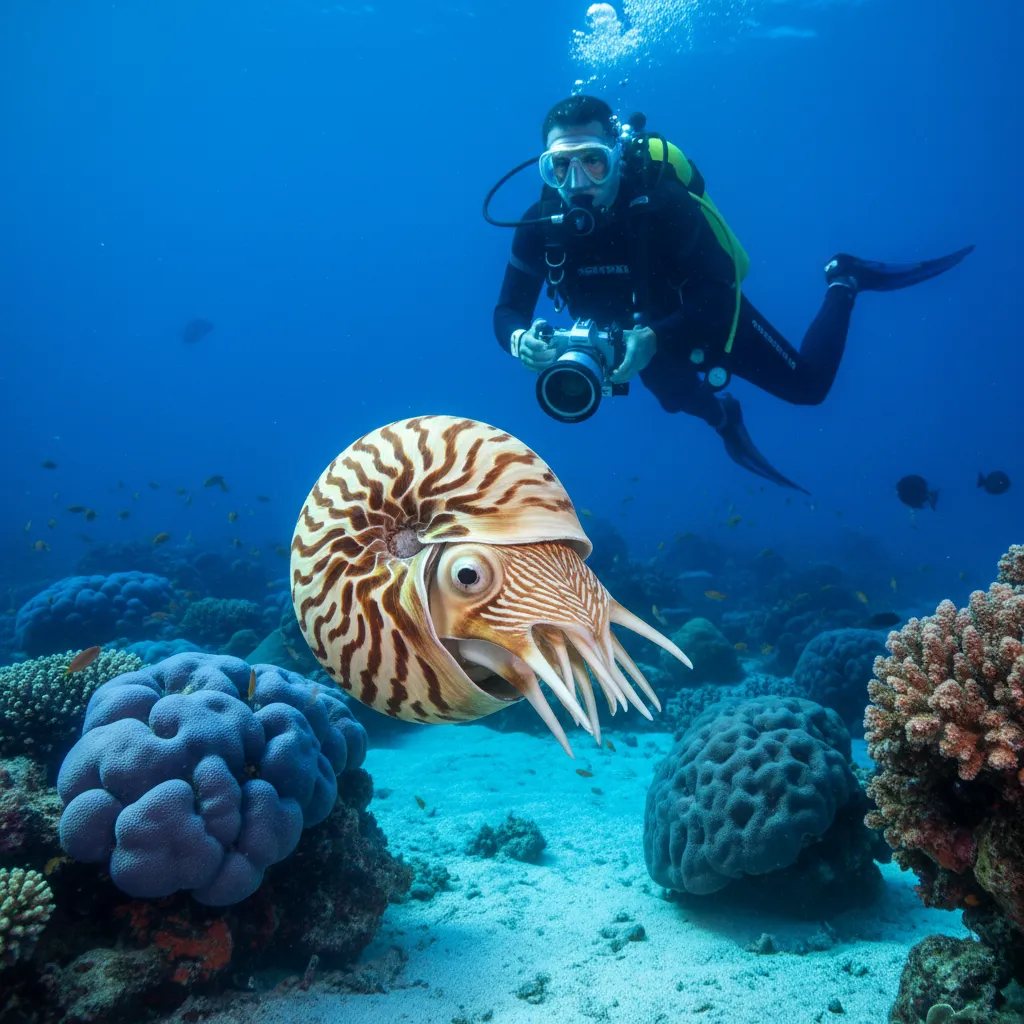
The nautilus is a living relic of deep time - a shelled cephalopod whose lineage stretches back over 500 million years, predating dinosaurs, trees, and even most insects. While their ancient relatives once dominated the world's oceans in forms up to 6 metres long, today's chambered nautiluses are modest animals of 15-25 centimetres, drifting through the deep waters of the Indo-Pacific in their exquisitely spiralled shells. Seeing a nautilus in the wild is one of diving's rarest privileges. These deep-dwelling animals spend their days at depths of 200-700 metres and rise along steep reef walls under cover of darkness to scavenge. An encounter with a nautilus feels like meeting a ghost from the Paleozoic - a survivor of five mass extinction events, still quietly going about its business in the dark depths of tropical seas.
Where to Dive with Nautilus
Found across 11 countries, based on 3,758 verified observation records.

Australia
1 area

Palau
2 areas

Philippines
2 areas

Samoa
1 area

Papua New Guinea
2 areas

India
2 areas

Myanmar
1 area

Malaysia
1 area
+ 3 more countries
Best Time to See Nautilus
Palau: nautiluses can be encountered year-round, but the best diving conditions are from October to May (dry season) when seas are calmer and visibility is best. Night dives on Blue Corner, Ngemelis, and other steep walls offer the highest probability. Papua New Guinea: year-round possibility, with calmer seas from May to November. Philippines (Bohol, Cebu walls): year-round, though encounters are very rare. New Caledonia: September to December offers the best conditions. In all locations, nautilus encounters are uncommon even on perfect dives - patience and repeated attempts are essential.
How to Dive with Nautilus
Wild nautilus encounters are extremely rare and require specific conditions. Nautiluses live at great depth during the day and migrate vertically at night along steep drop-offs and reef walls. Your best chance is a night dive or pre-dawn dive along a deep wall where the reef drops off sharply into very deep water. Palau is the most famous destination for nautilus encounters - the vertical walls around the Rock Islands plunge into deep water, and nautiluses occasionally rise to diveable depths (30-60 metres) at night. Papua New Guinea, particularly around Kimbe Bay and Rabaul, has produced sightings along deep walls. The Philippines, especially in the Visayas region near steep underwater cliffs, offers occasional encounters. New Caledonia's barrier reef walls are another known habitat. These encounters are never guaranteed and most divers who specifically seek nautiluses will need multiple night dives on deep walls. Some research expeditions use baited traps to study nautiluses, and occasionally dive operators in Palau arrange baited encounters at diveable depths.
Is it Safe to Swim with Nautilus?
The nautilus itself poses absolutely no danger - it is a slow-moving, docile scavenger with no venom or aggressive behaviour. The risk in nautilus diving comes entirely from the dive profile required. Deep night dives on vertical walls demand advanced skills, careful gas management, and strict adherence to depth limits. Nitrogen narcosis is a real concern at the depths where nautiluses are encountered (40-60 metres). Always dive with a reliable computer, carry a backup light, and never exceed your training limits in pursuit of a sighting. Decompression obligations can accumulate quickly at depth, especially on repetitive night dives. A surface marker buoy is essential for deep wall diving at night. Be honest with yourself about your experience level - a nautilus sighting is not worth a diving accident.
Conservation Status
Nautiluses are under serious threat from shell harvesting. Their beautiful shells are sold as decorative items, jewellery, and ornaments, driving intensive fishing in the Philippines, Indonesia, and other parts of their range. Unlike other cephalopods, nautiluses are long-lived (potentially 15-20 years), slow to mature, and produce very few eggs - making them extremely vulnerable to overfishing. In 2017, all nautilus species were listed under CITES Appendix II, requiring export permits for international trade. The United States has listed them under the Endangered Species Act. Despite these protections, illegal harvest continues. Population monitoring is difficult because nautiluses live at great depth. Supporting the CITES trade restrictions and choosing not to purchase nautilus shell products are the most important actions divers can take.
Species Profile

Recommended Equipment
Deep night diving gear is required: a reliable primary dive light with a burn time exceeding your planned dive time, plus at least one backup light. A dive computer rated for the planned depth with nitrox capability is essential. For dives below 40 metres, consider using enriched air nitrox for decompression optimisation (though you must switch to air or a lower nitrox mix at depth to stay within oxygen limits). A camera with strong low-light performance and a macro lens is ideal - nautiluses are not large and the encounter will be in darkness. Strobes will illuminate the shell's beautiful pearlescent surface. Carry a surface marker buoy and reel for ascending from deep walls at night. Warm exposure protection is important, as deep water is cold even in the tropics.
Browse dive equipmentFrequently Asked Questions
Where can you see a nautilus while diving?
Palau is the best-known destination for nautilus encounters, with steep reef walls dropping into deep water where nautiluses migrate vertically at night. Papua New Guinea and the Philippines also offer rare sightings on deep walls. Encounters are never guaranteed and require deep night dives on steep drop-offs.
How old are nautiluses as a species?
Nautiluses belong to a lineage that dates back over 500 million years to the Cambrian period. They have survived all five mass extinction events. While modern nautilus species are not that ancient individually, their basic body plan has remained remarkably unchanged for hundreds of millions of years, earning them the title of living fossils.
How deep do nautiluses live?
Nautiluses typically live at depths of 200-700 metres during the day, migrating to shallower water (sometimes 100-300 metres) at night along steep reef walls to scavenge. On rare occasions they rise to recreational diving depths (30-60 metres), which is when divers have the chance to encounter them.
Why are nautiluses endangered?
Nautiluses are threatened primarily by shell harvesting for decorative items and jewellery. They are exceptionally vulnerable because they are long-lived (15-20 years), slow to mature, and produce very few offspring. All nautilus species are now listed under CITES Appendix II to regulate international trade.
What is the difference between a nautilus and an ammonite?
Ammonites were shelled cephalopods that went extinct 66 million years ago alongside the dinosaurs. Nautiluses are their closest living relatives but belong to a different subclass. Ammonite shells typically had more complex internal structures (suture patterns) and many species had elaborate ribbed or spined shells, while nautilus shells are smooth with simpler chambers.