Diving in Sydney & New South Wales
Why dive here
Sydney & New South Wales offers some of Australia's richest diving, with 199+ marine species recorded in the area - including blue sharks, bull sharks, dolphins, dugongs and great white sharks. Water ranges 18-23°C, warmest January, February, March.
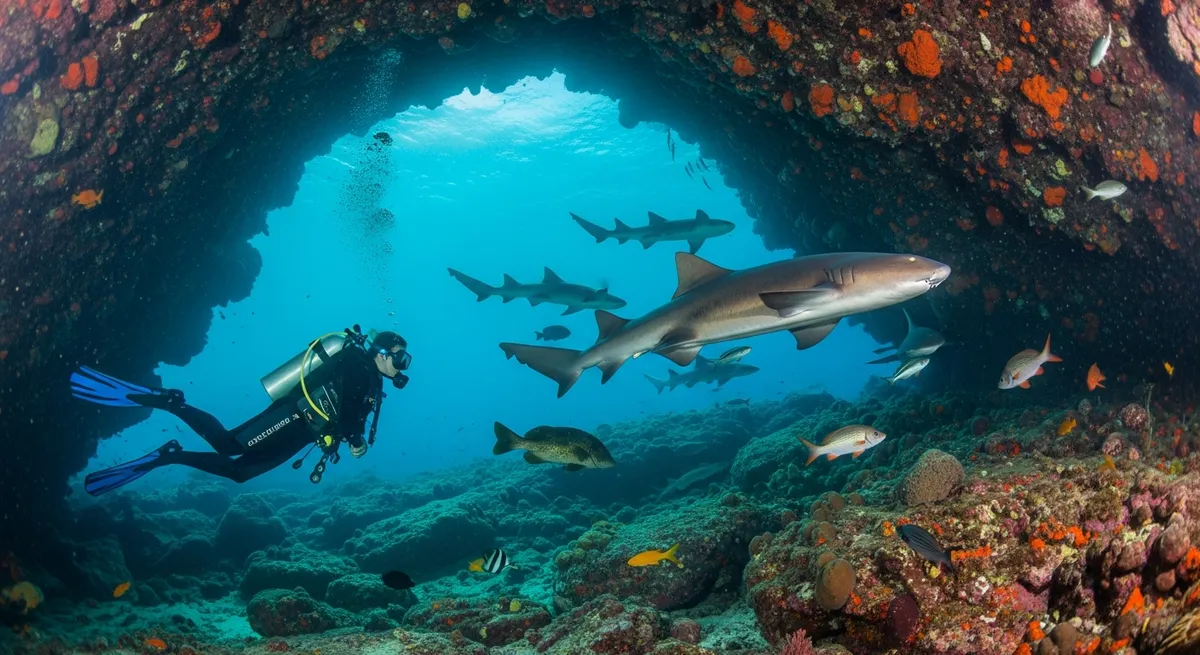
Forget everything you think you know about Australian diving outside the tropics. Sydney and regional New South Wales serve up some truly unique experiences. We love the dramatic topography; think caves, pinnacles, and walls carved by ancient currents, all blanketed in temperate corals and sponges. This is a place for the macro enthusiast, where you can spend an hour combing a single patch of kelp for pygmy pipehorses or the elusive weedy sea dragon. Our favourite spots often involve a bit of a journey. Fish Rock Cave near South West Rocks is a non-negotiable, a grey nurse shark highway in an enormous tunnel. Diving through it, with the sharks gliding past, feels like entering another world. Or head to Kurnell in Botany Bay for guaranteed weedy sea dragon sightings, often in surprisingly shallow water, the light filtering through the kelp. Wreck divers will find plenty to keep them busy too, from historic tugboats to naval vessels. The visibility can vary quite a bit, but when it's good, it’s stunning, and even on an average day, the sheer density of small critters makes up for it. Winter brings clearer water and the chance of migrating pelagics, while summer warms things up, making for longer bottom times. Just be prepared for cooler water temperatures year-round - a decent 7mm suit is your friend here.
Sydney & New South Wales Dive Site Map
Dive sites and dive centres in Sydney & New South Wales
Sydney & New South Wales Dive Sites
178 dive sites in Sydney & New South Wales
3 mile Bommie
The 3 Mile Bommie, just off The Entrance, is one of those sites that always delivers. We love the sheer scale of it, a proper reef system covering 30 hectares, not just a patch. We’re often treated to the sight of grey nurse sharks cruising through the deeper sections, an always impressive encounter, and the wobbegongs here are wonderfully placid. Keep an eye out for the big schools of yellowtail and bream that seem to perpetually swirl around the bommie’s edges; the sun filtering through them is a real moment. If you can time your dive for a calm day, the visibility often bumps up from its average 10m, making the shallow caves and channels even more inviting. This place really suits divers who appreciate a sprawling reef with plenty of nooks and crannies to explore.
3 mile Bommie
The 3 Mile Bommie, just off The Entrance, is one of those sites that always delivers. We love the sheer scale of it, a proper reef system covering 30 hectares, not just a patch. We’re often treated to the sight of grey nurse sharks cruising through the deeper sections, an always impressive encounter, and the wobbegongs here are wonderfully placid. Keep an eye out for the big schools of yellowtail and bream that seem to perpetually swirl around the bommie’s edges; the sun filtering through them is a real moment. If you can time your dive for a calm day, the visibility often bumps up from its average 10m, making the shallow caves and channels even more inviting. This place really suits divers who appreciate a sprawling reef with plenty of nooks and crannies to explore.
3rd Gutter
3rd Gutter is one of those Sydney sites that really delivers if you know what to look for, and we think it's often overlooked for its flashier neighbours. Descending into that 19-metre maximum, we usually find a surprisingly busy stretch of rocky reef, especially considering its proximity to the city. The real magic here, for us, is in the smaller stuff, the sort of things you only spot when you slow right down and really scan the crevices and the leafy growth. We've spent entire dives here captivated by frogfish, masters of camouflage, and if you’re patient, you might just spot a Sydney pygmy pipehorse swaying gently. Keep an eye out for nudibranchs, too; they seem to pop up in every colour imaginable. It’s a genuinely relaxing dive, generally with manageable currents, making it perfect for photographers or anyone who just wants to drift and observe. Visibility averages around 8 metres, which is decent for Sydney, but we’d suggest timing your dive for an incoming tide to potentially catch it at its clearest.
3rd Gutter
3rd Gutter is one of those Sydney sites that really delivers if you know what to look for, and we think it's often overlooked for its flashier neighbours. Descending into that 19-metre maximum, we usually find a surprisingly busy stretch of rocky reef, especially considering its proximity to the city. The real magic here, for us, is in the smaller stuff, the sort of things you only spot when you slow right down and really scan the crevices and the leafy growth. We've spent entire dives here captivated by frogfish, masters of camouflage, and if you’re patient, you might just spot a Sydney pygmy pipehorse swaying gently. Keep an eye out for nudibranchs, too; they seem to pop up in every colour imaginable. It’s a genuinely relaxing dive, generally with manageable currents, making it perfect for photographers or anyone who just wants to drift and observe. Visibility averages around 8 metres, which is decent for Sydney, but we’d suggest timing your dive for an incoming tide to potentially catch it at its clearest.
4th-5th Reefs
The 4th-5th Reefs offer a straightforward dive along a coral reef system off Sydney. You'll find a good scattering of hard corals and sponges, with a decent chance to spot various reef fish darting between the bommies. It's a solid choice for local divers looking for a reliable drift, or for those wanting a relaxed introduction to Sydney's offshore sites. Currents can pick up, so keep that in mind.
7th and 8th Reefs
The 7th and 8th Reefs offer a reliable dive when you are in the Sydney area. We find this site usually delivers decent visibility, with the hard corals providing shelter for schooling fish and occasional rays. It’s a good option for divers looking for a comfortable shore dive with consistent conditions. You will find a solid representation of temperate reef species here.
Acheron Ledge
Acheron Ledge, off the Sydney coast, offers a solid wall dive. We often find schooling yellowtail scad here, along with wobbegong sharks tucked into the crevices. It’s a reliable spot when the swell is down, suitable for experienced divers comfortable with deeper profiles and potential current.
Adelaide (Wreck)
The Adelaide, scuttled in 2011, isn't some ancient, decaying hulk. It's a purpose-sunk modern warship, and that’s precisely what makes it so much fun to dive. We love the sheer scale of it, upright and intact, dropping down to 31 metres. You can swim through the helicopter hangar, past the bridge, and even into some of the smaller cabins. What really grabs us is the way marine life has absolutely colonised this artificial reef. Kingfish often school so thick around the upper decks they block out the sun, and we’ve consistently spotted huge wobbegongs tucked into crevices. The nurse sharks have become quite the residents too, unbothered by divers poking around. Visibility averages about 11 metres, so it’s not always gin-clear, but when it’s good, the light plays beautifully through the ship's structure. This site really suits divers keen on exploring a substantial wreck, those who appreciate seeing nature reclaim something man-made, and anyone who gets a kick out of big schools of fish.
Adelaide (Wreck)
The Adelaide, scuttled in 2011, isn't some ancient, decaying hulk. It's a purpose-sunk modern warship, and that’s precisely what makes it so much fun to dive. We love the sheer scale of it, upright and intact, dropping down to 31 metres. You can swim through the helicopter hangar, past the bridge, and even into some of the smaller cabins. What really grabs us is the way marine life has absolutely colonised this artificial reef. Kingfish often school so thick around the upper decks they block out the sun, and we’ve consistently spotted huge wobbegongs tucked into crevices. The nurse sharks have become quite the residents too, unbothered by divers poking around. Visibility averages about 11 metres, so it’s not always gin-clear, but when it’s good, the light plays beautifully through the ship's structure. This site really suits divers keen on exploring a substantial wreck, those who appreciate seeing nature reclaim something man-made, and anyone who gets a kick out of big schools of fish.
Adreno (diving gear)
Alright, Adreno. Now, this isn't a coral reef you're finning over, but it’s still a crucial Sydney dive site. If your BCD just started free-flowing or your mask strap snapped on the way to Bare Island, Adreno is your lifeline. We love being able to pop in, grab a new spare, and be back in the water within the hour. It’s that instant gratification, that knowing nod from staff who actually dive the local spots, which makes it our go-to. You’ll see walls lined with regulators, racks of wetsuits, and shelves stacked with every fin colour imaginable. The smell of neoprene hits you first, then the hum of the air fill station from the back. It suits anyone from the beginner kitting out their first set of gear to the seasoned tech diver needing a specific O-ring. Our advice? Go in with a list, but leave time to browse. You always spot some bit of kit you didn’t know you needed.
Avoca
Avoca is one of our go-to shore dives when the westerlies really whip up around Sydney. It’s got this great natural protection that means even on a choppy day, it can be surprisingly calm here. We love dropping in and navigating the rocky reef, which is usually home to inquisitive Eastern Blue wrasse following you around. The real charm of Avoca, though, is how much life pops out of the crevices. You’ll often spot Wobbegongs tucked into rocky overhangs, and sometimes we’ve even seen a Rusty Catshark peeking out. We’ve had days here where the schools of yellowtail are so thick they almost block out the sun, a proper shimmering curtain. The maximum depth of 14m means you get plenty of bottom time to explore, which is great because there’s always something new to spot. Our favourite trick is to go slow, really scrutinising the rocks, because that’s when you’ll find the smaller stuff, like the colourful nudibranchs that often hide in plain sight. Visibility averages 10m, which is decent for a shore dive in this region, and on a good day, it can stretch to a comfortable 15m. It’s perfect for divers who enjoy a relaxed pace and appreciate the smaller, often overlooked, critters.
Avoca
Avoca is one of our go-to shore dives when the westerlies really whip up around Sydney. It’s got this great natural protection that means even on a choppy day, it can be surprisingly calm here. We love dropping in and navigating the rocky reef, which is usually home to inquisitive Eastern Blue wrasse following you around. The real charm of Avoca, though, is how much life pops out of the crevices. You’ll often spot Wobbegongs tucked into rocky overhangs, and sometimes we’ve even seen a Rusty Catshark peeking out. We’ve had days here where the schools of yellowtail are so thick they almost block out the sun, a proper shimmering curtain. The maximum depth of 14m means you get plenty of bottom time to explore, which is great because there’s always something new to spot. Our favourite trick is to go slow, really scrutinising the rocks, because that’s when you’ll find the smaller stuff, like the colourful nudibranchs that often hide in plain sight. Visibility averages 10m, which is decent for a shore dive in this region, and on a good day, it can stretch to a comfortable 15m. It’s perfect for divers who enjoy a relaxed pace and appreciate the smaller, often overlooked, critters.
Show all 178 dive sites in Sydney & New South Wales
- Bait Reef
- Balmoral Baths
- Bare Island East
- Barren s Hut
- Bass Flinders
- Bass Point
- Bennets Head North
- Big Seal Rock - The Cavern
- Bird Island
- Bird Island
- Bird Rock
- Bird Rock
- Black Rock
- Blacksmiths Western Artificial Reef
- Blacksmiths Western Artificial Reef
- Blue Devil Cave
- Blue Devil Cave
- Blue Fish Wall
- Bowen Island
- Broughton Island The Looking Glass
- Broughton Island The Looking Glass
- Bushrangers Bay
- Bushrangers Bay
- Camp Cove South
- Catherine Hill Coal Loader
- Cathie Wall
- Centurion
- Chowder Bay
- Chris’ Wall
- Clifton Gardens
- Cod Grounds Commonwealth Marine Reserve
- Container Wall Botany Bay
- Cowrie Island
- Crocodile Head
- Danger Reefs
- Depot Beach
- Desoto Inlet
- Drum and Drumsticks
- Echo Point
- Edith Breakers
- Ex HMAS Adelaide
- Fairlight
- Fairy Bower
- Fingal Head
- Fishermans Bay
- Fish Rock Cave
- Flagstaff
- Flinders Reef
- Fly Point
- Foggy Shark Cave
- Ghosties
- Gordon s Bay Clovelly
- Gordons Bay Underwater Trip Start
- Gravel Loader
- Green Island
- Guerrilla Bay
- Halifax Cliffs
- Halifax Point
- Harbord
- Hole in the Wall
- Hyams Beach
- Idol Bay
- Inner Reef
- Inscription point
- Itata
- Jibbon Bombora
- Julian Rocks
- Kiama blowhole
- Koputai
- Ladys Reef
- Latitude Reef
- Leah Lumps
- Light House Reef
- Little Beach - NSW
- Little Manly Cove
- Lobster Pot
- Long Reef
- Lou’s Reef
- Lucy’s Wall
- Magic Point
- Manly Bombie
- Mareela Reef
- Mermaid Reef
- Mermaid Reef
- Merries Reef
- Moon Island
- MV Malabar
- Norah Head (Cabbage Tree Bay)
- North Bondi
- North Coogee
- North Evans Reef
- North Reef
- Oak Park
- OLD Faithful
- Old Mans Hat
- Osbourne Shoals
- Outer Reef
- Palm Beach
- Pig Island
- Pipeline
- Point Perpendicular
- Port Macquarie Artificial Reef
- Redhead Point
- Sewage Pipe
- Shark Bay
- Shark point
- Shelley Beach
- Shiprock
- Skillion Cave
- Slot Cave
- Snapper Point
- South Evans Reef
- South Reef
- South Reef
- South Reef
- Sow and Pigs Reef
- SS Annie M Miller
- SS Catterthun
- SS Currajong
- SS Duckenfield
- SS Galava (Wreck)
- SS Kelloe
- SS Macleay Wreck
- SS Oakland Wreck
- SS Satara
- SS Tuggerah
- SS Undola
- SS Woniora
- Stoney Creek
- Swansea Bridge
- Swansea Bridge
- Terrigal Haven
- The Arch
- The Arch
- The Bar
- The Church
- The Coolooli
- The Cutting Farkernell
- The Gantry
- The Gutter
- The Igor
- The Leap
- The Loader
- The monuments
- The Pinnicles
- The Pipeline
- The Slide, Terrigal
- The Steps
- The Tribars
- The Valiant
- The Valliant (Wreck)
- The Wall
- Titan Crane
- Voodoo
- Wagstaffe Bar
- Wall
- Waterfall
- Whale Of A Time
- Windy Point
- Wottamolla
- Wreck of AHS Centaur
- Wreck of Dunbar
- Wreck of HMAS Adelaide
- Wreck of HMAS Australia
- Yena Extension
- Yena Gap
Sydney & New South Wales Dive Centres
21 dive shops and operators in Sydney & New South Wales
Abyss Scuba Diving
Aquatic Explorers
CENTRAL COAST DIVERS
Deep Sensations Pty Ltd
Dive Centre Bondi
Dive Centre Manly
Dive Forster
DIVE NEAR ME PTY LTD
Show all 21 dive centres in Sydney & New South Wales
Ocean Wildlife in Sydney & New South Wales
199 species recorded in Sydney & New South Wales
Sydney & New South Wales Daylight & Sunrise/Sunset
Sunrise and sunset times for Sydney & New South Wales, calculated from coordinates
Today - Sunday 11 October
Sunrise
05:19
Sunset
18:03
Daylight
12h 44m
Golden Hour
17:30
First light (dawn) at 04:54 · Last light (dusk) at 18:28
Monthly Averages
| Month | Sunrise | Sunset | Daylight |
|---|---|---|---|
| Jan | 05:00 | 19:07 | 14h 7m |
| Feb | 05:30 | 18:47 | 13h 17m |
| Mar | 05:53 | 18:14 | 12h 20m |
| Apr | 06:16 | 17:33 | 11h 17m |
| May | 06:38 | 17:04 | 10h 26m |
| JunShortest | 06:56 | 16:54 | 9h 58m |
| Jul | 06:56 | 17:04 | 10h 8m |
| Aug | 06:33 | 17:25 | 10h 52m |
| Sep | 05:54 | 17:45 | 11h 51m |
| OctNow | 05:14 | 18:06 | 12h 52m |
| Nov | 04:44 | 18:33 | 13h 49m |
| DecLongest | 04:39 | 18:59 | 14h 20m |
Times are approximate local times based on longitude. Actual times may vary slightly depending on the exact timezone observed in Sydney & New South Wales.
Where to Stay near Sydney & New South Wales
Prices from Booking.com. We may earn a commission at no extra cost to you.
Marine Protected Areas near Sydney & New South Wales
38 protected areas near Sydney & New South Wales - please respect local regulations when diving
Hunter
Port Stephens - Great Lakes
Crowdy Bay
Hunter Wetlands
Hunter Estuary Wetlands
Towra Point
Bouddi
North Sydney Harbour
Comerong Island
Towra Point Nature Reserve
Towra Point
Boat Harbour
Showing 12 largest of 38
Getting to Sydney & New South Wales
Williamtown
Sydney (Mascot)
Richmond
Plan & book
Ways to dive Sydney & New South Wales, from day trips to liveaboards.
Day trips & courses
via GetYourGuideGuided dives, courses and snorkel trips with instant booking.
Find dive trips in Sydney & New South WalesPlaces to stay
via Booking.comHotels and dive resorts near Sydney & New South Wales.
Search stays in Sydney & New South WalesDive insurance
Most travel insurance excludes or limits scuba. Check what you need before you go.
Dive insurance explainedPartner links: we may earn a commission if you book, at no extra cost to you. How we make money