Diving in Tubbataha Reef
Why dive here
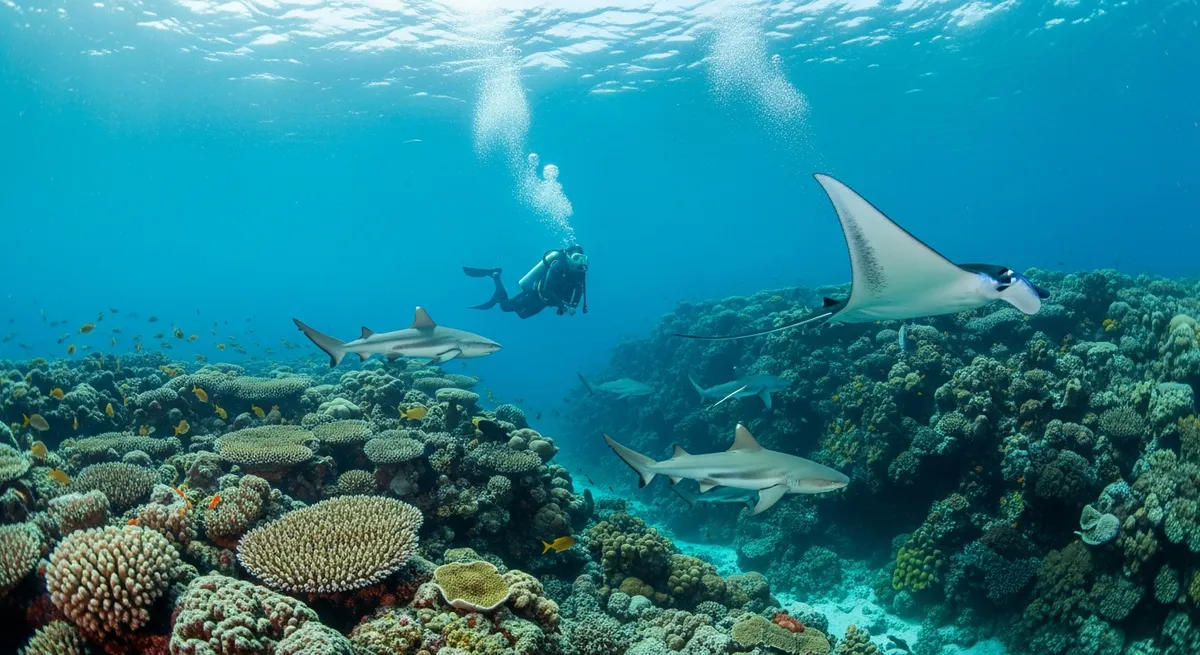
Tubbataha Reef offers some of Philippines's richest diving, with 477+ marine species recorded in the area - including barracuda, blacktip reef sharks, blue-spotted stingrays, dolphins and eagle rays.
Tubbataha. Just the name makes us want to pack our bags. This UNESCO site is a live-aboard only affair, and for good reason. It’s remote, it’s wild, and it is, in our opinion, some of the most consistent big-fish action in Southeast Asia. What makes it special? The walls here are just epic, dropping into the deep blue with a constant parade of pelagics. We’re talking reef sharks, grey reefs, even hammerheads if you’re lucky, often cruising by in the current. You'll drift past schools of bannerfish so thick they dim the light, and we’ve seen manta rays glide over the reef tops more times than we can count. Keep an eye out for those smaller, intricate things too - we’ve spotted flaming blennies peeking from crevices and the stout red shrimp waving from their anemones. The currents can be brisk, which means fantastic drift dives, but you’ll want to be comfortable with that. Our favourite time to go is late April, just as the weather settles, though you only have a short window, March to June, to experience it. It truly feels like an untouched wilderness down there.
Tubbataha Reef Dive Site Map
Dive sites and dive centres in Tubbataha Reef
Tubbataha Reef Dive Sites
58 dive sites in Tubbataha Reef
Amos Rock
Amos Rock, in Tubbataha's North Atoll, is a solid intermediate dive. We generally drop to around 24 meters, following a reef wall that’s thick with healthy hard corals. You'll often see whitetip reef sharks resting on the sandy ledges here, and schools of snappers hang in the blue. It’s a reliable site for those looking for a relaxed drift and consistent reef action.
C4
C4, a stern trawler sunk intentionally in Tubbataha, offers a different kind of dive for the area. Dropping down, you’ll find the wreck sitting upright, mostly intact, with penetration possible into the wheelhouse and engine room for those with the right training. Schools of bigeye trevally often circle the masts, while resident whitetip reef sharks patrol the sandy bottom nearby. It’s a good spot to hone wreck diving skills or simply enjoy the artificial reef effect, especially if you’ve had your fill of the pristine reef walls elsewhere in Tubbataha.
Cagayancillo Islands
The Cagayancillo Islands, often just called Cagayan, are a special treat for divers making the transit between Tubbataha and the Visayas. You’ll find walls here, much like Tubbataha, but with a surprising array of fans, sponges, and soft corals that can feel even more vibrant. The plateaus, resting between 10 and 20 meters, are a comfortable depth for lingering. We’ve spotted white tip reef sharks patrolling the deeper sections, and the general calm here makes for a relaxed exploration of genuinely healthy reefs. It’s a great stop for divers who appreciate quiet, uncrowded sites and don't mind a slightly longer journey.
Constancia Reef
Constancia Reef in Tubbataha is a lively coral reef, often with a good current running through it. We've seen reef sharks patrolling the drop-off and schools of trevally hunting in the blue. It’s a great spot for advanced divers who appreciate dynamic drift dives and pelagic action. Just be ready for that current; it can really pick up.
Crossing
Crossing at Tubbataha is a drift dive, often with a decent current pushing you along. You'll see plenty of pelagics here – grey reef sharks, whitetips, and sometimes manta rays cruising by. It’s a good spot for experienced divers who enjoy a dynamic dive with big animal encounters. Keep an eye out for tuna and barracuda schools too.
Cuttlefish Shawl
Cuttlefish Shawl in Tubbataha is where you’ll often find us drifting along a sloping reef. It’s a site that rewards patience, with cuttlefish frequently seen here, sometimes in pairs or even small groups out in the open. We’ve also spotted reef sharks patrolling the deeper edge. It’s a good spot for divers who enjoy a relaxed drift and appreciate the smaller, more elusive encounters.
DALL Reef
DALL Reef is a good spot within Tubbataha for those looking for a relaxed drift. We often find good numbers of reef sharks patrolling the deeper sections and schooling fusiliers blanketing the shallower coral, making for some nice wide-angle photo opportunities. It’s generally a pretty straightforward dive, suitable for most experience levels when conditions are calm.
Delsan Wreck
The Delsan Wreck, sitting upright at 29 metres, is one of those sites that just feels right for Tubbataha. It’s not some ancient Galleon, but a modern freighter, sunk in the late 1980s. That relatively recent sinking means a wreck that’s still very much a wreck, yet also wonderfully colonised. We love that balance. You get the thrill of exploring cargo holds and machinery, while also finning past schooling fusiliers and trevally that use the superstructure for shelter. Our favourite part is always the bow, where the chain locker offers a gloomy, atmospheric swim-through, often with a white-tip reef shark curled up inside. The current can pick up here, pushing you gently along the deck, which is perfect for lazy drift dives past the wheelhouse. Keep an eye out for giant groupers lurking in the shadows and massive schools of snappers that swirl around the masts. It’s an intermediate dive, really, because of that depth and potential for current, but the wreck itself is open and relatively easy to navigate. A fantastic combination of history and healthy reef life.
Delsan Wreck
The Delsan Wreck, despite being just the bow of a freighter sticking out of the water, really defines a Tubbataha trip for us. It’s not just a navigation marker, it’s a living monument. We love watching the sheer volume of seabirds wheeling overhead, a constant screeching soundtrack against the wide-open expanse of the Sulu Sea. Diving here, you’re looking at what’s left of the Delsan, a Vietnamese freighter that ran aground in 2005. It's an easy dive, often done as a drift, letting the current carry you along the reef wall adjacent to the wreck. We usually drop in near the bow, giving ourselves time to take in the sheer scale of the structure below. The main draw is the dense schooling fish. We're talking thousands of fusiliers and trevally, sometimes so thick they completely obscure the wreck itself. Look out for white-tip reef sharks patrolling the deeper sections. Our favourite thing is the way the light filters through the schools, creating these incredible, shifting patterns. It's an experience that really highlights the wildness of Tubbataha, a stark contrast between man-made disaster and natural recovery.
Finger reef
Finger Reef at Tubbataha is exactly what it sounds like, a long, narrow finger of coral extending out from the main atoll. We've seen reef sharks patrolling the drop-off and schools of barracuda hanging in the blue. It’s a drift dive, often with a decent current, making it perfect for experienced divers who enjoy going with the flow and keeping an eye out for larger pelagics. Visibility is generally excellent, allowing for expansive views of the reef structure.
FLY ROBIN
The Fly Robin isn't a deep dive, sitting shallow at just three metres, but don’t let that fool you into thinking it’s not worth your time. This yacht, grounded back in 2011 on a passage from Borneo, is an unexpectedly cool spot, especially when the light hits it right. We love to drift over the superstructure, watching the sunlight shimmer through the clear water, illuminating the hull below. What makes it special is the way the shallow depth allows the corals to really thrive, spreading across the wreck in colourful patches. You'll see schools of fusiliers darting around the mast, and it’s a favourite hangout for juvenile reef sharks, often spotted cruising in and out of the shadows. It's a photographer's dream on a sunny day, with those vibrant coral contrasts against the metal. We'd suggest going in the late morning, when the sun is high, to get the best light penetration. It’s an easy, relaxing dive, perfect for a long safety stop or just a gentle exploration of a wreck that’s found a second life.
Helmuth Reef
Helmuth Reef is pure Tubbataha, a wall dive dropping deep, coated in hard corals and a surprising number of giant barrel sponges. We've often found grey reef sharks patrolling the drop-off, particularly in the mornings. Keep an eye on the blue for manta rays gliding past the wall. It's a great spot for experienced divers looking for larger pelagics in a classic Tubbataha setting.
Show all 58 dive sites in Tubbataha Reef
- Jessie Beazley North End
- Jessie Beazley Reef
- Ko-Ok
- Lighthouse
- Light House - Tubbataha South Atoll
- Malayan (Wreck)
- Malayan Wreck
- Mares Rock
- MINDORO EXPRESS
- North Atoll
- North Atoll - Amos Rock
- North Atoll - Bird island
- North Atoll - Gorgonian Channel
- North Atoll - Malayan Wall
- North Atoll - Malayan Wreck
- North Atoll - Marine Park
- North Atoll - Ranger Station
- North Atoll - Seafan Alley
- North Atoll - Terraces
- North Atoll - Wall Street
- North Atoll - Washing Machine
- North Atol - Shark Airport
- PALAWAN PRINCESS
- Seafan Alley
- Shark Airport
- South Atoll
- South Atoll - Black Rock
- South Atoll - Black Rock North
- South Atoll - Delsan Wreck
- South Atoll - Eiger Wall
- South Atoll - Garden Wall
- South Atoll - Lighthouse
- South Atoll - Light House End
- South Atoll - South West Wall
- South Park - Tubbataha
- Southwest Wall
- Staghorn Point
- STANFORD
- Sulu Sea
- The Wall
- Tubbataha North Atoll
- Tubbataha North Atoll
- Tubbataha Reef
- T-Wreck
- Wall Street
- Washing Machine
Tubbataha Reef Dive Centres
5 dive shops and operators in Tubbataha Reef
Ocean Wildlife in Tubbataha Reef
477 species recorded in Tubbataha Reef
Tubbataha Reef Daylight & Sunrise/Sunset
Sunrise and sunset times for Tubbataha Reef, calculated from coordinates
Today - Sunday 11 October
Sunrise
05:50
Sunset
17:48
Daylight
11h 58m
Golden Hour
17:20
First light (dawn) at 05:28 · Last light (dusk) at 18:09
Monthly Averages
| Month | Sunrise | Sunset | Daylight |
|---|---|---|---|
| Jan | 06:21 | 18:00 | 11h 39m |
| Feb | 06:21 | 18:11 | 11h 50m |
| Mar | 06:09 | 18:13 | 12h 4m |
| Apr | 05:52 | 18:11 | 12h 19m |
| May | 05:42 | 18:14 | 12h 32m |
| JunLongest | 05:43 | 18:22 | 12h 39m |
| Jul | 05:49 | 18:26 | 12h 36m |
| Aug | 05:54 | 18:19 | 12h 26m |
| Sep | 05:52 | 18:03 | 12h 11m |
| OctNow | 05:50 | 17:46 | 11h 56m |
| Nov | 05:55 | 17:38 | 11h 43m |
| DecShortest | 06:09 | 17:45 | 11h 36m |
Times are approximate local times based on longitude. Actual times may vary slightly depending on the exact timezone observed in Tubbataha Reef.
Where to Stay near Tubbataha Reef
Prices from Booking.com. We may earn a commission at no extra cost to you.
Marine Protected Areas near Tubbataha Reef
6 protected areas near Tubbataha Reef - please respect local regulations when diving
Tubbataha Reefs National Marine Park
Tubbataha Reefs
Tubbataha Reefs National Marine Park
Tubbataha Reefs National Marine Park
Tubbataha Reefs National Marine Park
Rasa Island Wildlife Sanctuary
Getting to Tubbataha Reef
Puerto Princesa
Zamboanga
Cabatuan
Plan & book
Ways to dive Tubbataha Reef, from day trips to liveaboards.
Day trips & courses
via GetYourGuideGuided dives, courses and snorkel trips with instant booking.
Find dive trips in Tubbataha ReefPlaces to stay
via Booking.comHotels and dive resorts near Tubbataha Reef.
Search stays in Tubbataha ReefDive insurance
Most travel insurance excludes or limits scuba. Check what you need before you go.
Dive insurance explainedPartner links: we may earn a commission if you book, at no extra cost to you. How we make money