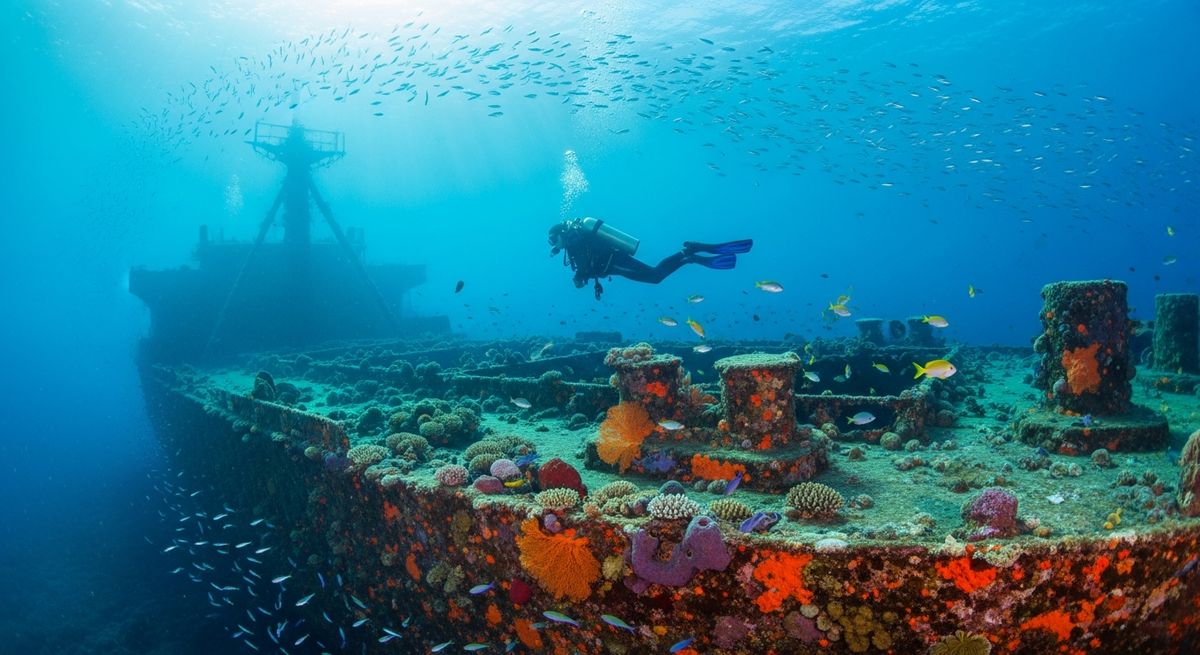
FARO - Scapa Flow, Orkney

The Faro, a steamship torpedoed in 1940, lies scattered across the seabed in Taracliffe Bay. It's not a single, intact structure, more a distributed collection of metal, but that's part of its charm. We find her boiler and triple expansion engine are the main focal points, substantial pieces that hint at the vessel's original scale. Schools of coalfish often swirl around the wreckage, and we’ve seen some decent lobsters tucked into the nooks. It's a good dive for those who appreciate exploring history that's been softened by the sea, rather than just swimming over a perfect shape.

Location
Scapa Flow, Orkney, United Kingdom, Mediterranean & Europe
Coordinates
58.912360, -2.766072
Type
wreck
Maximum Depth
0m

Marine Protected Area: Copinsay

Best Time to Dive in Scapa Flow, Orkney

The warmest water temperatures in Scapa Flow, Orkney occur in January, averaging 8.4°C. The coolest conditions are in December at 8.4°C.

Monthly Water Temperatures

  • January: 8.4°C (air: 5.5°C)
  • February: 8.4°C (air: 5.3°C)
  • March: 8.4°C (air: 5.9°C)
  • April: 8.4°C (air: 6.8°C)
  • May: 8.4°C (air: 9.7°C)
  • June: 8.4°C (air: 12.4°C)
  • July: 8.4°C (air: 13.2°C)
  • August: 8.4°C (air: 13.7°C)
  • September: 8.4°C (air: 12.7°C)
  • October: 8.4°C (air: 10.2°C)
  • November: 8.4°C (air: 8.0°C)
  • December: 8.4°C (air: 5.8°C)

Nearby Dive Sites in Scapa Flow, Orkney

Nearest Dive Centres to FARO

Marine Life in Scapa Flow, Orkney

Home to 155 recorded species including 63 reef fish, 17 whales & dolphins, 12 sharks & rays, 11 crabs & lobsters, 11 other, 10 seagrass & algae.

Notable Species

Recommended Packing List for FARO

Based on average water temperature of 8.4°C.

  • Drysuit - water at 8°C demands a drysuit with thermal undergarments
  • Hood & Gloves (7mm+) - critical to prevent heat loss
  • Mask - essential for every dive
  • Fins
  • BCD - buoyancy compensator
  • Regulator - your most safety-critical piece of gear
  • Dive Computer - tracks depth, time, and NDL
  • Surface Marker Buoy (SMB) - essential for boat pickups
  • Dive Torch - useful for crevices and colour at depth
  • Underwater Camera - capture your diving memories

Frequently Asked Questions

What is the typical maximum depth for recreational diving at the Faro dive site?
The provided data indicates a depth of 0m for the Faro dive site. This suggests that parts of this distributed wreck are extremely shallow, potentially at the surface. For precise maximum depths of accessible sections, divers should consult local dive operators.
What kind of marine life and underwater topography can divers expect to encounter at Faro?
At the Faro dive site, divers can expect to encounter the distributed remains of a steam ship vessel. The wreck, measuring 64.9m x 9.4m, features components like one boiler, a triple expansion engine, and a single shaft. This site offers an interesting underwater topography of historical artifacts.
What is the difficulty level for diving at Faro, and is it suitable for Open Water certified divers?
The Faro dive site is classified with an intermediate difficulty level. While the listed depth is 0m, this rating suggests that divers should possess skills beyond basic Open Water certification for navigating the distributed wreck. It is advisable to consult with local dive centers in Scapa Flow for specific requirements.
When is the best time of year to dive at Faro for optimal visibility and marine life sightings?
Information regarding the best time of year for optimal visibility and marine life sightings at the Faro dive site is not available in the provided data. For general guidance on seasonal diving conditions, please refer to our When to Dive section. Divers planning a trip should consult local operators for current conditions.
Are there specific scuba diving certifications required to dive at Faro, especially for deeper or more challenging areas?
The Faro dive site is rated as intermediate difficulty. While the listed depth is 0m, this classification implies that divers should have experience and potentially advanced certifications beyond Open Water for navigating the distributed wreck. Always check with local dive centers in Scapa Flow for any specific certification requirements.
What are the usual current conditions and water visibility like at the Faro dive site?
The provided data does not include specific information on the usual current conditions or water visibility at the Faro dive site. Divers planning to explore the wrecks in Scapa Flow should consult local dive operators. This will ensure they have up-to-date reports on environmental conditions before their dive.